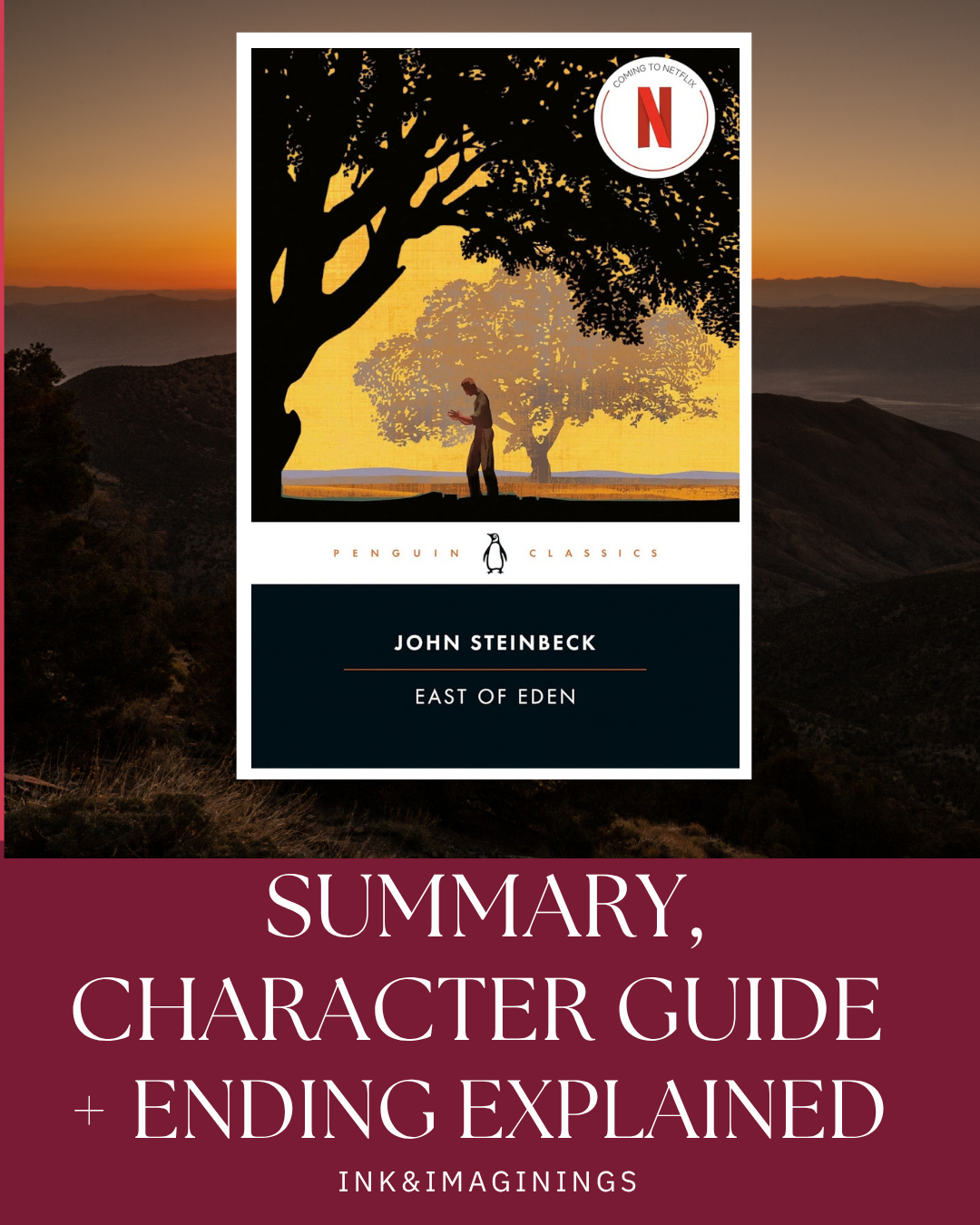
Netflix dropped the full East of Eden trailer on September 2, and all seven episodes land on October 1. Which means if you want to read the book first, it's time to start.
I started it in a car dealership waiting room, between signatures, and finished it last week then sat with it unsure how to sum it up. I get why this one has outlasted seventy years of required reading lists. Jordan's been reading it too, so it's become a whole household thing.
Zoe Kazan has turned it into a seven episode limited series with Florence Pugh as Cathy Ames. If like us you've been meaning to read this one for years, this is your excuse.
Below: the full plot, a character guide, the ending explained, everything confirmed about the Netflix series, fifteen book club questions, and what to read next.
⚠️ MAJOR SPOILER WARNING: Full spoilers for East of Eden, including the ending. It came out in 1952 and it's been adapted three times, so I'm treating it like a classic, not a new release. If you want to go in cold, skip down to the Netflix section.
East of Eden at a Glance
Author: John Steinbeck
Published: September 19, 1952
Length: About 600 pages, 55 chapters, four parts
Setting: Connecticut and California's Salinas Valley, from the Civil War through World War I
Genre: Literary fiction, family saga
Best for: Readers who love big family sagas, biblical parallels, and characters who get one real chance to choose
Book club rating: Extremely high. This book was built for arguing about.
Steinbeck won the Nobel in 1962. The Grapes of Wrath won him the Pulitzer, but East of Eden is the one he thought of as his real best work. He said everything he'd written before it was practice. Oprah picked it for her book club in 2003 and sent a fifty year old novel straight back onto the bestseller list. That tells you how well it holds up.
East of Eden Summary (Full Spoilers)
The book follows two families. The Hamiltons are real. They're Steinbeck's own grandparents, and Steinbeck shows up as a little boy at the edges of the story. The Trasks are made up, and they carry the mythology.
Underneath both of them is Genesis 4. Cain and Abel, told twice. Every major Trask has a name that starts with A or C. That's not an accident. Steinbeck wanted to make sure you to notice the parallels.
Part One: Cyrus, Adam and Charles
Cyrus Trask comes home from the Civil War missing a leg and carrying an infection he passes to his wife. When she finds out what he gave her, she drowns herself in a pond. He remarries a seventeen year old named Alice and has a second son. Then he builds a whole career on a war record he made up. He becomes a big voice in veterans' politics in Washington and dies with more than a hundred thousand dollars nobody can explain.
His two boys are the first Cain and Abel. Adam is gentle, passive, and his father's favorite. Charles is dark, strong, and desperate for the same love. For Cyrus's birthday, Adam gives him a free puppy and Charles gives him an expensive knife he had to work to earn the money for. Cyrus loves the puppy. The knife gets set aside. Charles later beats Adam nearly to death for it, then goes back with a hatchet to finish the job. Adam survives by hiding.
Later, Charles takes an iron bar to the forehead while prying a rock out of a field. It leaves a long dark scar that gets darker whenever he's angry or ashamed. It's the mark of Cain.
Cyrus sends Adam into the cavalry, where he spends years in the Indian wars hating everything he has to do. He reenlists rather than go home, drifts, lands on a chain gang, escapes, and finally ends up back on the farm living uneasily next to his brother.
Part One, Continued: Cathy Ames
Steinbeck introduces Cathy Ames with one of the most argued about passages in American fiction. He says some people are born without a conscience the way others are born without an arm.
At ten, Cathy is found in a barn with two older boys and her own wrists tied. The boys are punished. Her Latin teacher falls in love with her and ends up dead. At sixteen she robs her father's safe, sets the house on fire with her parents inside, and leaves enough evidence behind that the whole town mourns her as a victim.
She reinvents herself as Catherine Amesbury and attaches herself to Mr. Edwards, who runs a circuit of brothels. He breaks his own rules and falls in love with her. When he finds out what she really is, he leaves her for dead in the Connecticut countryside, her nose and jaw broken.
She crawls to the nearest porch. It belongs to the Trask brothers.
Adam falls in love on sight. Charles takes one look and knows exactly what just showed up. Adam marries her anyway. On their wedding night she drugs Adam and slips into Charles's room. She gets pregnant, and Steinbeck never makes it clear whose children they really are.
Part Two: The Salinas Valley
Adam takes her west and buys a beautiful ranch in the Salinas Valley. He wants to build a garden. Cathy tries to end the pregnancy herself and fails.
This is where the Hamiltons come in. Samuel Hamilton is an Irish immigrant who drills wells, invents things constantly, and never makes a dollar off any of it. He becomes Adam's friend and the moral center of the book. He delivers Cathy's twins, and she bites his hand hard enough to scar it. She won't look at the babies.
A week later she shoots Adam in the shoulder and walks out. She goes to Salinas and takes a job at Faye's brothel. She is now Kate.
Adam falls apart. For more than a year he doesn't even name his sons. It takes Samuel hitting him to snap him out of it. That night Samuel, Adam and Lee open Genesis together, and the boys finally get named Caleb and Aron.
Meanwhile Kate slowly poisons Faye while playing the devoted caretaker, and inherits the house. She turns it into something much colder. She keeps photographs of important men in compromising positions and runs a quiet blackmail business on the side.
Part Three: Timshel
This is the conversation the whole novel is built around. Reading the Cain and Abel story, Lee, Samuel and Adam get stuck on Genesis 4:7, where God talks to Cain about sin.
The King James Version says thou shalt rule over him. That reads like a promise. The American Standard Version says do thou rule over him. That reads like an order. Lee isn't satisfied with either one, so he takes the question to a group of Chinese elders in San Francisco, and they spend two years learning Hebrew to settle it.
The word is timshel. It means thou mayest.
Neither a promise, or an order, but a choice. Lee's speech about it is the heart of the book. A person can choose to rule over sin, or choose not to, and that choice is the thing that makes a life worth anything.
Before he leaves the ranch for good, Samuel tells Adam where Cathy is. Not long after, Samuel dies. His family comes apart. His daughter Dessie moves back to the ranch to be with her brother Tom, gets sick, and dies after Tom gives her the wrong medicine. Tom can't live with it and shoots himself.
Adam finally goes to see Kate. He looks at her and feels nothing, and he tells her so. It's the only time anyone ever gets the better of her, and she never forgets it.
Part Four: Cal and Aron
The second Cain and Abel. Aron is beautiful, devout and idealistic. He's planning to become an Episcopal priest, and he treats his girlfriend Abra like a stained glass window instead of a person. Cal is dark, clever and watchful, and convinced he inherited something rotten from a mother he can't remember.
Cal finds out the truth about Kate and goes to see her. She tries to convince him he's just like her. He walks out, and somewhere on the way home in the dark, he realizes he doesn't have to be. That's the first time timshel does real work in the book.
Adam, meanwhile, sinks a fortune into shipping lettuce packed in ice to New York by train. The train gets held up. The ice melts. He loses almost everything.
So Cal goes into business with Will Hamilton, buying up beans from Salinas Valley farmers and selling them to the British during the war. He clears fifteen thousand dollars. He wraps it in tissue paper and gives it to his father at Thanksgiving.
Adam won't take it. He tells Cal to give it back to the farmers. Then he holds up Aron, doing so well at college, as the kind of gift he actually wanted. That's the moment that breaks Cal.
Cal burns the money, one bill at a time.
Then he takes Aron to the brothel and shows him their mother.
Aron doesn't survive it. Not really. He enlists and ships out. Kate, after watching her golden son look at her in horror, writes a will leaving everything to Aron and swallows the morphine capsule she's been wearing around her neck.
Then the telegram comes. Aron has been killed in France. Adam has a stroke that leaves him paralyzed.
The Ending Explained: What Timshel Actually Means
Cal stands at his father's bed and confesses. He says he killed his brother. He says he did it because his father didn't want his gift.
Adam can't speak. He's paralyzed and dying. Lee, who has spent the whole novel explaining people to themselves, begs him. Don't leave this boy carrying this. Give him your blessing.
Adam raises his hand. The last word of the book is "Timshel."
Thou mayest.
This is why it wrecks people. Adam doesn't say Cal is innocent. He doesn't say it wasn't his fault, because partly it was. He doesn't forgive him in a tidy way. He gives him something harder. You may. You may rule over it. The door isn't locked. Your mother isn't your verdict. Your father's rejection isn't your verdict. The worst night of your life isn't your verdict.
Every character in this book gets some version of that door. Charles never opens it. Cathy never opens it. Cyrus builds a whole life on refusing to. Adam uses his last breath to open it for his son.
Cal is the first one who gets to walk through it with time left on the clock.
East of Eden Character Guide
There are a lot of people in this book. Here's who to keep straight.
Adam Trask
The passive center of the book. Kind, dreamy, and catastrophically bad at seeing what's right in front of him. Adam's flaw isn't cruelty. It's absence. He loves an idea of Cathy instead of Cathy, checks out on his sons, and turns down Cal's gift without ever understanding what he's refusing. He also gets the last word of the book. He earns it.
Charles Trask
Adam's half brother and the first Cain. Violent, jealous, and a lot more self aware than anyone gives him credit for. He clocks exactly what Cathy is within an hour of meeting her, which makes him the only person in Part One who sees clearly. He dies alone on the farm and splits his money between Adam and Cathy. Mike Faist plays him on Netflix.
Cyrus Trask
The father who poisons two generations. He built a career on a lie, gave one son too much and the other nothing, and left behind money nobody could account for. Tracy Letts plays him, which is inspired casting.
Cathy Ames, later Kate
The reason people are still arguing about this book. Steinbeck calls her a monster up front, then spends four hundred pages giving her fear, pain and a very specific kind of intelligence. She sees the worst thing about every person she meets and nothing else. She can't imagine goodness, so she reads Adam's love as stupidity and Aron's purity as a trick.
By the end she's crippled by arthritis, paranoid, and fantasizing about shrinking small enough to disappear, like Alice in Wonderland. She's far more human than her introduction promised. Florence Pugh plays her, and I cant wait!
Caleb "Cal" Trask
The real main character, though the book takes its time admitting it. Jealous, manipulative, generous and desperate to be loved, sometimes all in the same paragraph. He's also the only one who genuinely tries to be better.
Aron Trask
The golden one. Aron isn't stupid, but he's brittle, because his goodness depends on everything being beautiful. He idealizes his dead mother, idealizes Abra, idealizes God. When one of those cracks, they all do. Joe Anders plays him.
Lee
The best character in the book, and the one most likely to make you cry. Lee is Chinese American, born in a railroad work camp under horrific circumstances, and educated at Berkeley. He speaks pidgin English for years because white Californians can't handle him any other way, and drops it the second someone actually listens. He raises both boys, drives the timshel investigation, and quietly carries the moral weight of the whole novel. His dream is a bookstore in San Francisco he never quite opens. Hoon Lee plays him.
Samuel Hamilton
Steinbeck's real grandfather. An Irish immigrant inventor who was too generous and too impractical to get rich off a single patent. He's the book's conscience for three hundred pages and the one who drags Adam back into his own life. Ciarán Hinds plays him, and that's about as perfect as casting gets.
Liza Hamilton
Samuel's wife. Tiny, iron willed and deeply religious. She's the one actually holding nine kids and a dry farm together while her husband invents things.
Abra Bacon
Aron's girlfriend, and eventually Cal's. One of the most grounded people in the book. Practical, warm, and more and more tired of being worshipped instead of known. Her turn toward Cal isn't a love triangle. It's a woman choosing the person who can actually see her.
Tom Hamilton
Samuel's most gifted and most tormented son. After Dessie dies, he can't live with his part in it. His last chapter is one of the quietest and hardest in the book.
Will Hamilton
The one Hamilton who's good with money. He's Cal's partner in the bean deal, and a reminder that Steinbeck didn't think being practical was a sin.
Dessie Hamilton
Samuel's warmest daughter. A dressmaker in Salinas whose shop was the happiest room in town, until grief closed it.
Olive Hamilton
Steinbeck's mom, appearing as herself. The chapter where she wins a ride in a military plane during a war bond drive is one of the funniest things he ever wrote.
Faye
The madam who runs a genuinely kind house, treats Kate like a daughter, leaves her everything, and gets slowly poisoned for it. Martha Plimpton plays her.
Joe Valery
Kate's enforcer. A small time crook who thinks he's playing her. He's being played from minute one.
Mr. Edwards
The brothel operator who falls for Cathy and nearly kills her. He's there to show you what happens to anyone who thinks they can hold on to her.
Alice Trask
Charles's mother. Married to Cyrus at seventeen, dies of consumption, and is remembered by Adam mostly for a private smile she never showed anyone else.
Themes to Bring to Book Club
Free will versus inheritance
The whole novel is one long argument about whether you are your parents. Cal's terrified he's Cathy. Adam's terrified he's Cyrus. Charles proves the bleak version. Cal disproves it, barely, and only after doing something unforgivable.
Rejection drives everything
Put the two gift scenes side by side. Charles offers a knife. Cal offers fifteen thousand dollars. Both get turned down by fathers who have no idea what they just did. Almost every act of violence in this book traces back to a boy who wasn't chosen.
The good son isn't actually good
Aron isn't virtuous. Aron is protected. Steinbeck makes sure you see that the "good" brother's goodness has never been tested by one hard fact. Which is exactly why one hard fact destroys him.
The Salinas Valley as a second Eden
Adam wants to build a garden. The land is gorgeous and the water is unreliable. Steinbeck opens with the Gabilan mountains on one side, full of light, and the Santa Lucias on the other, dark and closed off. The valley tells you the terms before a single character shows up.
Who gets to speak
A whole theology turns on one Hebrew verb, and the people who crack it are a Chinese American servant and a group of elders nobody else in the book would think to ask. Steinbeck put the moral key to his big American novel in the hands of the people America wasn't listening to. That's a whole book club night by itself.
My Honest Take
I've been struggling to articulate how I feel about this one, which is probably the most honest thing I can tell you about it.
The writing is the Steinbeck I love. That part was never going to be the problem.
The problem is that there's really nobody worth cheering for. Six hundred pages and no one to root for. That's a struggle.
But that's also the point. Nobody in this book is perfectly good or perfectly bad.
Even Samuel Hamilton who is the most lovable person on the page and he's the hardest one to watch, because he never turns any of that genius into anything. It's painful.
So yes, it's a hard book to read. Not because of the writing. It's hard because having no clear hero makes you uncomfortable, and Steinbeck will make you sit in that discomfort for six hundred pages.
Jordan who is a huge Steinbeck fan hit the same wall. He read it alongside me and landed on exactly the same sticking point, that it's hard to get through a book with no character to root for.
His actual verdict is "I enjoyed the interspersed ramblings and observations of the human condition more than any of the narrative."
Which is its own kind of recommendation. The digressions are generally the reason to read Steinbeck.
But in this case what makes it hard is also what makes it good for you.
The Netflix Series: Everything We Know
Netflix released the full trailer on September 2, 2026, and all seven episodes drop at once on Thursday, October 1, 2026. No weekly rollout, which for a book this dense is the right call.
Who made it
Zoe Kazan wrote all seven episodes and is co showrunner with Jeb Stuart. And yes, the last name matters. Her grandfather Elia Kazan directed the 1955 film. She's basically gone back to finish what her family started, with the three quarters of the book he left out.
Garth Davis directs episodes one through four, and Laure de Clermont-Tonnerre directs five through seven. Fifth Season and Anonymous Content produce.
The cast
- Florence Pugh as Cathy Ames, also an executive producer
- Christopher Abbott as Adam Trask
- Mike Faist as Charles Trask
- Joseph Zada as Caleb "Cal" Trask
- Joe Anders as Aron Trask
- Hoon Lee as Lee
- Ciarán Hinds as Samuel Hamilton
- Tracy Letts as Cyrus Trask
- Martha Plimpton as Faye
The seven episodes
- Genesis
- Cathy
- In the Valley
- Kate
- Departure
- The Great Try
- East of Eden
Where it was filmed
New Zealand, mostly around Dunedin and Oamaru, with more work in Auckland, from October 2024 through March 2025. So the Salinas Valley you're about to see is the Otago region in a very convincing costume.
What the trailer shows
Cathy meeting Adam, the marriage, a smile that curdles, and one image anyone who's read the book will recognize instantly. The voiceover is doing the heavy lifting: evil isn't always obvious at first glance, and it can show up dressed as goodness, or beauty, or love.
How it compares to the 1955 film
Elia Kazan's 1955 film with James Dean is a great movie and a very partial adaptation. It only covers Part Four. No Cyrus, no Charles, no Samuel Hamilton, no Cathy backstory, no timshel investigation. Just Cal, Aron, Adam, Abra, and a Kate who shows up fully formed. Jo Van Fleet won the Oscar for Best Supporting Actress as Kate, and Dean was nominated after his death. It was the only leading role he lived to see released.
Seven episodes is the first version with room for the whole thing. Which is why the Hamiltons finally have a cast list.
How it compares to the 1981 miniseries
ABC aired an eight hour version over three nights in February 1981, with Jane Seymour as Cathy, Timothy Bottoms as Adam, Bruce Boxleitner as Charles and Karen Allen as Abra. It was a real ratings event, and Seymour's Cathy is still the one a lot of readers picture. It's also very much a 1981 network production, which means the sharpest edges got sanded off.
What I'll be watching for
Three things. Whether Lee gets his full inner life or gets flattened into a wise servant. I feel like that's the single biggest risk in adapting this book. Whether the show can make Cal's bean money land on screen, since it's mostly interior on the page. And whether they keep the last word.
If you like tracking exactly what an adaptation changed, I did that for Every Summer After and I'll be doing it again here after October 1.
East of Eden Book Club Discussion Questions
Fifteen questions, from easy openers to the ones that'll keep everyone at the table an extra hour.
- Steinbeck tells us exactly what Cathy is before we see her do anything. Did that hold up for you, or did the book undercut its own narrator?
- Cyrus rejects Charles's gift and Adam rejects Cal's. What is each father actually turning down, and does either of them know?
- Is Cal responsible for Aron's death? Where does his responsibility start and stop?
- Lee is the only person in the book who keeps choosing well. Why give that role to the character with the least power in the room?
- Timshel means "thou mayest." How is that different from forgiveness, and which one does Cal actually need?
- Abra chooses Cal over Aron. Is that a judgment about the brothers, or about how each of them sees her?
- The Hamiltons are real and the Trasks are invented. What does Steinbeck get from putting his own family in the same book as his mythology?
- Charles never gets a redemption arc and Cal does. What really separates them?
- Cathy is dying, in pain and terrified at the end. Did that change how you felt about her? Should it?
- Adam can't bring himself to raise his sons after Cathy leaves. Is that grief, or a failure of character?
- Steinbeck wrote this book for his two young sons. What did he want them to take from it, and would you hand it to a teenager today?
- Samuel dies right in the middle of the book. What does the novel lose when he goes, and does anyone replace him?
- Faye's house is warm and Kate's is cold and transactional. What's Steinbeck saying with those two versions of the same business?
- If timshel is real, every character had a door. Pick one and name the moment their door was open.
- The book ends on one word from a dying man. Is that an ending or a beginning, and did it work for you?
If your group wants more guided discussions like this, my running list of every Reese, Oprah and Read with Jenna pick of 2026 gets updated every month.
What to Read If You Loved East of Eden
If you came for the family saga
Homegoing by Yaa Gyasi follows two half sisters and their descendants across three hundred years. Pachinko by Min Jin Lee is the closest modern match in feeling: four generations, an unforgiving country, and so much tenderness. The Covenant of Water by Abraham Verghese is the big warm doorstopper of the group. North Woods by Daniel Mason follows one piece of land across centuries of owners, which is the Salinas Valley idea taken all the way.
If you came for the biblical parallels
Gilead by Marilynne Robinson is a dying father writing to his son about blessing and prodigals, and it's the closest spiritual cousin to Adam's last word. The Brothers Karamazov is the other great novel about brothers, a terrible father, and whether a soul is fixed at birth. Demon Copperhead by Barbara Kingsolver asks Cal's exact question: am I just what I came from?
If you came for Cathy
Gone Girl by Gillian Flynn gave us Amy Dunne, who is basically Cathy's literary granddaughter. We Need to Talk About Kevin by Lionel Shriver takes on the born wrong question and is a lot less sure of the answer. My Sister, the Serial Killer by Oyinkan Braithwaite does beautiful, remorseless and beloved with way more comedy. And if you want a modern take on calculated cruelty in a nice suburb, my Big Little Lies recap is a good place to start.
If you came for the American West
Angle of Repose by Wallace Stegner is the other great California family novel, and it's in direct conversation with this one. Lonesome Dove by Larry McMurtry, for the friendship and the scale. The Son by Philipp Meyer, for a family fortune built on things nobody wants to say out loud.
If you want more Steinbeck
The Grapes of Wrath is the angrier, more political book, and the one that won him the Pulitzer. Of Mice and Men takes an afternoon and hits like a truck. Travels with Charley is Steinbeck driving around America with his poodle, and it's the warmest thing he ever wrote. And Journal of a Novel collects the letters he wrote to his editor every morning before starting that day's pages of East of Eden. It's the best companion read there is.
If you want something from my shelf with the same feeling
The Burning Side by Sarah Damoff and Kin by Tayari Jones are both about families deciding what to do with what they were handed. Whistler by Ann Patchett does quiet family devastation beautifully. Theo of Golden is the gentle one, for after. And if you want more classics, here are the 20 classics I want my kids to read and my breakdown of The Odyssey before the 2026 movie.
Content Notes
This is a hard book in places. There are several deaths by the characters' own hand, one of them on the page. Lee faces period accurate racism for most of the book. Steinbeck isn't gratuitous about any of it. He just doesn't let us look away.
The Audiobook
If you'd rather listen, the audiobook narrated by Richard Poe runs about 25 hours. I read this one in print, so I can't vouch for it myself. If audio is your format, I keep a running list of books that are better on audio.
East of Eden FAQ
Is East of Eden hard to read?
Not at the sentence level. The prose is plain and the chapters are short. It's hard in a different way. There's nobody in it to root for, and sitting with that for six hundred pages takes something out of you. The middle also slows down to spend time with the Hamiltons, which is where most people bounce.
Do I need to read the book before the Netflix series?
No, but you'll get more out of both if you do. The book gives you an inner life no adaptation can fully carry, especially for Cal and Lee.
What does timshel mean?
It's the Hebrew word in Genesis 4:7 that Lee and a group of elders spend two years translating. It means "thou mayest," which makes overcoming sin a choice rather than a promise or an order. It's the last word of the novel.
Are the twins Adam's or Charles's?
Steinbeck never says. Cathy sleeps with Charles on her wedding night, and Cal's darkness echoes his uncle's. The ambiguity is the point. The whole book argues that what you inherit doesn't decide who you are.
Is East of Eden based on a true story?
Partly. The Hamiltons are Steinbeck's real family, including his grandparents Samuel and Liza and his mom Olive, and Steinbeck shows up as a kid. The Trasks are made up.
When does East of Eden come out on Netflix?
All seven episodes premiere Thursday, October 1, 2026.
Who plays Cathy Ames in the Netflix series?
Florence Pugh, who's also an executive producer on the series.
Is the Netflix series the same story as the James Dean movie?
No. The 1955 film only adapts Part Four. The Netflix series covers the whole book, including Cyrus, Charles, Cathy's backstory and the Hamiltons.
One Last Thing
This book hasn't survived seventy years of reading lists because of the plot. It's survived because Steinbeck refused to let anyone off the hook, and refused to write anyone off either. He spent six hundred pages arguing that even the worst person in the room still has a door. Then he walked his hero through it about ninety seconds before the lights went out.
So tell me before October 1. Team Cal or Team Aron? And be honest about why. Also what do you think of the casting?