Netflix's East of Eden is finally here; Florence Pugh as Cathy, and Zoe Kazan writing every episode. If you have read Steinbeck's novel, you are probably wondering how much of it made it to the screen.
The short answer is the bones are all there, but the show is a very different but some of the meat is missing.
Jordan and I both read the book before the show came out, and I have mixed feelings. Florence Pugh is phenomenal as Cathy, exactly as I hoped she would be. But the show's biggest swing, making Cathy sympathetic, changes the point Steinbeck was making. More on that below.
Below is every big change, what stayed the same, and whether you should read the book first.
Full spoilers for both the book and the series ahead.
This post contains affiliate links. If you buy through them, I may earn a small commission at no extra cost to you. Thanks for supporting Ink & Imaginings.
The Quick Answer: How Different Is the Show?
- Biggest change: the show is built around Cathy. The book is a sprawling family saga with Cathy as its darkest thread.
- Biggest cut: most of the Hamilton family, Steinbeck's own relatives, along with the narrator who is a version of Steinbeck himself, and kind of the nicest part of the book.
- Biggest shift in tone: Cathy is far more sympathetic. The show makes her childhood abuse explicit, where the book only hints at it.
- Biggest additions: Cathy's backstory on screen, Charles appearing to Cathy after his death, and a much bigger San Francisco storyline for Lee.
- What stayed: the ending. Aron's fate, Cathy's end, and Adam's final word, timshel, all land the way they do in the book.
Need a refresher on the book first? My East of Eden summary, characters, and ending explained has the full story.
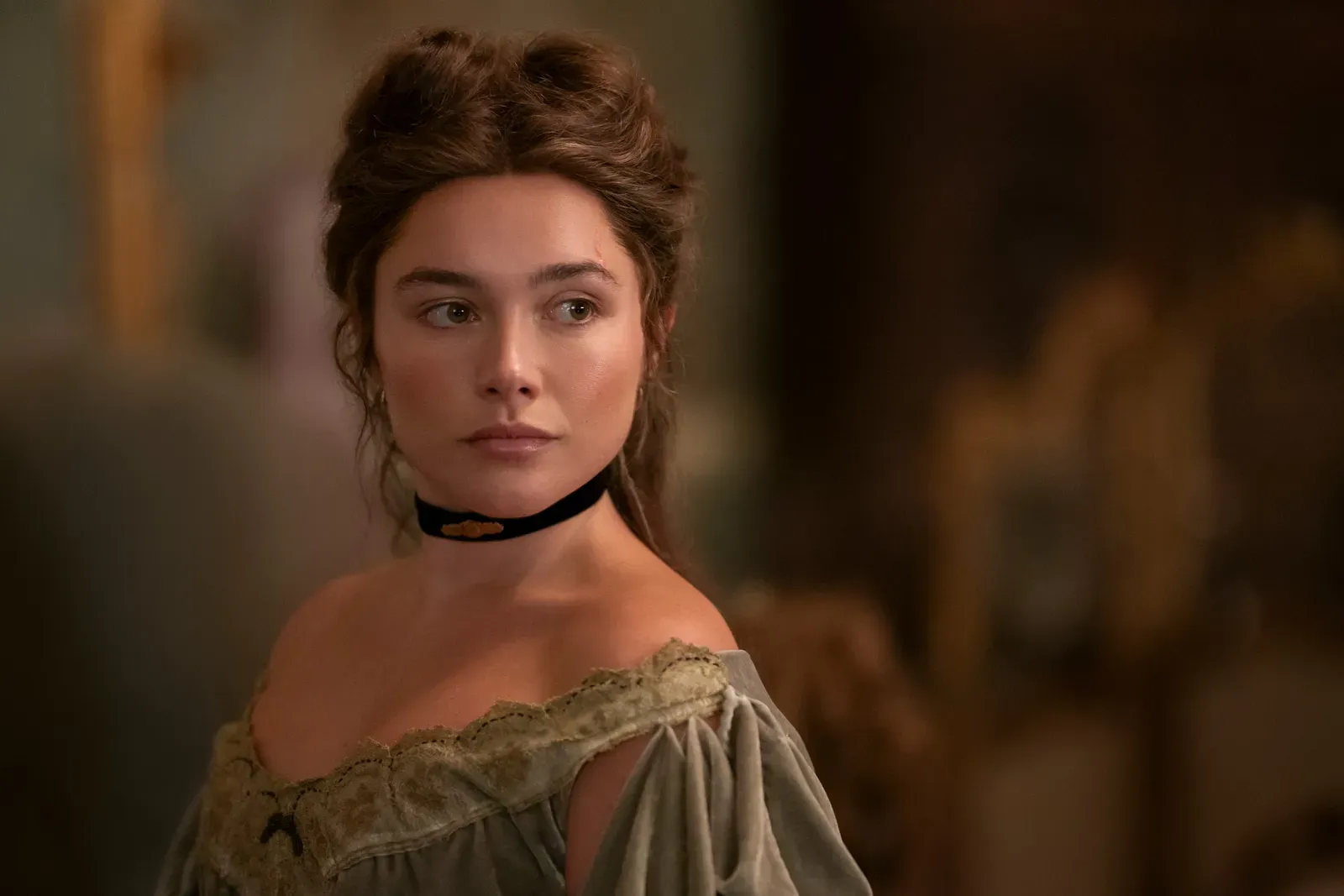
Florece Pugh as Cathy in East of Eden
Every Big Change the Show Made
1. The story is told around Cathy
In the book, Cathy does not even appear until chapter eight. The novel opens on the Salinas Valley itself, then follows Cyrus Trask and his sons in order, and runs the Trask and Hamilton families side by side across decades.
The show flips that. Cathy is the center, and everyone else is arranged around her. It opens on a flash-forward: Cathy, beaten and barely conscious, crawling toward the Trask farmhouse in the dark. Over that image, she delivers Steinbeck's famous lines about monsters in her own voice, words the book gives to its narrator. Two episodes are named for her. If the book is about two families and the pattern of Cain and Abel repeating, the show is about one woman and the damage she does and the damage done to her.
2. Less time with Adam and Charles
In the book, Adam and Charles spend a long stretch rebuilding their relationship after thirteen years apart, including Adam's story about his time on a chain gang. It all feeds the question of which brother is the good one.
Because Cathy arrives so early in the show, most of that is gone. The brothers barely have time to settle in together before she upends their lives.
3. Cathy gets a new backstory, and a lot more sympathy
Steinbeck is blunt about Cathy. The narrator tells you outright that some people are born without a conscience and that she is one of them. You watch what she does, and the book tells you what to think about it.
Steinbeck introduces her with one of the most famous lines in the book, the narrator's belief that some monsters are born to human parents. In the novel, Cathy uses her sexuality to manipulate people, and the abuse in her childhood is only hinted at.
The show does not hand you such a clear condemnation of Cathy. Our first look at young Cathy is a five-year-old paging through Alice in Wonderland when an older boy lures her into the woods with candy, and the show eventually confirms the assault the book only hints at, Florence Pugh has said the team felt it was important to show what the book only alludes to.
Cathy still does the terrible things she does in the book, but the show frames much of her cruelty as a response to what was done to her, and to how few options a woman had at the time. As she puts it in the show, the only freedom in this world is economic freedom.
Kazan has said that everything in the series has at least a root in the book, and that she read some of Cathy's experiences differently than Steinbeck did. Whether it works for you probably depends on how you felt about Steinbeck's monster in the first place.
4. Charles never really leaves
In the book, Charles dies off page back on the family farm and mostly drops out of the story once it moves west. Steinbeck gives only a passing sense of his presence when Cathy grows paranoid late in the book.
In the show, Mike Faist's Charles keeps coming back. As Cathy's life closes in on her, she has full, drug-hazed conversations with him. It is one of the series' biggest inventions, and it gives Faist far more to do than the book gives Charles.
The show also gives Cathy one last vision the book does not have. Just before her death, she imagines embracing the five-year-old girl in the Alice in Wonderland dress from the first episode. It is the emotional peak of Florence Pugh's performance, and the clearest sign of how differently the show sees her.
5. The Hamiltons are mostly gone
This is the one that stings. The Hamiltons fill roughly a third of the novel. Samuel, Liza, and their nine children are based on Steinbeck's own mother's family, and they are the warm, poor, joyful counterweight to the Trasks.
The show keeps Samuel (Ciarán Hinds) as the one man who tells Adam the truth, and Will Hamilton turns up later, when Cal takes him under his wing. Beyond that, the family is mostly gone. Kazan has said the Hamiltons were among her favorite characters and that leaving so much of their story behind hurt her heart, and co-showrunner Jeb Stuart called the choice risky. With them goes the little version of Steinbeck who wanders through the novel, so there is no narrator voice at all.
6. Lee goes to San Francisco, and we go with him
In the book, Lee leaves the Trasks to open a bookstore in San Francisco, realizes almost immediately that it is not what he wants, and comes home. It takes a few pages.
The show turns it into a full storyline. We follow Lee to San Francisco, see him reconnect with family and try to open his shop, and it is racist exclusion, not loneliness, that ends the dream. His return to the Trask house becomes a deliberate choice, and when he comes back, Adam finally listens to him as family. Kazan has said she pictured that episode like a Wong Kar-wai movie and simply wanted to know Lee better. One thing that feels modern but is straight from the book is Lee switching between broken English and perfect English depending on who is in the room.
7. Aron's breakdown moves faster
In the book, Aron's unraveling is slow. He becomes more and more rigidly religious, which starts to push Abra away long before the night Cal takes him to meet their mother.
The show plays down that religious arc and moves straight from the shock of seeing Cathy to the war. With seven episodes to cover sixty years, the second generation arrives late, and Cal and Aron's story has much less room than the book gives it.
What the Show Kept from the Book
For all the changes, the ending is Steinbeck's. Cal takes Aron to meet their mother. Aron enlists and is killed in the war. Cathy dies by her own hand. Adam has a stroke, and on his deathbed, at Lee's urging, he gives Cal the word that the whole book has been building to: timshel, "thou mayest." The idea that we are not doomed to repeat our parents, that we get to choose, is still the heart of it.
The show also keeps the small moments readers love, like Samuel forcing Adam to finally name the twins more than a year after they were born.
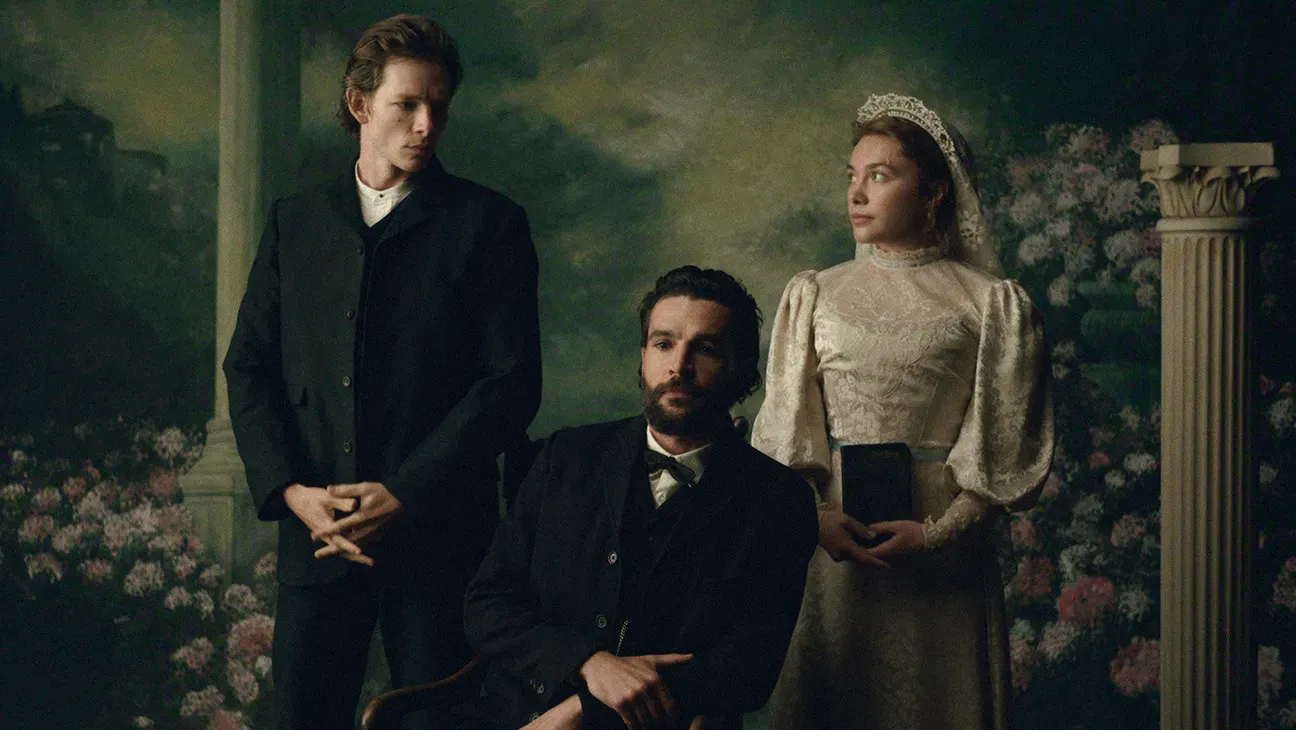
Left to right: Mike Faist, Christopher Abbott and Florence Pugh. COURTESY OF NETFLIX
How It Compares to the 1955 James Dean Movie
If you only know East of Eden from the James Dean film, the series will feel like a whole new story. Elia Kazan's 1955 movie (directed by Zoe Kazan's grandfather) covers only the last part of the book, starting with Cal and Aron as young men. It skips Adam and Charles's history, Cathy's origins, and even Lee, who is left out completely. The series covers the whole book, brings Lee back, and gives Cathy far more time than any adaptation before it.
My Take: Does the New Cathy Work?
I understand why a modern adaptation would want to give Cathy more sides, and a reason for the evil. But I think it weakens what Steinbeck was trying to say with her. If timshel means you have a choice, then the story needs someone who always chooses evil, and Cal needs to know that person is his mother. That is the whole argument. Cal is not doomed to be Cathy, but Cathy has to be someone worth being afraid of becoming.
The change to her childhood shows the difference. In the book, when Cathy is caught with two older boys as a young girl, the boys insist she planned the whole thing and even charged them. The adults do not believe them, but the narrator frames the moment as early proof of how calculating and manipulative she is. Going from that to a little girl lured into the woods with candy is a very different take.
That said, something bothered me in the original, too. For a child that young to understand her own power over people to that degree, something had to have happened to teach her that lesson. There is a limit to what a child would instinctively understand, and this adaptation tells me I was not alone in that feeling.
As for the rest, I loved the Hamiltons, so while I understand cutting them for time, I missed them. And I really enjoyed getting more of Lee. It may not be accurate to the book, but it is absolutely accurate to the time period, and Hoon Lee is wonderful in the role. He brings so much quiet warmth and intelligence to a character who spends most of the story being underestimated.
Should You Read the Book First?
If you have the time, yes. The show is good, but the book is where the Hamiltons live, where the Cain and Abel pattern has room to repeat across two generations, and where timshel gets the slow build that makes it land. The show is the Cathy story. The book gives you the whole valley.
And if the show made you see Cathy differently, the book may surprise you. Late in the novel, the narrator who called her a monster stops and admits he is no longer sure that was true, and that it is easy to call her bad without knowing why. The show did not invent its sympathy for Cathy. Steinbeck left the door open.
If you already watched it, the book is still worth it. You will meet an entire family the show barely shows you, and Cal and Aron get the space they deserve.
East of Eden by John Steinbeck Book Cover
📖 Amazon | Bookshop | 🎧 Audible
Reading it for book club? My East of Eden guide has fifteen discussion questions, a character guide, and the ending explained. And if you love comparing books to their adaptations, here is every change Every Year After made to Every Summer After.
Frequently Asked Questions
Is Netflix's East of Eden faithful to the book?
Mostly in its plot and ending, less in its structure. The series centers Cathy, cuts most of the Hamilton family and the Steinbeck narrator, and adds scenes like Cathy's childhood, her visions of Charles after his death, and Lee's longer trip to San Francisco. The ending, including Adam's final word, timshel, follows the book.
How many episodes is the East of Eden series?
Seven. All seven episodes premiered on Netflix on October 1, 2026, written by Zoe Kazan.
Does the East of Eden show cover the whole book?
Yes. It moves through the whole story, from the Trask brothers' youth to Cal, Aron, and the ending, though the second generation gets much less time than in the novel.
Are the Hamiltons in the East of Eden show?
Only partly. Samuel Hamilton, played by Ciarán Hinds, is still a key character, and his son Will appears later in the story, but most of the Hamilton family and their storylines from the book are cut.
How does the East of Eden show end?
Like the book. Aron dies in World War I, Cathy dies by her own hand, and Adam, after a stroke, speaks the word timshel to Cal on his deathbed, telling him that he is free to choose who he becomes.
Should I read East of Eden before watching the show?
If you can. The show captures Cathy's story, but the book gives the Hamilton family, the two-generation Cain and Abel pattern, and the meaning of timshel far more room.
Did you read it first or watch first? And are you Team Steinbeck Cathy or Team Kazan Cathy? Tell me in the comments.