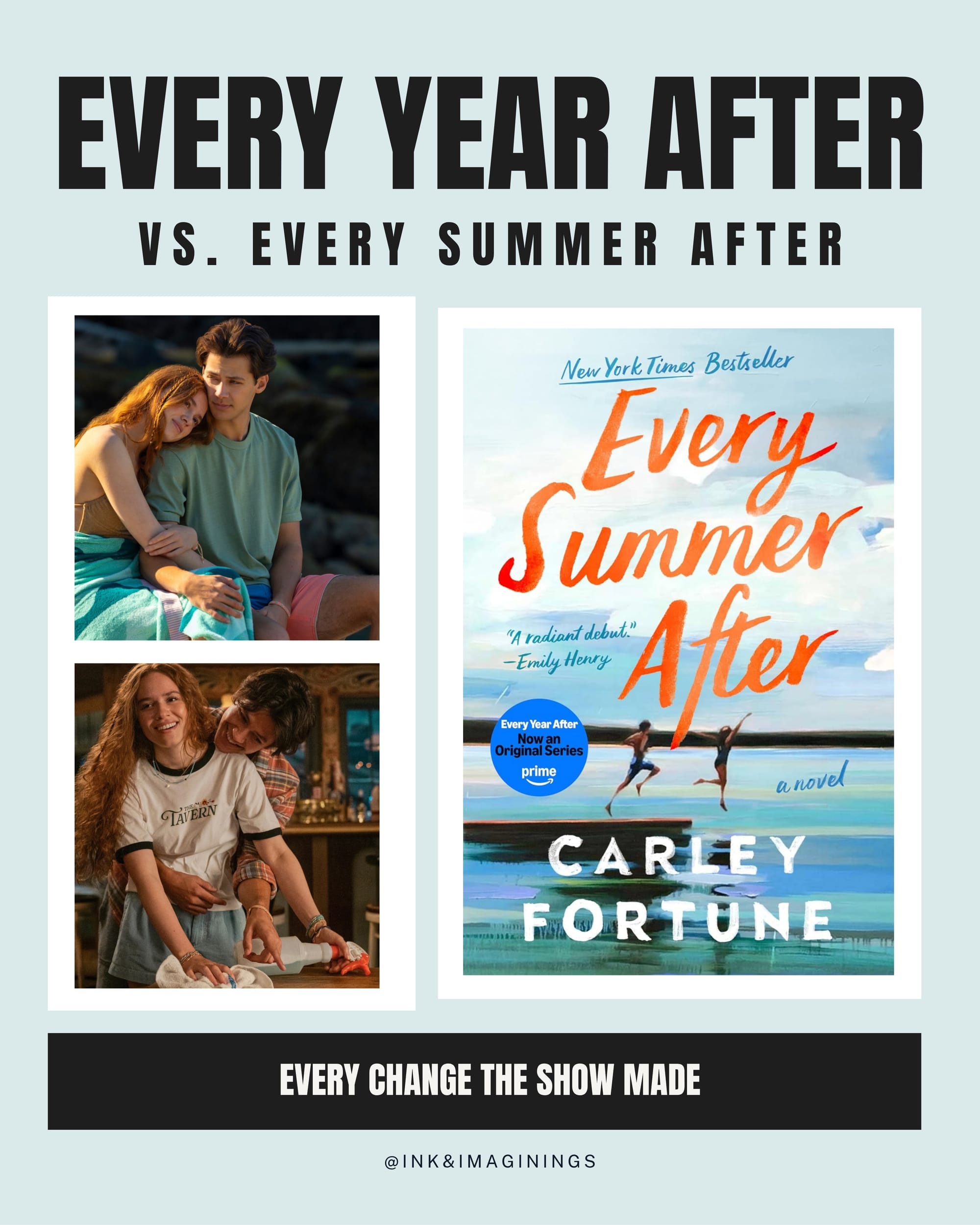
🚨 Spoiler warning. This post contains complete plot details for Every Summer After by Carley Fortune and Every Year After (the Prime Video series, all eight episodes including the season one finale cliffhanger). If you have not finished the season, bookmark this and come back. It will still be here.
Prime Video adapted Carley Fortune's debut novel into an eight-episode series, and pulled material from her sequel, too. Here is every change, every expansion, and every clue about what is coming in season two.
The headline most reviews are missing
The Prime Video show is not based on one Carley Fortune novel. It is based on two.
Every Summer After (2022) is the source. That much is in the credits, that much is in the marketing, that much is in Carley Fortune's executive producer billing. But the season one finale (the Tavern inheritance, Sam working as a cardiologist, the yellow-speedboat photograph that triggers Charlie's heart attack) pulls directly from One Golden Summer, Fortune's 2025 companion novel that returns to Barry's Bay and follows Charlie Florek's love story.
Showrunner Amy B. Harris confirmed it directly: she "honored details of One Golden Summer" in the finale. Carley Fortune called the finale "brilliant, emotional." If you are watching Every Year After and want to know what season two is going to pull from, One Golden Summer is the book you need.
That dual-source DNA is why so much of the season one finale lands differently than the book's ending, and why every other "what changed" post that names Every Summer After and stops there is leaving viewers half-prepared.
This post is the full inventory: every character change, every expanded storyline, every preserved line of dialogue, every plot beat that didn't survive the adaptation, and every clue about where season two is going. Sourced from interviews with the showrunner, Carley Fortune, and actor Michael Bradway (Charlie), and a careful read of all eight episodes against both novels.
Let's go.
The big picture: who made this, why every change is intentional
Showrunner: Amy B. Harris. Harris adapted the series and serves as an executive producer.
Author: Carley Fortune. Fortune is also an executive producer. She signed off on every change. When she gives an interview saying she trusts the showrunner, she means it, but it also means every difference between the book and the show has her blessing.
The other executive producers are Lindsey Liberatore, Amy Rardin, John Stephens, and Grace Gilroy.
The show premiered at the Tribeca Festival on June 8, 2026. All eight episodes dropped on Prime Video on June 10. It was filmed in British Columbia, which stands in for the show's relocated Barry's Bay. (The book is set in Ontario cottage country.)
That last point matters more than it looks. The book's Barry's Bay is a real place: eastern Ontario, three hours from Toronto, where Fortune spent her own childhood summers. Moving it to British Columbia is the show announcing from the first frame that this is an adaptation, not a transcription. The geography is about the feeling.
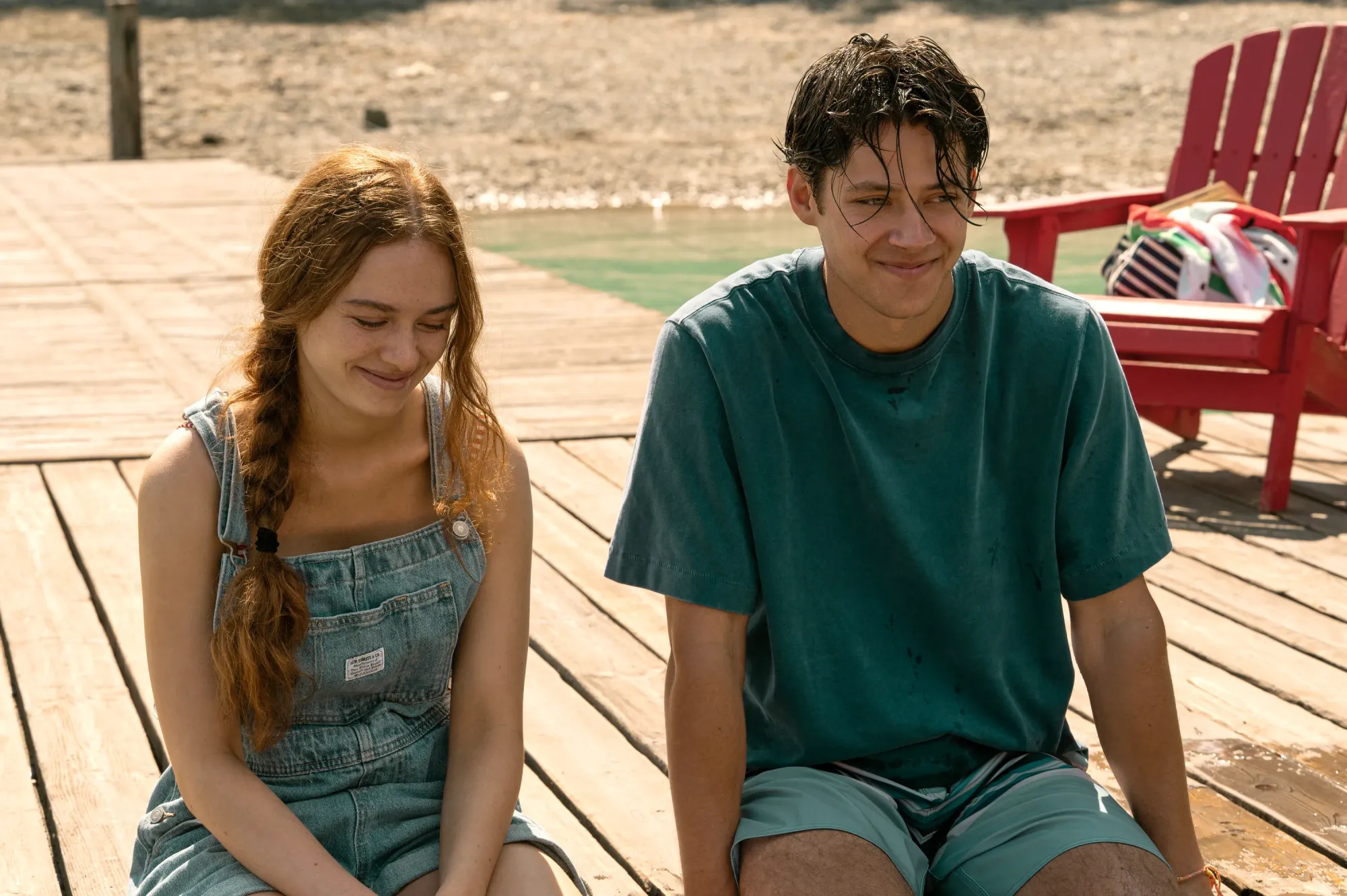
Photo of Percy and Sam Every Summer After Show
The geographic and identity changes
Setting: Ontario → British Columbia. The book's Barry's Bay is an Ontario cottage town. The show keeps the name but moves the location to BC. The lake, the dock, the floating raft, the yellow speedboat. All preserved. The drive distance from a major city is preserved as part of the show's "your childhood is three hours away" framing. But the province itself moves.
Percy's last name: Foster → Fraser. Small change, no thematic weight, just an adaptation decision. The bigger Percy change is geographic.
Percy's home base as an adult: Toronto → Seattle. Sadie Soverall's Percy lives in Seattle as an adult, returning to Barry's Bay when Charlie calls about Sue. The book's Percy lives in Toronto. The Seattle move is part of the "Percy has built a life as far from Barry's Bay as she could" framing, and it gives the show's present-day timeline a quieter American melancholy that the book's Toronto setting did not have.
Percy's job: magazine editor → writer. The book's Percy is a magazine editor in Toronto. The show's Percy is a writer in Seattle, and her writing career is itself a casualty of the trauma. After the breakup she stops writing. By the end of the season she is writing again. Her career and her healing are the same plot.
Sam's job: veterinarian → cardiologist. This is the biggest character profession change and the one with the most thematic load. The book's Sam is a quiet, gentle, rural-life veterinarian. The show's Sam is a cardiologist. The change carries the entire One Golden Summer subplot: in OGS we learn that the Florek brothers' father died of a sudden heart attack. The show pulls that detail forward and uses it to explain why Sam chose cardiology, and then weaponizes it in the finale by having Charlie collapse from a heart attack of his own. Book Sam is a vet because Fortune is writing about small-town life. Show Sam is a cardiologist because Harris is writing about inherited grief.
The expanded characters: why each one matters
The show keeps the central trio of Percy, Sam, and Charlie at the emotional center but expands several supporting characters into full storylines. This is the single most consistent change across the eight episodes.
Chantal (Aurora Perrineau) is the show's biggest expansion. In the book, Chantal is a peripheral friend. In the show, she is a high-powered attorney holding the emotional load of her relationship and her career, a character study in what it looks like when a smart, ambitious woman is in a relationship she cannot stop calibrating around.
Jordy / Jordie (Joseph Chiu) in the book is a small-town presence. In the show, he gets a full backstory: a basketball injury ended his pro dreams, he is now reluctantly running his family's business, he has a history with Chantal that the show finally lets land. By the finale, Chantal and Jordy are together. Harris has hinted in interviews that season two will introduce Jordy's first love returning to disrupt that pairing.
Delilah (Abigail Cowen) is the most visible "show invention" of the season. Book Delilah is far smaller. Show Delilah is an interior designer who hooks up with Charlie, runs the redesign of the Tavern, and by the finale is Percy's business partner in reopening it. The Delilah-Percy Tavern partnership is entirely a TV addition. It does not exist in either book.
Sue Florek (Elisha Cuthbert) is a casting prestige play. Sue dies before the present-day timeline begins. The show treats Sue's death as the inciting incident (the reason Percy comes home) rather than just emotional context the book delivers in parallel.
Young Percy (Juliette Hawk) and Young Sam (Blue Clarke) carry the past timeline. Both are TV-only. There is no equivalent "young actors" cast in the book because the book uses Percy's first-person memory rather than dual-cast performances. Their casting is structurally essential: the show's 20-year span needs visible aging in a way that prose does not.
The plot expansions: where the show really starts taking swings
The character changes I've covered. The plot changes are where the show really starts diverging from the book, and where the most viewers are going to argue about whether it "got it right."
The Sam-Percy-Charlie rupture is more visceral in the show than in the book.
In the novel, when Sam finally learns about the night Percy and Charlie spent together, the betrayal is devastating but the rupture has the muted texture of memory. Percy is recounting it in retrospect, and we feel it through her, blunted by years of distance.
The show does the opposite. Sam finds out in real time, on screen, and the camera stays in his face. Matt Cornett plays the moment as something closer to grief than rage. A man losing two people simultaneously. The rupture between Sam and Charlie hits harder than in the book because the show makes us watch it. The rupture between Sam and Percy hits harder because Cornett refuses to make it scenery-chewing. He just goes quiet, the way people actually go quiet when something true breaks.
Sam sends Percy a breakup notice via email.
This is a show invention with surprising emotional weight. In the book, the end of Percy and Sam's teenage relationship is more amorphous, a slow unraveling Percy reconstructs from memory. The show gives Sam a specific cruelty: a typed-out, sent-from-his-phone, dated-and-timestamped goodbye. It's a small change but it carries a thematic load. Sam, the cardiologist who has built his life's emotional discipline around his father's heart attack, ends his most important relationship with the most formally distant message he could send. The email is the show telling you who he is.
Percy turns to Charlie for comfort, and cuts ties with Sam without explaining why.
In the novel, the chronology of Percy-Charlie is laid out as a single catastrophic decision. Percy is hurting, Charlie is there, they sleep together, the secret eats Percy alive for a decade. The show reframes it slightly: Percy initially turns to Charlie just for comfort after Sam's email. The intimacy escalates. After it happens, Percy regrets it and goes silent, disappearing on Sam without ever telling him why, because she cannot survive saying it out loud.
The change is subtle but it shifts the moral weight. Book Percy and book Charlie share a betrayal. Show Percy and show Charlie share a wound that became a betrayal in the dark, and the show lets you grieve for all three of them at once.
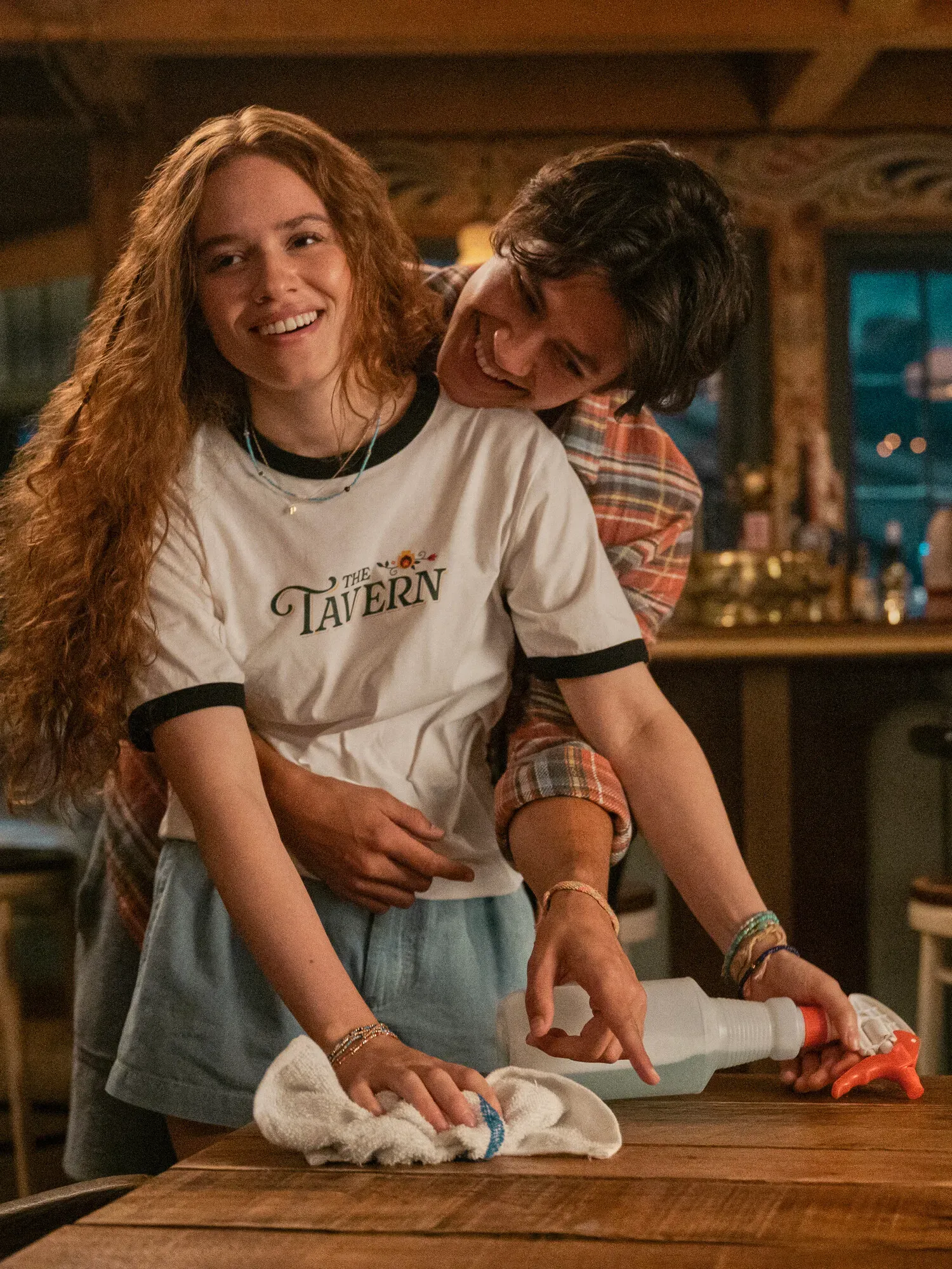
Photo of Percy and Sam Every Summer After Show
The One Golden Summer DNA: the dual-source reveal
This is the section the post exists for. Hang with me.
Here's what Carley Fortune did when she wrote One Golden Summer in 2025: she returned to Barry's Bay and built a companion novel around Sam's older brother Charlie. The Florek family expanded. Their father's death (referenced briefly in Every Summer After) became plot relevant. The yellow speedboat photograph that Alice took as a seventeen-year-old became the centerpiece of an entire novel.
When Amy B. Harris adapted Every Summer After for Prime Video, she didn't just adapt that one book. She read both books and pulled forward the OGS-canon details that would let her tell a richer story in season one, and set up multiple seasons of material to come.
Here is the full inventory of OGS-source material in Every Year After:
Sam as a cardiologist. Book Sam is a veterinarian. Show Sam is a cardiologist because, in OGS canon, the Florek boys' father died of a sudden heart attack. Michael Bradway told Deadline the show made this explicit: "Obviously, [Charlie's] father died from a sudden heart attack, which is a big reason why Sam wanted to be a cardiologist and to help people, because of what happened to his father." That's OGS-canon load-bearing in the show's character architecture from episode one.
The Tavern inheritance. In Every Summer After, Sue's Tavern is part of the setting, the place where summers happen, where Percy and Sam meet. In One Golden Summer, Sue leaves Percy the Tavern in her will, and Percy reopens it. The show pulls that plot beat forward into the season one finale. Percy gets a letter from Sam. Inside is the deed to the Tavern. By the time we see her again, she's renovating it with Delilah and reopening it under her own ownership.
The yellow-speedboat photograph. This is the easter egg almost no one is catching. In the show's final moments, Charlie is alone in his office, late at night, and he finds an old photograph: him, Sam, and Percy on a yellow speedboat. He's flooded with feeling. Then he collapses.
In One Golden Summer, the centerpiece image of the entire novel is a yellow-speedboat photograph of three teenagers, taken by Alice when she was seventeen, the photo that launched her photography career. Bradway calls it "the famous photo" in his Deadline interview. Harris confirmed she "honored details of One Golden Summer" in the finale. The visual rhyme isn't coincidence. Whether the show is positioning Charlie's office photo as literally Alice's photograph or as its emotional cousin, the message lands the same way: the show is announcing the entire setup of book two as the cliffhanger for season one.
If you didn't read One Golden Summer, the photograph is a beautiful visual callback to the show's own past timeline. If you DID read One Golden Summer, you understand what Charlie's office moment is really doing, and what season 2 is going to pull from.
Charlie's heart attack itself. In One Golden Summer, Charlie has heart problems. His father's death haunts him both emotionally and genetically. Bradway told Deadline: "It just so happens that Charlie also has heart problems, and unexpectedly, he's looking at the famous photo and he's reminiscing, and unfortunately it hurts too much, and he has a heart attack." The show is loading season two with OGS plot directly.
Showrunner Amy B. Harris confirmed the strategy: she "honored details of One Golden Summer" in the finale. Carley Fortune called the finale "brilliant, emotional" and praised Harris specifically for the OGS material.
This is why I started the post by saying every other write-up that names only Every Summer After is leaving viewers half-prepared. The show isn't an adaptation of one book. It's an adaptation that already has the next two seasons of source material mapped out, and the smartest thing you can do as a viewer is read OGS before the next season drops.
The ending change: what the show does that the book doesn't
The book and the show end in completely different places. This matters.
The book's ending: Sam and Percy reconcile. They move in together in Toronto. They continue to spend their summers at Barry's Bay. Years later, in OGS, we learn they're blissfully married and expecting their first child. That's the destination.
The show's ending: Open-ended. Almost defiantly so.
Here's what actually happens in the season one finale:
Sam learns about the night with Charlie. He gives Sue's eulogy at her funeral, where Sue (in flashback) has told Percy: the Florek boys don't run this town; the women do. This is the show planting its flag (and arguably planting OGS's flag too) about who really inherits Barry's Bay.
After the funeral, Sam and Percy spend the night together one last time. As they're lying together in the car, Sam says: "I want so much to forgive you, but I don't think I can do this." Percy answers, "I know," and the show lets the grief breathe.
Then there's a time jump. Nearly a year later. Percy has received a letter from Sam, and inside it, the keys to Sue's Tavern. Percy and Delilah are renovating the Tavern. Reopening night happens. Sam doesn't attend.
After everyone else has gone home, Percy is alone in the kitchen, washing dishes. She hears a familiar voice. It's Sam.
"You came home," she says.
This is the show's biggest book callback and its most precise act of inversion. In the novel, that line belongs to Sam. It's what he says to Percy when she finally returns to Barry's Bay as an adult. In the show, Percy says it to Sam. Same words, opposite direction, completely different meaning. He came back to her. The relationship economy has flipped.
But that's not where the show ends.
The final scene cuts to Charlie. He's working late at his office. He stumbles on the yellow-speedboat photograph. He's overcome. As we established a few paragraphs up, that photograph is the visual centerpiece of One Golden Summer. He collapses. Heart attack. Alone. As the season ends.
The show declines to give Sam and Percy their book-ending closure and instead leaves them in an almost-but-not-yet, with the OGS material taking over as the cliffhanger. Structurally, it's the show telling you: this isn't Every Summer After's ending. It's the prologue to whatever comes next.
Season 2: what's coming and where it pulls from
We have showrunner-confirmed and author-praised hooks for at least four season-two storylines. They all pull from OGS, or set up future Fortune material, or invent new territory the show wants to explore.
Charlie's heart attack and recovery. Bradway told Deadline that Charlie's father died of a sudden heart attack and Charlie inherited heart problems. One Golden Summer gives Charlie an extended recovery arc, a return to Barry's Bay, and a love story with Alice (the photographer who took the yellow-speedboat photograph). Season 2 will almost certainly lean heavily on OGS for Charlie. Whether they introduce an Alice character or fold that storyline into Delilah's expanded role remains to be seen.
Sam and Percy's reconciliation arc. The book finishes their love story. The show paused it on a precipice. Season 2 will need to land them somewhere, probably toward but not all the way to OGS's "married and expecting" canon. Harris is going to put them through the wringer first.
The Delilah-Tavern partnership. This is the most expanded show-invented storyline, and the show seems to be treating Delilah as Percy's permanent foil and business partner. Season 2 will need to deepen her, and there's a real chance the show folds OGS's Alice into Delilah rather than introducing a new character.
And looking longer term, when seasons 3 or 4 land, Meet Me at the Lake is sitting there as another Fortune source. Different characters, but the same emotional terrain. And, in a complication most people aren't tracking, currently in development as a Netflix film produced by Prince Harry and Meghan, Duchess of Sussex. That production could affect what Prime Video can or can't do with MMTL material, but the source novel is available for thematic mining either way.
The point: this show's writer's room already has two to three seasons of plot waiting on the shelf, in Carley Fortune's published catalog. Most adaptations spend season 2 inventing material out of thin air. This one doesn't have to.
Should you read the books first?
Here's the framework.
If you haven't watched the show yet: Read Every Summer After first if you can. The book's first-person perspective and dual-timeline structure are some of its best features, and you'll get the emotional architecture of the show's foundational love story without the show's expansions getting in the way. Then watch the show. Then read One Golden Summer. That's the order that gives you the most pleasure with the least confusion.
If you've already finished the show and want more: Start with One Golden Summer. It's the book the show pulls from for the finale and (almost certainly) for season 2. You'll understand the cliffhanger immediately. Then go back and read Every Summer After for the slower, fuller version of the love story the show condensed.
If you've only watched the show and want a comparable summer romance: Meet Me at the Lake is Fortune's closest emotional read-alike to Every Summer After. Same Ontario lake setting, same dual-timeline structure, same decade-later second-chance question.
The fastest way to get all of this in one place is the comp listicle linked below, which pairs all twelve Carley Fortune-adjacent reads with their specific use cases for Prime Video viewers.
A quick note on the critical reception
The reviews dropped split, and it's worth knowing what kind of split.
Variety, TIME, theviewersperspective, and thetvcave read the show as a smart, faithful, beautifully cast adaptation that honors what readers loved. They praised the chemistry between Sadie Soverall and Matt Cornett, the eight-episode breathing room, and the soundtrack (Lana Del Rey, Dolly Parton).
TheWrap was harsher, calling the show "decidedly uninspired," comparing it unfavorably to Heated Rivalry, with a headline that read "Prime Video Romance Fans Deserve Better."
Both takes are defensible. The positive reviewers were reviewing it as an adaptation against the bar set by the source material. TheWrap was reviewing it as romance TV against the bar set by the genre's recent peaks. If you came because you loved the book, you'll probably come away pleased. If you came expecting Heated Rivalry-level risk-taking on sex, structure, or subversion, you may not.
Fan reception, for what it's worth, is running far more positive than mixed reviews suggest. That's where season 2 demand will come from.
What to read next
Want all twelve Carley Fortune-adjacent reads in one place? Books Like Every Summer After: 12 Reads for Carley Fortune Fans. The comp listicle pairs Meet Me at the Lake as the featured read-alike with eleven other picks across Fortune's catalog and beyond. One Golden Summer is in there as the show's dual-source companion. Same cluster, same audience, more depth on every Fortune book.
Want this in newsletter form? The Weekly Bookmark is Ink & Imaginings's free book newsletter.
Frequently asked questions
Is Every Year After on Prime Video the same as Every Summer After?
Yes. The show is the television adaptation of Carley Fortune's 2022 debut novel Every Summer After. The title change was a streaming-platform decision. But the show also pulls material from Fortune's 2025 companion novel One Golden Summer, most visibly in the season one finale, where the Tavern inheritance and Charlie's heart attack come directly from the second book.
Is Carley Fortune the showrunner?
No, but she's an executive producer on the show, which means she has creative input and sign-off authority on the adaptation. The showrunner is Amy B. Harris, who adapted the series for television. Fortune has said in interviews that she trusts Harris and praised the season one finale as "brilliant, emotional."
Why is Sam a cardiologist in the show instead of a veterinarian like in the book?
This is a deliberate change that pays off in the finale. In Fortune's companion novel One Golden Summer, we learn that the Florek brothers' father died of a sudden heart attack. The show pulls that detail forward and uses it to explain Sam's profession, and then weaponizes it in the season one finale by having Charlie collapse from his own heart attack. Book Sam is a small-town vet. Show Sam carries inherited grief. Both versions are true to the character; the show is just using the OGS-canon to deepen him.
What happened to Charlie at the end of Every Year After?
Charlie suffers a heart attack alone in his office after looking at an old photograph of himself, Sam, and Percy on a yellow speedboat. The collapse is the season one cliffhanger and is the show pulling directly from One Golden Summer, where Charlie has heart problems inherited from his father. Whether he survives, and how his recovery unfolds, is almost certainly the load-bearing arc of season two.
Will there be a season 2 of Every Year After?
Prime Video has not officially announced season 2 as of this writing, but the show was clearly built with one in mind. The season one finale is a cliffhanger, multiple storylines are deliberately unresolved, and showrunner Amy B. Harris has given interviews suggesting where season two would take the characters. The show also has two Carley Fortune novels worth of source material still mostly untapped (One Golden Summer and Meet Me at the Lake), which makes renewal commercially logical. For the official announcement when it lands, subscribe to The Weekly Bookmark, Ink & Imaginings's free weekly book newsletter.
Should I read Every Summer After before watching the show?
If you have the time, yes. The book is short (about 350 pages), reads in a weekend, and its first-person perspective gives you emotional context the show necessarily compresses. But the show is built to work as a standalone for viewers who haven't read it. Carley Fortune is an executive producer and the show keeps the central emotional architecture intact. The bigger recommendation: if you have finished the show and want season-two preparation, read One Golden Summer next.
Where can I read One Golden Summer?
One Golden Summer is Carley Fortune's fourth novel, released May 6, 2025 by Berkley/Penguin Random House. Available in hardcover, paperback, ebook, and audiobook. ISBN 9780593638910. It's a companion novel to Every Summer After: same Barry's Bay setting, same Florek family, following Charlie's story. If you watched Every Year Afterand want to see what season two is pulling from, this is the book.
Where can I read more from the Carley Fortune cluster?
Books Like Every Summer After: 12 Reads for Carley Fortune Fans is the comp listicle that pairs the show's audience with all twelve Fortune-adjacent reads, including reading order across her catalog, Meet Me at the Lake as the closest emotional read-alike, and the Beach Read / Phoebe Dynevor adaptation news for what's coming next. For continuing coverage as the show's season two news rolls in, subscribe to The Weekly Bookmark, the free Ink & Imaginings newsletter that delivers Book vs. Show breakdowns like this one before the search wave peaks.