“Ah, the invisibility of the middle-aged woman. I’d read countless pieces on the indignity of it. My hot take on turning invisible? Finally!.”
That line tells you everything you need to know about Adora Hazzard. She's a fifty-something Stoic philosopher living in Manhattan's Ansonia building, tutoring billionaire eleven-year-olds in the four cardinal virtues they cheerfully recite and immediately ignore. She makes fried egg sandwiches with the precision of a Michelin chef. She's building a coven with her friends. And she is absolutely not looking for love.
Then a man in Italian loafers recognizes her name on a ballet ticket, and the next three hundred pages go places I genuinely did not see coming. The man she meets in the second chapter turns out to know her in a way that recontextualizes thirty years of her life.
If your book club picked this one, the discussion questions at the bottom are going to fuel at least an hour of heated conversation. Possibly two. The NDA subplot alone could carry an entire meeting.
This post contains affiliate links. If you buy through them, I may earn a small commission at no extra cost to you. Thanks for supporting Ink & Imaginings.
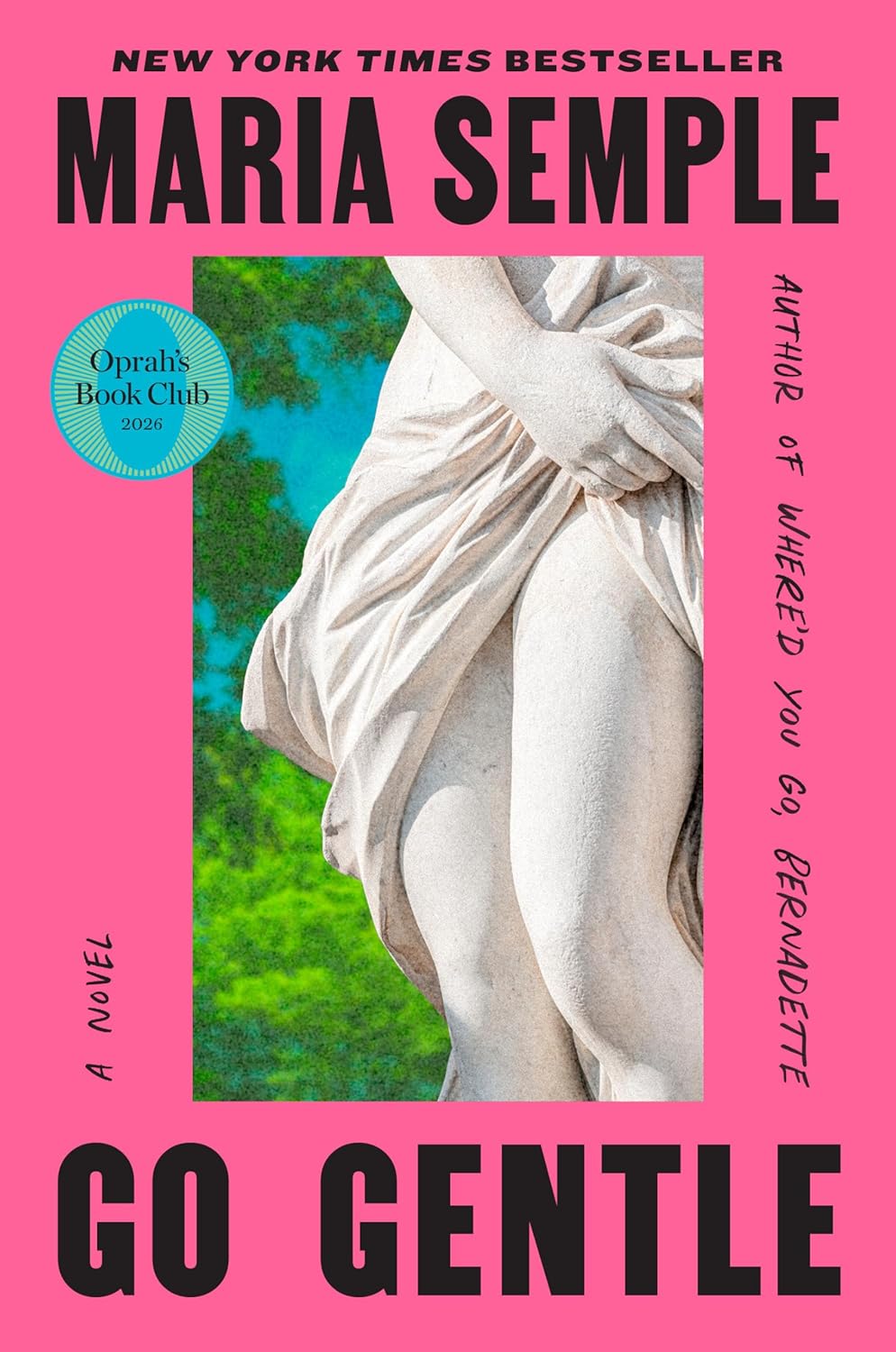
Go Gentle by Maria Semple Book Cover
📖 Buy on Amazon | Buy on Bookshop.org | 🎧 Listen on Audible
📖 Oprah's Book Club April 2026 Pick (coming soon) see the full 2026 book club picks tracker for every Reese, Oprah, and Jenna pick of the year, updated monthly.
Full spoilers for Go Gentle by Maria Semple. If you haven't finished it, every twist will be ruined. You've been warned.
Quick Answers
What is Go Gentle about?
Go Gentle follows Adora Hazzard, a fifty-something Stoic philosopher in Manhattan who falls for a mysterious man named Digby and then uncovers an art conspiracy at the Lockwood Library that recontextualizes thirty years of her own life.
What does the ending of Go Gentle mean?
Adora discovers that Digby was the attorney who wrote her NDA thirty years ago, the Venus de Milo in the Louvre is a forgery, and her Stoic philosophy has been keeping her safe and isolated in equal measure. The ending is about letting love in without giving up the philosophy that saved her.
Is Go Gentle a sequel to Where'd You Go, Bernadette?
No. It's a standalone novel. Maria Semple's latest, with a new cast and setting but the same razor-sharp voice.
Who is Digby in Go Gentle?
Digby is David Ignatius Beale. A former attorney turned dispute resolver working for the Louvre and the unnamed lawyer who sat across from Adora during her NDA signing thirty years ago. The reveal lands in the last quarter of the book.
Is Go Gentle a good book club pick?
Excellent, particularly for groups that love a debate. The NDA subplot, the question of whether Stoicism is salvation or cage, and whether Digby can be trusted after thirty years will fuel a long and heated discussion.
Go Gentle Full Plot Summary
The Coven
Adora Hazzard is working a fellowship at the Lockwood Library on Fifth Avenue. Her real passion project is the coven: she and two friends, theater director Minna and lawyer Emily Ann, have bought apartments on the same floor of the Ansonia, pooling resources to age in place together. When apartment 716 becomes available, Adora starts scouting a fourth member.
At work, she spots the visitor badge of Blanche Falk, the landscape architect who designed the Lockwood family's wild garden. The decision is instant. The invitation is extravagant. Blanche is in.
The Ballet
Emily Ann cancels on ballet at Lincoln Center, leaving Adora with a spare ticket. She offers it to the last man in the standby line. Fifties, full hair, Italian loafers, a Rolex, and an expression of guileless astonishment. He recognizes her name from her Stoic translations.
During a sensuous pas de deux, Adora discovers her hand has turned palm-up toward his, fingers curled open like a question. She panics, rips her program off her lap with a sound that cracks through a pianissimo, and flees past a dozen swiveling heads. She gives the ticket to her teenage dog walker Ziggy and disappears into Broadway.
The man calls her name across the fountain. She's already gone.
Boy With Apple
In the Lockwood Library's parterre garden, curator Ravi denounces a statue Layla Lockwood bought from French aristocrat Celine Montfort. It's a Boy With Apple that appears in no art database. The argument ends when alarms go off.
Adora drags wheelchair-bound Lionel Lockwood from his standing frame. After a controlled detonation of a suspicious briefcase in the lobby, the smoke reveals a foil-wrapped burrito and a cream-colored card engraved with a name: David Ignatius Beale.
He's the man from the ballet, waiting on a bench across Fifth Avenue. He tracked Adora through Ziggy. She scrawls a restaurant name on his card and sends it back through the Lockwoods' assistant Hannah. She will come to call him Digby.
How Adora Saved Lionel
Five years earlier, Layla hired Adora to reach her husband. Lionel was once a marble-carved Harvard athlete, now one-armed and half-paralyzed from a climbing accident, lying in a mechanical bed, radiating silent fury. Adora told him events were neutral. Suffering was his construction.
When he scoffed, she rolled up her sleeve and showed him her left wrist: Latin words for Love Fate tattooed in white ink over a faint vertical scar. Lionel gripped her hand and recognized a kindred soul.
Over five years, they chased ideas through Montaigne, Nietzsche, and Richard Pryor while Blanche's untamed garden rioted to life outside the glass walls. Lionel regained mobility, became a Democratic donor, and wept before the armless Venus de Milo in Paris. Her limbless beauty gave him permission to see beauty in his own mutilation. Layla credited the statue with saving his life. Adora let her.
Dinner and Digby
Dinner at Salumeria Rosi is flawless. Dolce gorgonzola, fried artichokes, spring pea pasta, banter so precisely calibrated it feels choreographed. He asks her to call him Digby. She reveals her tattoo. He calls it kind of hot.
She confesses it has been years since anyone touched her. He takes her hand and its warmth alone could sustain her.
At the Lowell Hotel, they ride the elevator in held-breath silence. Then Digby sits on the love seat and confesses. He spent all day watching her from a bench across Fifth Avenue. He followed her to Lincoln Center. Someone has stolen something from his client, and he needs Adora to deliver a sealed letter to Layla Lockwood without being seen.
The Letter
Despite her devastation, Adora studies the Lockwood Library's thirty-camera surveillance grid and discovers one blind spot: the monitor room itself. She lures Hannah away by inventing a celebrity sighting and slips Digby's letter into the mail cart.
The thrill surprises her. She is disturbingly good at deception.
Digby's next note arrives: an address on Madison Avenue. They meet at an STD clinic, test clean in minutes, and share their first kiss in the elevator. What follows is transformative. She has forgotten the luxury of skin on skin.
Hollywood
This is where the book breaks open.
Adora was twenty-nine, a struggling comedy writer in West Hollywood, when she got the call: head writer Vince O'Quinn wanted her on Laugh Riot, television's hottest sketch show. She joined the writers' room and became one of the guys, typing their sketches and absorbing their fraternity.
She co-wrote her first original sketch with TJ Steele at his bungalow. She cleaned his filthy bathroom. She gave him oral sex he framed as not-quite-cheating. At the table reading, as a hundred people laughed at their sketch, TJ's hand moved from her knee past elastic, his wedding ring cold against her flesh.
Across the table, two other writers convulsed. Not at the jokes. It was a bet. TJ pocketed a roll of hundreds. The sketch got career-making applause. Nobody saw a thing.
Her agent brokered the settlement. $350,000. She signed away her voice forever. The spiral accelerated: isolation, colleagues who blamed her for ruining it for all female writers, a Nike box packed with XXXL sports bras as a parting prank from the guys.
She wrote the actor's name on her thigh, opened a box cutter, and sliced her wrist. A roofer found her. During recovery at her mother's house, she discovered Stoicism in a newspaper column. Events are neutral. The judgment can be changed. Something lifted.
Celine's Threat
Celine Montfort summons Adora to her guest suite. She's seen the blush. She knows about Digby. After his closet meeting with Layla, Celine's art deal was abruptly canceled. She demands Adora convince Digby to stand down, or she'll expose everything to the Lockwoods.
Adora confronts Digby at the Lowell. He tries to recruit her deeper, invoking grand language about stepping into the arena. When she refuses, he dismisses her Stoic principles as an elaborate excuse for playing small. She shoves him hard and walks out.
Both people who want something from her have concluded she is a useful fool.
The Investigation
Adora flees to Connecticut with Viv and the dog. There, Viv drops a bomb: while Adora slept, she photographed Digby's letter to Layla. One line in ornate cursive, claiming knowledge of an arms deal.
Back in the city, Adora recruits the Ansonia's doorman Dante to pull Lockwood surveillance footage. They watch Ravi in the storage vault with a woman and a mysterious machine, sampling the French crates. Ziggy, who lip-reads for gossip sites, deciphers Ravi's phone call. The key words: Nazis, Mona Lisa, reputation, arms, C-4.
Adora becomes certain the crates contain weapons. She reports her findings to the FBI.
Go Gentle Ending Explained
The Raid
Adora accompanies the FBI raid on the Lockwood Library. Agents and bomb-sniffing dogs swarm the parterre where the crates have been moved for the statue's unveiling. All four are empty and clean.
On the plinth stands a marble boy, one hand raised, offering an apple. The crates are labeled C1 through C4. French for Caisse. Standard shipping notation. Not C-4 explosives.
The arms deal was literally about arms. The statue's arms. Shipped in numbered wooden boxes.
Celine spells it out with acid delight. Lionel, bewildered and heartsick, asks Adora why she would call the FBI on his family. Layla fires her on the spot.
The NDA
At the Ansonia, a manila envelope awaits. Hand-delivered by Digby. Inside: her original 1998 NDA, yellowed and brittle. A letter from TJ Steele's grown daughter Evelyn, formally releasing Adora from the agreement. And a cover note on law firm stationery, addressed to Travis, signed by David.
Adora flips to the NDA's appendix and finds the name she never noticed: David I. Beale, point of contact.
Digby was the unnamed attorney who sat across from her thirty years ago. He wrote her silence. He watched her wipe condensation off the table with her shirt and thought she was unlike anyone he had met. He willed her to demand more money, and she did.
This whole time, he had known her.
The Venus de Milo
In Paris, Blanche reveals she has been working for Interpol, sent to monitor the Lockwood crates because of terrorist chatter. Ravi was found locked inside the Lockwood residence's soundproof room, trapped for a week, his kidneys failing.
Adora pieces it together at a lectern in a centuries-old anatomy theater. The arms deal was literal. Pierre Montfort didn't merely smuggle the Mona Lisa during the Nazi occupation. He also took the real Venus de Milo and replaced her with a forgery that has stood in the Louvre for sixty years.
When a Greek fisherman recently pulled marble arms from the sea, Celine flew to Greece and bought them before the museum could investigate, then fabricated Boy With Apple to smuggle the arms out of France. She shoved Ravi into the soundproof room when his analysis threatened exposure.
Adora drives to Chateau Montfort and lays out the truth. Celine throws the evidence into the fire. Copies exist, Adora tells her. Blanche's contractor Dorris moves through the chateau knocking on walls, and behind a tapestry, in a hidden chamber lit by a single spotlight, finds the real Venus de Milo.
Digby's Truth
Digby finds Adora at the Louvre. He was working for the museum all along, not for Celine's half-brother. A terrorist operative drapes the fake Venus in pink netting during their reunion. The blast throws Adora onto Viv, Digby shielding them both. They survive.
What the Ending Means
Weeks later, at the unveiling of the restored Venus, her arms now holding an apple, Adora watches Lionel see the statue whole for the first time. The proof of his growth ripples across his face: fear, bracing, nothing, joy. He is fine.
Digby tells Adora he loves her without qualifiers. They bicker over promises. He buys the apartment above the coven. Ravi recovers. Adora returns to the Lockwood Library.
The book is ultimately about a woman who built an entire philosophy around not needing anyone, and then discovered that needing someone isn't weakness. It's the whole point. Adora's Stoicism saved her life after Hollywood. But it also became a wall she hid behind for thirty years. Digby didn't tear the wall down. He just walked around it.
The coven gets its fourth member. Digby gets the floor above. Adora crosses Central Park each morning to her office overlooking the garden. Her circle remains small. Inside, she feels vast.
Go Gentle Characters
Adora Hazzard
A fifty-something Stoic philosopher who tutors billionaire's kids in virtue and makes fried egg sandwiches like a Michelin chef. She survived Hollywood, an NDA, and an attempt on her own life. She rebuilt herself through philosophy and convinced herself she didn't need love. She's fiercely intelligent, compulsively enthusiastic, and disarmingly funny. She's also wrong about not needing people and the entire book is about her figuring that out.
Digby (David Ignatius Beale)
Full hair, Italian loafers, Rolex, and the ability to make a woman feel cherished and managed simultaneously. A former attorney turned pro-bono dispute resolver. He was the unnamed lawyer at Adora's NDA signing thirty years ago. He watched her and thought she was unlike anyone he'd met. He's spent decades carrying guilt about writing her silence. His charm is real. His strategic mind is terrifying.
Viv
Adora's fifteen-year-old daughter. Beachy waves, hot chocolate pilgrimages, fierce loyalty disguised as indifference. She tracks Adora's phone, reads forbidden letters, and sees through adult deception. She photographs Digby's letter while Adora sleeps.
Lionel Lockwood
Wheelchair-bound billionaire who lost his arm in a climbing accident. Once suicidally depressed, he was transformed by Adora's philosophical companionship and Blanche's garden. He wept before the armless Venus de Milo in Paris and found permission to see beauty in his own body. His reaction to the restored Venus at the end is proof that growth can last.
Layla Lockwood
Lionel's wife, former soap opera actress turned fierce CEO of their post-accident life. She will do anything to protect Lionel, which is both her greatest strength and her most dangerous weakness.
Celine Montfort
French aristocrat, Louvre board member, and the villain of the piece. Her family stole the real Venus de Milo during WWII. She fabricated an entire art deal to smuggle the marble arms out of France and locked Ravi in a soundproof room when he got too close. Elegant, razor-tongued, and willing to sacrifice anyone for her family legacy.
Ravi Bhardwaj
The Lockwood Library's curator. Binary taste: things are either tacky or kind of great. He's the first to notice something wrong with Boy With Apple. Married to Scott, expecting a baby via surrogate. His dedication to art integrity puts him in real danger. He's locked in a soundproof room for a week. He survives and names his daughter Ravija, daughter of the sun.
Blanche Falk
Landscape architect, Columbia professor, and secretly working for Interpol. Sun-damaged skin, wild hair, combative directness. She's the opposite of Upper East Side polish. She and Adora recognize something fierce in each other immediately. She joins the coven. She also helps take down a sixty-year art forgery.
TJ Steele
The actor from Laugh Riot. Ice-blue eyes and a laconic drawl concealing predatory behavior the whole writers' room sanctioned. His exploitation of young Adora was a bet among colleagues. His grown daughter Evelyn eventually releases Adora from the NDA, which is both an act of atonement and an indictment of an industry that took thirty years to correct itself.
Themes Worth Discussing
The Coven: Women Building Something New at Fifty
“We want women like us. Women who present as scary, but have good hearts. Women who know how to get shit done. Women who, despite our age, share a dirty little secret: we’re just getting started.”
The coven isn't a fallback plan for women who couldn't find husbands. It's an intentional, chosen, architecturally designed community of women who decided that aging together on their own terms was more interesting than anything a rom-com could offer. Your book club will argue about whether the coven is feminist utopia or a fancy way of avoiding intimacy.
Stoicism as Shield
Adora's Stoicism saved her life after Hollywood. "Events are neutral. The judgment can be changed." That philosophy got her off the floor and into a new career. But it also became the reason she hasn't let anyone touch her in years. The book asks whether the thing that saves you can also be the thing that keeps you stuck. Your group will have strong opinions about this one.
The NDA and Silence
Adora signed away her voice for $350,000 when she was twenty-nine. Thirty years later, the daughter of the man who exploited her releases her from it. The book doesn't let this feel like a clean redemption. It feels like what it is: too late. The industry silence, the women who blamed Adora, the XXXL sports bras as a goodbye gift. Semple handles this with precision and anger. The question for your book club: does the release of the NDA give Adora closure, or does it just reopen everything?
The Arms Deal That Wasn't
The most elaborate misunderstanding in the book. C-4 was Caisse 4. The arms deal was about the statue's arms. Adora called the FBI on the family that employed her because she was so deep in espionage mode that she stopped reading the obvious answer. Is this a comment on how trauma makes you see threats everywhere? Or is it just a really good plot twist? Honestly, probably both.
Book Club Discussion Questions
Ordered from warm-up to heated.
- The coven is Adora's dream: four women buying apartments on the same floor to age together. Would you do this? Is it aspirational or does it feel like giving up on something else?
- Adora shows Lionel her wrist scar on their first meeting. Is that an act of courage or manipulation? Does it matter if it works?
- The ballet scene is the most romantic meet-cute in recent memory, and it turns out to be a recruitment. Did you feel as betrayed as Adora? Or did you see it coming?
- Adora discovers she's "disturbingly good at deception." How does this change how you see her? Does her Stoic philosophy make her a better liar or a worse one?
- The Hollywood flashback is brutal. TJ's exploitation of Adora was a bet. The sketch got applause. Nobody saw a thing. How does this section change the way you read Adora's present-day emotional armor?
- Digby was the attorney at Adora's NDA signing thirty years ago. He wrote her silence. He also fell in love with her that day. Can both things be true? Does his guilt excuse the original act?
- Adora calls the FBI based on what she thinks is evidence of weapons. The crates contain a statue's arms. Is this a reasonable mistake given her state of mind, or did she let her fear override her judgment?
- Layla fires Adora on the spot after the raid. Is Layla justified? Adora was trying to protect the family. Does intention matter when the outcome is this humiliating?
- TJ's daughter Evelyn releases Adora from the NDA thirty years later. Does this feel like justice, too little too late, or something else entirely?
- Digby tells Adora he loves her without qualifiers. After everything he did, manipulating her, recruiting her, knowing her secret for thirty years, do you trust him? Should Adora?
My Honest Take
I adore Where'd You Go, Bernadette. So I had high expectations for this one, and for the first third I was completely delighted. Adora's voice is razor sharp. The Ansonia setting is gorgeous. The coven concept is the kind of idea you text your friends about immediately. And the ballet meet-cute might be the most romantic scene I've read this year.
But then the book turns into something completely different. And then into something completely different again. This is three-novels-in-one book. The Hollywood flashback is devastating and important, but it lives in a different book than the art heist thriller that follows. And the Venus de Milo conspiracy, while genuinely clever, asks you to take a very large leap.
"The book as a whole felt like three excellent novels fighting for the same cover."
I kept loving individual scenes, loving Adora's voice, loving the way Semple writes wit and pain in the same sentence. But the parts, for me, weren't stitched together in a way that felt believable.
That said, your book club will have a LOT to talk about. The NDA subplot alone could carry an entire meeting. And the question of whether Stoicism is Adora's salvation or her cage is the kind of thing that splits a group right down the middle.
If You Liked Go Gentle, Read These Next
📚 The First Time I Saw Him by Laura Dave Another book about a woman who discovers the man she's connected to has been hiding something massive. Different genre, same gut-punch.
📚 The Fine Art of Lying by Alexandra Andrews Reese's May pick. Art world secrets, a hidden villain, and an ending that recontextualizes everything. If the Lockwood Library intrigue grabbed you, this delivers.
📚 Into the Blue by Emma Brodie Reese's April pick. A decades-spanning love story about two people who keep finding each other. Adora and Digby's thirty-year connection will resonate.
📚 Yesteryear by Caro Claire Burke Reese pick. Family secrets, dual timelines, and an ending your book club will argue about for an hour.
📚 Whistler by Ann Patchett Another literary powerhouse about a woman reconnecting with someone from her past. Coming June 2.
Already read one of these? Come back and check out the full guides. We have ending explained posts, character breakdowns, and book club discussion questions for all of them:
First Time I Saw Him Guide | Fine Art of Lying Guide | Into the Blue Guide | Yesteryear Guide
📚 See every 2026 book club pick from Reese, Oprah, and Jenna → Living tracker, updated monthly. Bookmark it.
Still Processing That Ending?
Tag me when you finish this one I want to know which of the three novels was your favorite, and whether you trust Digby in the end. (My honest take: I trust him about 70%.) Drop a comment with the line from the book that landed hardest.
The Weekly Bookmark lands every Tuesday with honest reviews, ending explained posts, and the books I'd text a friend about. No spam.
Want a curated pick each month? Try Book of the Month for $5 a new book every month, hand-picked.
Frequently Asked Questions
What is Go Gentle about?
Go Gentle follows Adora Hazzard, a Stoic philosopher in Manhattan who falls for a mysterious man named Digby while uncovering an art conspiracy at the Lockwood Library. The story weaves together a present-day romance, a devastating Hollywood backstory involving an NDA, and a sixty-year art forgery involving the Venus de Milo.
Who is Digby in Go Gentle?
Digby is David Ignatius Beale, a former attorney turned dispute resolver working for the Louvre. He was also the unnamed attorney at Adora's NDA signing thirty years ago. He knew her the entire time.
Is the Venus de Milo in the Louvre a fake in Go Gentle?
In the novel, yes. Pierre Montfort stole the real Venus during the Nazi occupation and replaced her with a forgery that stood in the Louvre for sixty years. The real statue is found hidden at Chateau Montfort.
What is the NDA in Go Gentle?
As a young comedy writer, Adora was sexually exploited by actor TJ Steele on the show Laugh Riot. She signed a $350,000 NDA that silenced her for thirty years. TJ's grown daughter Evelyn eventually releases her from it.
Is Go Gentle a good book club pick?
Absolutely. The NDA subplot, the question of whether Stoicism is salvation or cage, and whether Digby can be trusted after thirty years of knowing Adora's secret will fuel a long and heated discussion.