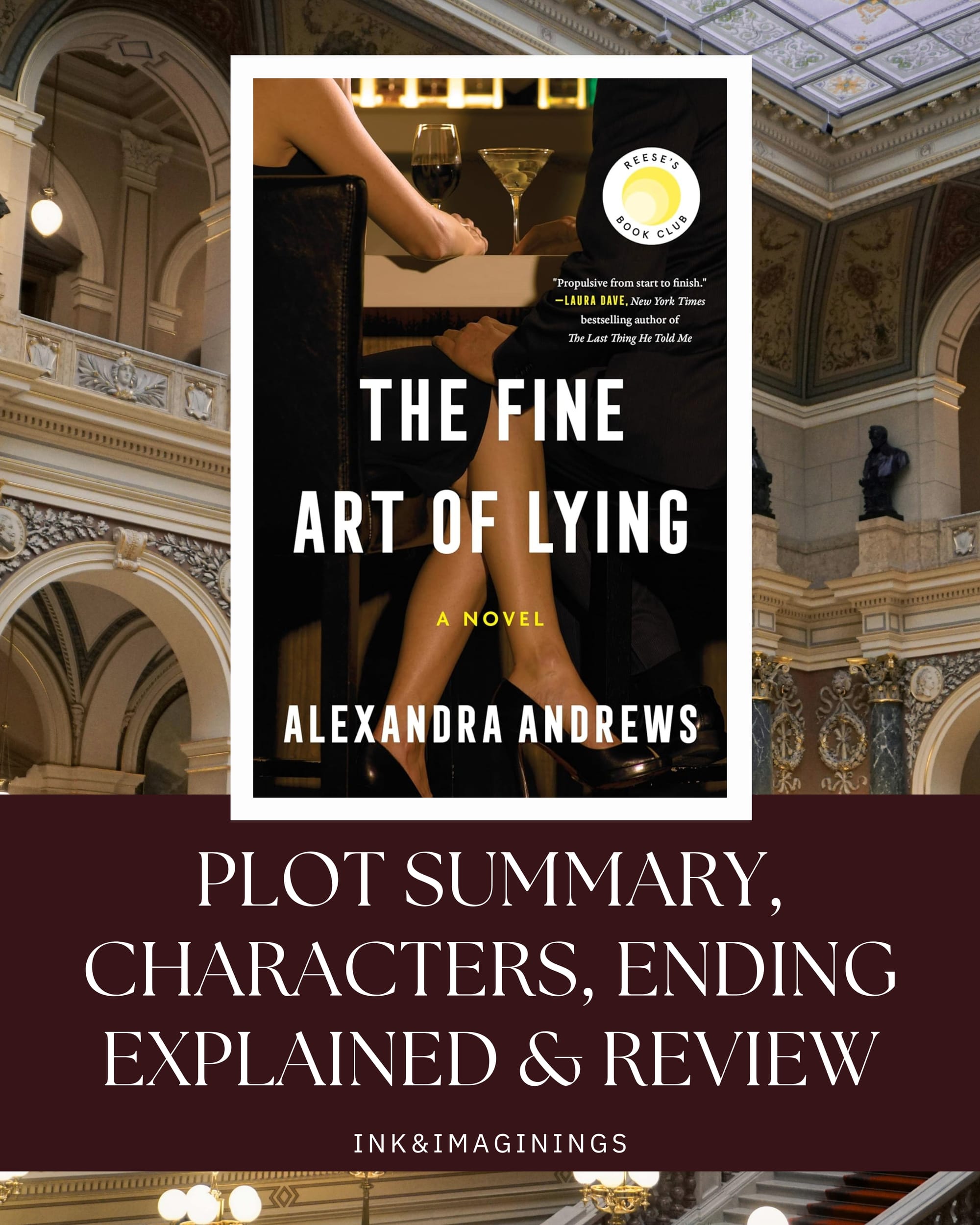
📖 Reese's Book Club May 2026 Pick
We open on Clare standing naked over a dead body, blood pooling at her feet, her mind flicking through art history's crimson spectrum to calm her panic.
This is one of the most arresting openings I've read this year. How did she get here? Who's dead? And what does a painting have to do with any of it?
The Fine Art of Lying is a thriller about art, marriage, desire, and the lengths people will go to protect what they've built. It's also about a woman who discovers that everyone around her, including herself, has been lying about something. If your book club picked this one, the discussion questions at the bottom are going to fuel at LEAST an hour of heated conversation.
Full spoilers for The Fine Art of Lying by Alexandra Andrews. If you haven't finished it yet, every twist will be ruined. You've been warned.
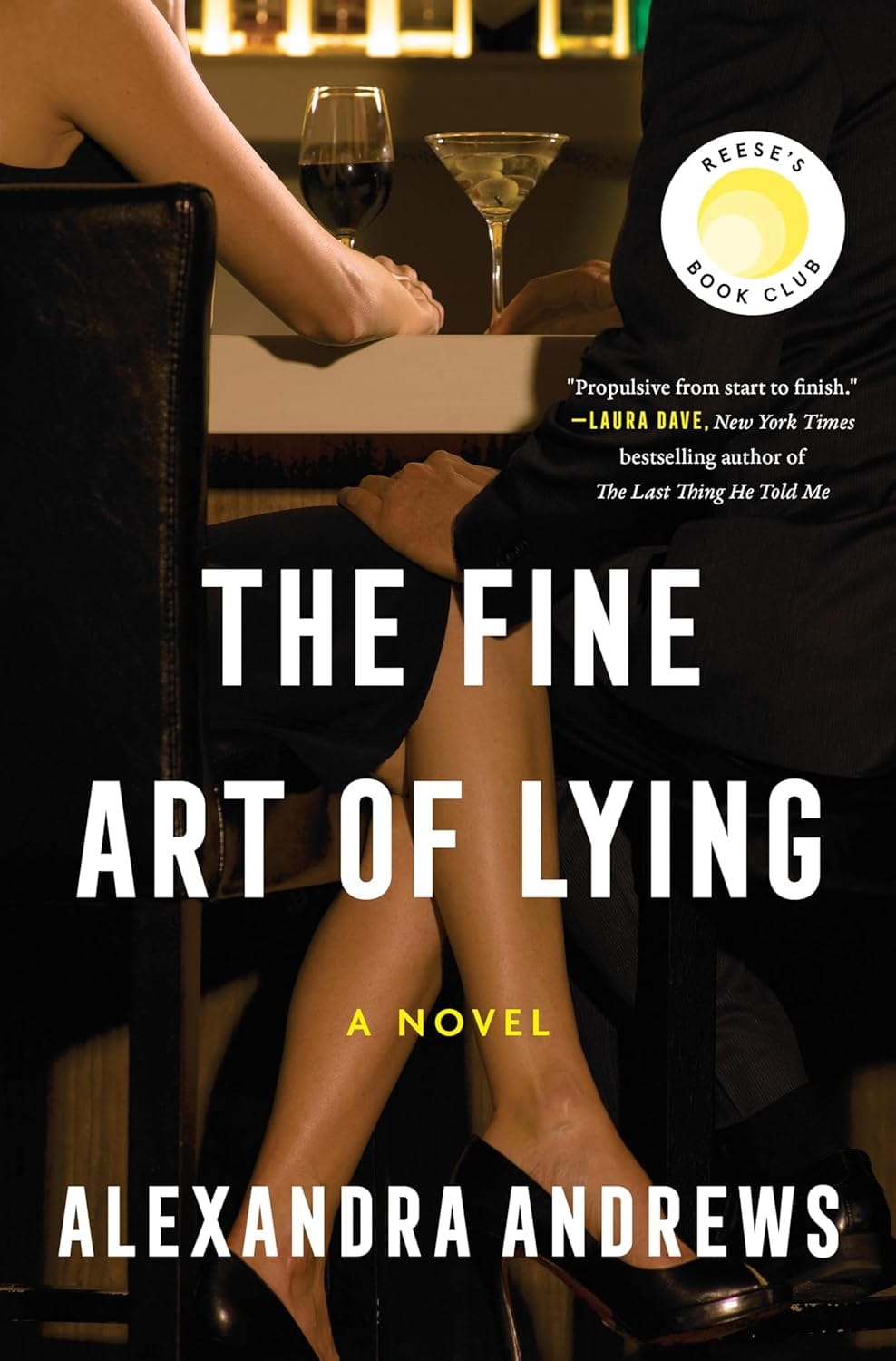
The Fine Art of Lying by Alexandra Andrews Book Cover
📖 Buy on Amazon | Buy on Bookshop.org | 🎧 Listen on Audible
The Fine Art of Lying Full Plot Summary
Clare's World
Clare is a brilliant but insecure art historian who traded her academic ambitions for the stability of marriage to Jed Bast, a well-meaning man from a wealthy New York family. They have a young daughter, Sadie, and a life that looks perfect from the outside. Brownstone, family dinners, the whole package.
But Clare is suffocating. Her unfinished dissertation haunts her. Her connection to art, that electric hum she used to feel, has gone quiet. She's disappeared into the role of wife and mother, and she can feel the distance growing between the life she has and the life she imagined
The Bast family dynamics are something else. Jed's mother Dorothy is a controlling force who views outsiders as threats to the family legacy. She wields approval and disapproval with surgical precision.
Early signals tell you everything: when Dorothy changes Sadie's dress for her birthday party without asking, when Jed gets a rabbit without consulting Clare that looks exactly like his childhood pet, and when he and his mother try to talk Sadie out of the name she chose for it... you know immediately that this family has layers of control that go deep.
If the thriller pacing grabbed you, try The First Time I Saw Him.
Gabriel and the Affair
Gabriel walks into Clare's life and represents everything she's missing. He's an art dealer with flexible ethics and irresistible charm. At the center of their connection is a painting called Longfin. A rare masterpiece that becomes the symbol of everything Clare wants and cannot have.
The affair begins as an awakening. Clare visits Gabriel's house, seduced not just by him but by the painting's electric energy and forbidden promise. Their encounters are secret, intensified by stolen art references and the thrill of risk. Everything she thought she had starts to crack
She rationalizes the affair as a recipe for renewed happiness. If she can just keep the two worlds separate. But the boundaries that keep her secret are built from lies and omissions, and they make her more vulnerable with each passing week.
The Double Life Unravels
Clare's two worlds start colliding. She's seen with Gabriel on the High Line by her sister-in-law. She lies to Jed. She invents a consulting job as cover. A missed school pickup triggers Dorothy's intervention.
At a lavish gala, Clare is forced to navigate the unbearable situation of her husband and her lover in the same room. It's the kind of room where guilt and desire have nowhere to hide.
Dorothy's suspicions harden into threats. She confronts Clare, leveraging her wealth and power to demand an end to the affair. The message is clear: your privilege as a Bast is conditional. Your life is not your own.
Gabriel's Murder
The affair ends as both Clare and Gabriel realize the increasing risk and destructiveness. But it's too late. Gabriel is murdered during what appears to be a robbery. Clare finds herself standing over a body, choosing what narrative to tell.
She wipes evidence and flees, choosing self-preservation for her family. The spiral of guilt, fear of discovery, and self-condemnation begins. The thing she usually does, disappearing into art until the feelings pass, doesn't work when the feeling is a dead body.
The Investigation
The police investigation tightens around Clare and Jed. Every attempt at clarity makes Clare look more guilty. Circumstances and manipulated evidence set the trap. Jed's fingerprints implicate him.
Clare discovers that Longfin may be a forgery shattering any remaining certainties about art and loyalty. Only her depth of art-historical knowledge allows her to see the truth: Gabriel and his people were running a con, and the whole art world's obsession with what's real and what's fake is basically the story of Clare's life.
The Real Villain: Tasha Wolfe
Gradually, through detective work and intuition, Clare unearths the layered machinations of the true villain: Tasha Wolfe.
Tasha is wealthy, strategic, and unapologetically ruthless. She operates as a puppet master in both the art world and among her social circle. Her bodyguard Emil is the actual killer. Always present, rarely noticed, trusted and completely unremarkable.
Tasha orchestrated Gabriel's murder and framed the evidence to point at Clare and Jed.
In a tense confrontation, Tasha tries to gaslight Clare with alternative narratives. "Jed did it," "Alec did it," "You imagined it all" and tries to pull Clare into her cover story. But Clare, finally empowered, recognizes she has to fight Tasha on her own terms.
The Fine Art of Lying Ending Explained
Clare exposes Tasha. Through careful manipulation and sacrifice, Clare exposes Tasha, Emil, and the conspiracy. Tasha is arrested. Jed is eventually vindicated.
But victory is partial. The marriage is broken. Innocence is lost. Clare recognizes that art, trust, and desire are always fragile and vulnerable to exploitation.
Clare becomes something new. In the aftermath, she builds a new existence as a single mother and art investigator. Shaped by the skills her ordeal taught her she's forever changed, having learned "the fine art of lying".
The closing line: "Fate is what happens to the ill prepared." Clare is no longer ill prepared.
What the ending means: Clare's arc is a complete transformation from a passive woman who traded her ambitions for security, to someone who was nearly destroyed by desire and deception, to an active force who uses the very skills that almost ruined her to pursue justice. She doesn't get a fairy tale ending. She gets agency. And the book argues that's worth more.
For another thriller with a mother at the center, try Caller Unknown
The Fine Art of Lying Characters
Clare
The heart of the novel. A brilliant art historian who traded ambition for stability and then nearly lost everything chasing what she gave up. By the end, she's moved from pawn to player in a world of art, lies, and ambition. You will argue about whether she's sympathetic or not. That's the point.
Jed Bast
Clare's husband. Solid, loving, earnest and completely unable to see the manipulation around him. He abandoned his own youthful ideals for safety and struggles as a husband to a restless wife. When the affair and murder come to light, his loyalty and self-interest collide. His willingness to cover for Clare reveals both his goodness and his dependency. By the end, his illusions about marriage, family, and class are completely shattered.
Gabriel
Sophisticated, charming, morally flexible. He represents everything Clare misses and everything that's dangerous about wanting more. His relationship with Clare is part seduction, part genuine longing, and ultimately fatal.
Tasha Wolfe
The secret antagonist. Wealthy, strategic, ruthless. She views relationships as transactions and loyalty as currency. Her schemes are as elaborate as any forgery. She orchestrated Gabriel's murder through Emil and framed the evidence to destroy Clare and Jed. Her downfall comes only through acts of genuine authenticity from others. The one thing she can't predict or control.
Dorothy Bast
Jed's mother. Ice-cold control disguised as family loyalty. She wields legal and social power to keep outsiders in line and her children dependent. She manipulates through kindness just as much as through threats.
Sadie Bast
Clare and Jed's daughter. The emotional center and the central stake in every adult decision. Her anxiety, her imagination, her love of nesting dolls... she's the reason Clare fights and the cost of every lie.
Emil
Tasha's bodyguard. The hand of violence. Always present, rarely noticed. Trusted, unremarkable, and ultimately revealed as the killer.
Elise Vargas
Art crime investigator who becomes Clare's wary ally. She has a fixed moral compass and brings the detective work that drives the resolution. Her presence signals the shift from emotional drama to strategic pursuit of justice.
Michael
Gabriel's business partner and executor. Less passionate, more strategic. The "business" side of art and occasionally the voice of reason.
Clement
Art world gatekeeper. Vulnerable to flattery and ambition. Seduced by possibility, ultimately a tool for others' ends. Exposing how institutions are quietly co-opted.
Themes Worth Discussing
Art as Metaphor
The parallels between restoring art and restoring a life run through every page. Fixing, hiding flaws, presenting a polished surface. Longfin isn't just a painting. It's a crystallized version of every character's relationship with authenticity. Is the forgery less beautiful because it's fake?
The Cost of Choosing Safety
Clare gave up her dissertation, her ambitions, and her connection to the electric hum of art for a stable marriage. The book asks: what happens when safety becomes a prison? And is the desire for more a betrayal of what you already have?
Who Gets to Lie?
Tasha lies to accumulate power. Clare lies to protect herself. Jed lies to avoid conflict. Dorothy lies to maintain control. The book treats all lies equally. They're all destructive, regardless of intent. But not all liars face the same consequences. Wealth and power determine who survives their deceptions.
Motherhood as Leverage
Sadie is used as leverage by almost every character. Dorothy threatens Clare with custody. Clare's decisions are shaped by Sadie's safety. The book doesn't sentimentalize motherhood it shows how it's weaponized.
Book Club Discussion Questions
These are the ones that will get your group talking. Ordered from warm-up to heated.
- Clare is described as a "flawed woman" who gives in to her desires. Did you find her sympathetic? Did your sympathy change over the course of the book?
- Longfin operates as both a literal painting and a symbol. What does it represent for Clare? For Gabriel? For Tasha?
- When Dorothy changes Sadie's dress for her birthday party without asking, the novel signals something important about the Bast family dynamics. What did that moment tell you? Did it prepare you for what came later?
- Clare rationalizes the affair as something that will make her a better wife and mother. Is there any truth to that, or is it pure self-deception?
- The book is called The Fine Art of Lying. Every character lies. Whose lies do the most damage? Whose lies are the most forgivable?
- Tasha Wolfe is described as someone who views relationships as transactions. Is she a villain, or is she simply the most honest character about how power actually works?
- Clare's final transformation is from "pawn to player" she learns to use deception strategically. Is this growth or corruption? Has she become a version of Tasha?
- The novel ends with Clare as a single mother and art investigator. Is this a happy ending? A bittersweet one? Or simply an honest one?
- "Fate is what happens to the ill prepared." How does this closing line reframe Clare's entire journey?
- The discovery that Longfin may be a forgery shatters certainties about art and loyalty. Can something fake still be beautiful? Can a relationship built on lies still have been real?
My Honest Take
THE FINE ART OF LYING has secrets, lies, and murder all surrounding a complex web of art and the New York elite. Andrews gifts her readers with tension and very real emotions surrounding all types of relationships. What I love about this book is that it gets MESSY.
Clare is a flawed woman. She gives in to her desires, and because of that, she's thrust into a situation forcing her to defend her innocence and discover the truth. As she gets further into the case, Clare realizes those around her are all hiding something, and no one is exactly as they seem.
The twists. The turns. The ending. It is so good.
When Dorothy changes Sadie's dress for her birthday party, when Jed gets a rabbit without talking to Clare that looks just like his childhood pet and promises to be responsible for it, when he and his mother then try to talk Sadie out of the name she chose for said rabbit I immediately knew we were in for some layers of crazy from that family.
If your book club is looking for a May pick that will fuel an hour of heated discussion about marriage, desire, art, and who gets to decide what's real this is it. Bring wine and opinions.
If You Liked The Fine Art of Lying, Read These Next
📚 Yesteryear by Caro Claire Burke: Another Reese pick with family secrets, dual timelines, and an ending your book club will argue about for an hour. (Spoiler warning applies.)
📚 The Calamity Club by Kathryn Stockett: Kathryn Stockett's first novel in 14 years. Women doing impossible things for the people they love, and the question of whether the ends justify the means.
📚 Caller Unknown by Gillian McAllister: Jenna's May pick. A mother smuggling drugs across the Mexican border to save her kidnapped daughter. The queen of twists does not disappoint.
📚 Into the Blue by Emma Brodie: Reese's April pick. A decades-spanning love story about choosing the terrifying unknown over the comfortable cage. Frustrating characters in the best way.
📚 Mad Mabel by Sally Hepworth: An 81-year-old woman, a hidden past, and layers of deception that unfold beautifully.
Already read one of these? Come back and check out the full guides. We have ending explained posts, character breakdowns, and book club discussion questions for all of them:
Yesteryear Guide | Calamity Club Guide | Caller Unknown Guide | Into the Blue Guide | Mad Mabel Guide
Still Processing That Ending?
If you want book club guides, honest reviews, and ending explained posts for every major release The Weekly Bookmark lands in your inbox every Tuesday. No spam. Just the books I'd text a friend about.
Frequently Asked Questions
What is The Fine Art of Lying about?
The Fine Art of Lying follows Clare, an art historian married into a wealthy New York family, who begins an affair with an art dealer centered around a rare painting called Longfin. When the dealer is murdered, Clare is thrust into a web of deception, forgery, and family manipulation that forces her to fight for her innocence and her daughter.
Who killed Gabriel in The Fine Art of Lying?
Emil, Tasha Wolfe's bodyguard, killed Gabriel on Tasha's orders. Tasha orchestrated the murder and framed the evidence to implicate Clare and Jed.
Who is the villain in The Fine Art of Lying?
Tasha Wolfe. She's the secret antagonist, wealthy, strategic, and ruthless. She orchestrated Gabriel's murder, manipulated evidence, and used her social power to shield herself from suspicion.
Is Longfin a forgery?
Yes. The discovery that Longfin is a forgery shatters the remaining certainties about art, authenticity, and loyalty. Gabriel and others were engaged in a layered con that mirrors the duplicity in Clare's own life.
Does Clare go to jail?
No. Through careful investigation, Clare exposes Tasha and Emil. Tasha is arrested and Jed is vindicated. Clare becomes a single mother and art investigator.
Is The Fine Art of Lying a good book club pick?
Absolutely. The themes of marriage, desire, deception, motherhood as leverage, and who gets to lie make it one of the richest discussion books of 2026. Every character lies. The question is whose lies are forgivable.