So you finished The Calamity Club. You spent 640 pages with Meg and Birdie and Charlie in 1933 Oxford, Mississippi, and now you're sitting with that very specific Kathryn Stockett afterglow. The laugh-cry whiplash. The quiet ache when it ended.
The Calamity Club is a Southern Gothic and a furious indictment of the eugenics movement in 1930s America wrapped in dialogue that'll make you laugh out loud right before it knocks the wind out of you.
I get it. The Calamity Club was 17 years in the making, which means it's going to be a minute before Stockett gives us another. Lucky for us, historical fiction has a whole shelf in the same emotional register.
Southern settings, Depression-era stakes, women-against-the-odds plots, sisterhood as a survival strategy, and that specific Stockett blend of warmth, humor, and unflinching honesty about how the world treats women who don't follow the rules.
Here are twelve I'd hand you next, in the order I'd hand them. Each one earns its spot for a different reason and I've noted which Calamity Club thread you'll find again in each book.
Haven't read the guide yet? The Calamity Club: Summary, Characters & Ending Explained is the full breakdown. Start there, then come back here for what to read next.
This post contains affiliate links. If you buy through them, I may earn a small commission at no extra cost to you. Thanks for supporting Ink & Imaginings.
1. The Four Winds by Kristin Hannah
The Calamity Club thread: A Depression-era woman holding her family together through impossible economic hardship.
Elsa Martinelli is left to raise her two children alone when her husband leaves during the Dust Bowl. She makes the choice that millions of real women made — load up the family and head west to California, where she discovers that survival has costs she didn't anticipate. Kristin Hannah at her most propulsive: it's a 450-page novel that reads in two sittings, and the ending will gut you.
This is the closest tonal match to Calamity Club on the list. If you loved the way Stockett built a community of women out of economic desperation, The Four Winds is the first book you should read.
2. Hang the Moon by Jeannette Walls
The Calamity Club thread: Prohibition-era Southern setting, indomitable young woman against a corrupt local power structure.
Sallie Kincaid is the daughter of the biggest man in a small Virginia town. Moonshine empire, bootlegging, the unofficial mayor and fixer of Claiborne County. Sent away as a child after an accident, she returns at seventeen and starts insisting on a life of her own choosing. Walls (better known for her memoirThe Glass Castle) writes Sallie with the same fierce wit Stockett gives Meg.
If you loved Meg's wisecracking refusal to be small, Sallie is her older Virginia cousin.
3. The Help by Kathryn Stockett
The Calamity Club thread: Same author, same Mississippi setting, same architecture of women's voices braided together to tell one truth.
If you somehow haven't read The Help yet, or you read it years ago and want to revisit, this is the natural double-feature. Jackson, Mississippi, in the early 1960s Skeeter, Aibileen, and Minny telling a story about Black domestic workers that nobody wanted told. Stockett's debut sold over 15 million copies for a reason.
4. Where the Crawdads Sing by Delia Owens
The Calamity Club thread: Motherless girl in the rural South who learns to rely on no one.
Kya Clark is six when her mother walks out of the family shack in the North Carolina marshlands. The novel follows her growing up alone, the town that decides she's a freak, and the murder trial that pulls her story open decades later. Owens writes the natural world the way Stockett writes Mississippi like a place that's a character of its own.
The Meg parallel here is striking: a young girl learning the hard way that the people who should protect her won't, and figuring out who she becomes when the world stops watching.
5. Lessons in Chemistry by Bonnie Garmus
The Calamity Club thread: The author Bonnie Garmus blurbed The Calamity Club "Smart, funny, and driven by unforgettable characters whose opinions and actions leap off the page, this is a must-read."
Elizabeth Zott is a chemist in 1960s California who refuses to play the role 1960s America wants her to play. She ends up hosting a cooking show that becomes a quiet rebellion. The book is sharp, funny, and ruthlessly observed about how women get underestimated and how they refuse to stay that way.
If you loved the laugh-out-loud moments in Calamity Club sitting next to the moments that gut you, Garmus gives us more of that just with mid-century chemistry instead of Depression-era Mississippi.
6. The Vanishing Half by Brit Bennett
The Calamity Club thread: Louisiana sisters whose lives diverge across decades, and the questions about race, class, and what we owe the people we leave behind.
Stella and Desiree Vignes are twins from a small Louisiana town that doesn't appear on most maps. A place where colorism shapes everything. As young women they run away together. Then one of them disappears into a white life, and the consequences ripple across generations.
Bennett's book and Calamity Club both reckon with what happens when sisters' fates diverge by choice or by force, and the Stockett reader will find the same quiet ache in Bennett's pages.
7. The Book Woman of Troublesome Creek by Kim Michele Richardson
The Calamity Club thread: Depression-era setting, fierce woman doing dangerous work in a community that punishes her for it, the deep specificity of place that Stockett brings to Mississippi brought instead to 1936 Kentucky.
Cussy Mary Carter is a real-life figure: one of the Pack Horse Librarians of Kentucky, women who rode mules through the Appalachian backcountry delivering books during the Depression. She's also a blue person. Descended from a real family in Kentucky with a rare genetic skin condition which makes her a target wherever she goes.
An underestimated woman, a brutal economic moment, a community that needs her even as it abuses her.
8. The Nightingale by Kristin Hannah
The Calamity Club thread: Two sisters under impossible pressure, finding completely different ways to survive and the love-and-friction it creates between them.
Vianne and Isabelle Mauriac are sisters in Nazi-occupied France. One stays quiet and tries to keep her daughter alive under occupation; the other joins the Resistance. The novel is told in alternating perspectives and the sisters' parallel arcs of survival, sacrifice, and the costs they pay are the closest WWII analogue to what Birdie and Charlie are doing in 1933 Mississippi.
Be warned: this one will undo you. Bring tissues.
9. Demon Copperhead by Barbara Kingsolver
The Calamity Club thread: filled with the kind of grit and humor that Stockett gives Meg. A child raised by a community that's both failing him and saving him.
Damon Fields is a copper-haired boy born to a single teen mother in the mountains of Virginia, and he's the narrator and engine of his own novel. Kingsolver retells Dickens's David Copperfield through the opioid crisis and the slow death of rural Appalachia, but what makes the book go is Damon's voice — wisecracking, observant, refusing to feel sorry for himself even when sorry is the only logical option.
If Meg's voice was your favorite part of Calamity Club, Damon is who you read next. Different region, different era, same heart.
10. Hello Beautiful by Ann Napolitano
The Calamity Club thread: Four sisters, decades of life, the slow accretion of how families both make and break us.
The Padavano sisters are four girls growing up in 1980s Chicago, and the novel follows what happens when one sister's marriage upends the family. It's a Little Women retelling in temperament — Napolitano is openly working in that lineage — and the strength of the book is the way each sister becomes the protagonist of her own arc without losing the others.
Stockett's gift is giving Meg, Birdie, and Charlie distinct voices that nonetheless add up to one chorus. Napolitano does the same with four sisters across a longer canvas. If you loved the multi-POV architecture of Calamity Club, this is the contemporary literary version.
11. The Personal Librarian by Marie Benedict & Victoria Christopher Murray
The Calamity Club thread: A woman keeping a secret that if exposed would destroy her in a society that doesn't grant her room to exist. Same architecture of identity-under-pressure that Stockett builds in Calamity Club.
Belle da Costa Greene was a real person — J.P. Morgan's personal librarian, the most powerful woman in the New York art world in the early 1900s, and a Black woman passing as white in order to hold a job she could never have held otherwise. The novel imagines her interior life in a deeply researched, dual-author collaboration.
This one is for the reader who wants a quieter, more literary cousin to Calamity Club.
12. The Cliffs by J. Courtney Sullivan
The Calamity Club thread: Multiple women across multiple time periods, secrets layered into a single Maine house, and the long arc of how women's stories get passed down or lost.
Jane Flanagan returns to her Maine hometown after a personal disaster and finds the abandoned Victorian house she loved as a teen is now owned by a wealthy summer person who insists the house is haunted. Jane is hired to research its history and uncovers a century of women whose lives shaped that house and the town around it.
This is the most recent book on the list (it was a Reese pick in September 2024) and the one that lands closest to Calamity Club's sense of women threading across decades, refusing to disappear. Quieter than Stockett, but the same emotional architecture.
Bonus: Three More Worth Mentioning
The 12 above are the closest comps. Three more deserve a quick shout for specific reasons:
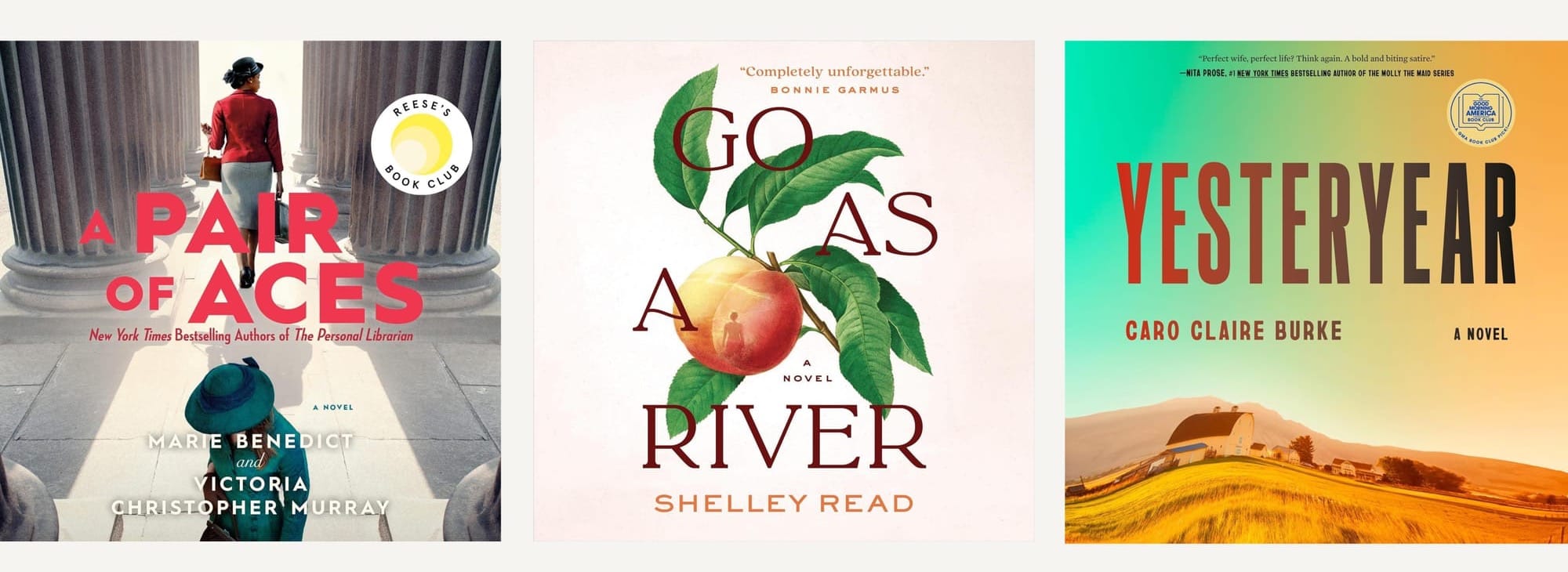
📚 Go As a River by Shelley Read: Shelley Read also blurbed The Calamity Club. Postwar Colorado, a young woman fleeing a violent family secret, big sweep, atmospheric prose. If the rugged female-survival energy of Calamity Club hit, Read's debut delivers the same.
📚 A Pair of Aces by Marie Benedict & Victoria Christopher Murray: 1930s setting, two real women, unlikely female alliance against a corrupt system. Same era as Calamity Club, same architecture of women joining forces against power. Reese's June 2026 pick. Full guide here.
📚 Yesteryear by Caro Claire Burke: This is in a different lane from Calamity Club, but worth flagging if you're a book club person: GMA's April 2026 pick is a dark, biting satire of a tradwife influencer with millions of followers who wakes up trapped in what appears to be 1855. Sharp, funny, and ruthless about social-media performance and evangelical womanhood. Full guide here.
Where to Start If You Want to Choose Just One
If you're not in the mood for all twelve and you want to pick the one book that comes closest to scratching the Calamity Club itch, here's how I'd guide you:
- For the Depression-era / community-survival energy: The Four Winds by Kristin Hannah
- For Meg's wisecracking-orphan voice: Demon Copperhead by Barbara Kingsolver
- For Birdie and Charlie's outraged-sisterhood plot: Hang the Moon by Jeannette Walls
- For Stockett's sharp humor cut with serious themes: Lessons in Chemistry by Bonnie Garmus
- For a quieter, more literary cousin: The Cliffs by J. Courtney Sullivan
All five of those are five-star comps. Start with whichever suits your mood and come back for the rest.
Frequently Asked Questions
What is The Calamity Club about?
Kathryn Stockett's second novel, published May 5, 2026 by Spiegel & Grau, set in 1933 Oxford, Mississippi during the Great Depression. It follows three women eleven-year-old orphan Meg, outspoken Birdie, and Charlie, a woman with a past whose fates converge in a plan to take back control of their lives in a place and time where women's freedom is fragile. It's been on every most-anticipated list of 2026 and was 17 years in the making after The Help.
Is The Calamity Club a sequel to The Help?
No, it's a standalone novel. Different characters, different setting (1933 vs. 1960s), different city (Oxford vs. Jackson). Stockett has said she deliberately built this one around class rather than race, having reflected on the conversations The Help prompted in the years since.
Is The Calamity Club worth reading?
Yes. It's earned NYT Editor's Choice, made every major most-anticipated list of 2026, and has the Bonnie Garmus seal of approval. It's also 640 pages, so it's a commitment set aside the weekend.
What should I read after The Calamity Club?
Start with The Four Winds by Kristin Hannah, the publisher's own comp and the closest tonal match. From there, work down the list above based on which mood you're in.
Where can I read the full Calamity Club book guide?
The Calamity Club: Summary, Characters & Ending Explained: full plot summary, character breakdown, the ending explained, and 10 book club discussion questions.
Want more book recommendations like this? Subscribe to The Weekly Bookmark every Tuesday I send the books I'd text a friend about, plus the new releases worth catching this week.
What to read while you wait for Stockett's next one
Here's the thing: if seventeen years passed between The Help and The Calamity Club, none of us are getting another Stockett novel tomorrow. The good news is the historical fiction shelf is full of writers doing similar work the kind of book that takes its time, sits with its characters, and trusts you to handle hard truth without flinching.
If you haven't read The Calamity Club itself yet, the full reader guide is here characters mapped, ending explained, and book club questions ready to print.
If you've already devoured it, bookmark this list for the next slow Sunday afternoon. And drop your favorite Stockett-adjacent read in the comments. I'm always adding to mine!