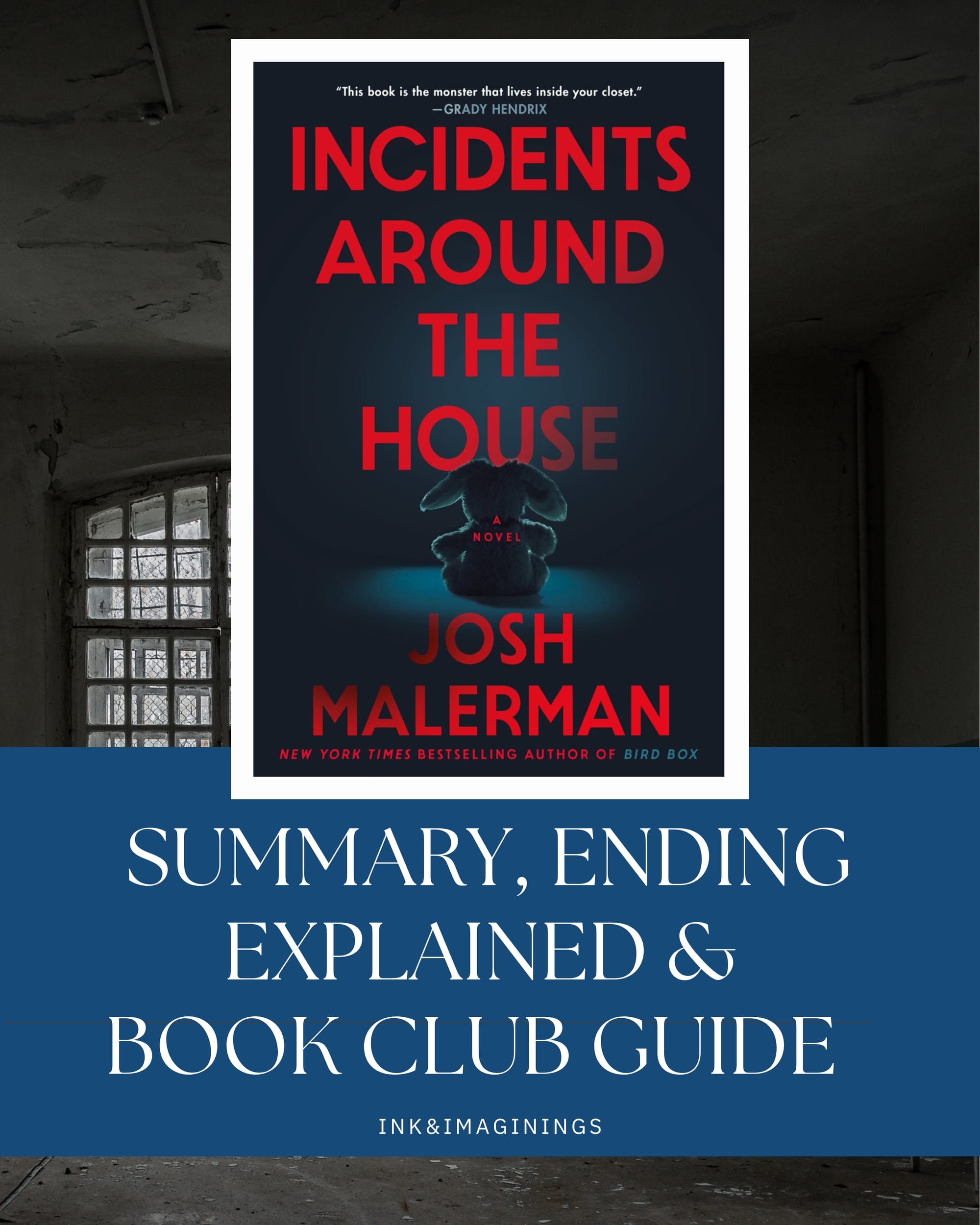
Full spoilers from here on. This page walks through the entire ending of Josh Malerman's Incidents Around the House. If you haven't finished it, my spoiler-light guide is where you want to be instead, and it has the full content notes if you'd rather know what's coming before you start.
Most people arriving from the movie don't know this yet. The film and the book don't end the same way. They end in opposite directions. If you watched Other Mommy and then went looking for an explanation, you've probably been reading about a completely different ending than the one Malerman wrote.
So this covers both. What actually happens on the last pages, what Other Mommy is, why telling Bela the family secret made everything worse, and exactly where the movie parts ways.
📚 Amazon | Bookshop | 🎧 Audible
How Incidents Around the House Ends
The last chapter moves fast, and it's worth walking through in order, because a lot of the confusion comes from how little Bela understands of what she's describing.
Bela is sitting with Grandma, working on a jigsaw puzzle of Michigan, and she's getting sleepy. Then Grandma's face changes. It isn't Grandma. It's Other Mommy wearing her.
Bela hides in the coat closet in the foyer. She hears screaming upstairs. And while she's in there, in the dark, she finds Grandma Ruth's body in the closet with her.
Then the house goes quiet.
Bela comes out and finds her parents in her bedroom, face down on the carpet, not moving. In her eight-year-old way she tells them not to worry. She says she'll keep watch so they can sleep.
And then the part that breaks people. Bela sits on her bed and cries, because she thinks she's completely alone and she wants somebody with her. Other Mommy comes. It asks the question it has asked every single night for the whole book.
Can I go inside your heart?
Bela says yes.
The last thing we get is Bela somewhere vast and empty, which the book is careful to tell us is not a house. And Other Mommy, now in Bela's body, practicing her voice.
What Other Mommy Actually Is
Malerman has been unusually direct about this in interviews, and what he says is mostly about what it isn't.
It's not a replacement mother. It's not a stand-in for an absent parent. It isn't a person, and Malerman says it isn't a woman either. He points to the moment Ursula says of it, “It's not a woman,” as the line that settles it. Bela reads it as female and names it Other Mommy because that's what an eight-year-old has words for. That naming is Bela's, not the book's.
Inside the story, the paranormal investigator Lois Anthony lands on a different idea. She doesn't think it's a ghost. She thinks it's trying to come back, to live again, and that it needs Bela's body to do it.
What the book never gives you is an origin. No backstory, no explanation of where it came from or how long it's been doing this. That's deliberate, and Malerman has said he has no interest in filling it in. He describes the whole novel as watching one entity try to get in.
The one rule it seems bound by is the important one. It has to be invited. It asks Bela every night, for years, and it never once just takes her. That's why the ending lands the way it does. Nothing overpowers Bela. She agrees.
The Family Secret, and Why Telling Bela Backfired
This is the hinge of the whole ending, and it's the part most summaries skip right past.
On the beach at Sleeping Bear Dunes, Bela's mother Ursula tells her the truth. Ursula was married to a man named Douglas Cain when she met Russ, the man Bela calls Daddo. She and Russ started seeing each other while she was still married. A paternity test settled it. Douglas Cain is Bela's biological father, and Russ chose to raise her anyway.
There's a second secret, revealed earlier, and it's uglier. Ursula was having an affair with a man named Frank Doherty. Frank turns up dead in a closet. Bela works out for herself that Other Mommy did it, as a gift, to fix her parents' marriage.
Now here's why the beach confession matters. The adults didn't blurt it out. They did it on purpose, as a weapon. Lois had a theory that what draws the entity is Bela's innocence, and that handing her a hard adult truth would spend that innocence and make her less appealing.
It doesn't work even slightly. The entity doesn't care. What the confession actually does is teach Bela that every adult in her life has been lying to her. She decides adults are liars, and she decides to start lying back.
So by the last chapter she isn't just unprotected. She's alone in a way she wasn't before, and she doesn't trust a single person who could help her. The adults did that. Then they left her in a room with the thing that had been asking for eight years.
Does Bela Die?
No. Something stranger happens to her.
Bela isn't killed. She's moved. When she says yes, her consciousness ends up in that enormous empty space, still thinking, still herself, while Other Mommy takes over her body, her name and her voice. She's alive and she's gone at the same time.
There's a reading of this that's popular with readers and I think it has something to it. Bela leaves intact. Whatever she gave up, she didn't give up her goodness, and the thing that won gets a body in a world that isn't any better than wherever it came from. It's a victory that doesn't buy it much. That's a reader's reading rather than anything Malerman has confirmed, but it's the one that makes the last page bearable.
Do Bela's Parents Die?
This is the most-searched question about this book, and the honest answer is that the novel never tells you.
What the text gives you is this. Other Mommy wears Grandma Ruth's face and uses Ruth's voice to call Russ and Ursula upstairs. There's a struggle that Bela doesn't see. Afterward she finds both of them face down on her bedroom carpet, not responding to her.
That's it. The word is never said. Bela, who is eight, decides they're sleeping.
Two readings, and I'd say they're both fair:
They're dead. It lured them up there deliberately. It had already killed Ruth and Frank. Bela's narration is unreliable here not because she lies but because she's a child looking at something she can't name, which is exactly the trick the book has been running the whole time. Most readers land here, and most coverage of the book states it flatly.
It's left open on purpose. Malerman shows you a body when he wants you to see one. He showed you Ruth's. He showed you Frank's. He doesn't show you theirs. The whole ending runs on what Bela can't process, and leaving the parents unresolved keeps you locked inside her point of view right to the last page.
I don't think the book wants you to settle it. The not-knowing is doing work.
What Happens to Grandma Ruth
Ruth is the one death the book is unambiguous about. Other Mommy kills her and then wears her face.
Her car is in the driveway when the family gets back from the lake. She gives Bela the speech that the whole title of the book is secretly about: the heart is a house with many rooms, and you have to be careful who you let into them. Then later, over the puzzle, Bela realizes the woman beside her isn't her grandmother. Ruth's body is in the coat closet.
There's a theory among readers that I find genuinely unsettling, and I'll flag it as a theory rather than a fact. What if Ruth was already dead before that speech? What if the heart-is-a-house line wasn't a grandmother's warning but the entity explaining itself to its target, out loud, and nobody caught it? The book doesn't confirm this. But it also doesn't rule it out, and once you've thought it you can't unthink it.
The Lake Michigan Scene, and the Lie That Follows It
This scene gets described wrong a lot, so let's be precise. There's no drowning in this book, and nobody has to pull Bela out of the water.
What happens is quieter and worse. The family drives about a hundred miles to Lake Michigan, because Lois thinks the entity may have a limit on how far it can follow. At the water Bela admits something she hasn't said out loud, which is that Other Mommy told her saying yes would be easy. She sees a skinny, dog-like shape crawling up the beach that never gets any closer. Around the fire that night, Other Mommy's face appears upside down in the flames.
Then Ursula tells her about Douglas Cain.
Bela runs into the waves. And standing in the water, she sees Other Mommy's legs.
She comes back and tells the adults it's gone, that it's over, that they did it. She's lying. That's the moment the book turns. A hundred miles wasn't far enough, and from here on Bela handles it alone.
Is There an Epilogue?
No. No epilogue, no prologue, no jump forward in time. The book stops on the swap, and what follows is an author's note and the acknowledgments.
Worth saying clearly, because this is where movie viewers get tangled: the Christmas-lights scene is not in the book. Neither is the post-credits moment. Those belong to the film.
How the Other Mommy Movie Changes the Ending
Rob Savage's adaptation keeps the premise and reverses the outcome. This isn't a trimmed detail or a softened edge. It's the opposite answer to the book's central question.
In the film, the family barricades themselves in the basement. Ursula confesses, and she confesses more than she does in the novel: the paternity secret, and also that she never wanted to be a mother, though she tells Bela she loves her. The confession seems to weaken the entity, and it devastates Bela, who runs upstairs and begs Other Mommy to come into her heart.
Other Mommy makes her an offer. She'll never feel pain again.
And Bela remembers what Ruth told her, that pain is part of being alive, and she says no. Over and over. The entity is beaten. Months later the family is hanging Christmas lights together, and the only shadow is a look on Ursula's face that suggests her own unhappiness is coming back. After the credits, Other Mommy shushes the audience.
Where the two versions split, character by character:
Bela. Book: says yes, loses her body, ends up in the empty space. Film: refuses, repeatedly, and wins.
Ursula and Russ. Book: found face down and unresponsive, fate unstated. Film: both survive.
Grandma Ruth. Book: killed, and the entity wears her face to reach the parents. Film: survives, and her lesson about pain is the thing that saves Bela.
Frank. Book: already dead in a closet when we get there. Film: killed on screen in front of the family.
The point of view. Book: locked inside Bela's head, first person, present tense, no quotation marks. Film: an ensemble, which loses the thing that made the novel work, because you can no longer be the only one in the room who understands what Bela is looking at.
The entity also shows up far earlier on screen and looks far more monstrous. The novel's bird-like details and its smell are gone. Jessica Chastain plays Ursula and Other Mommy both, which gives the impersonation a weight the book handles differently.
Nobody involved has publicly explained why the ending was changed. Not Savage, not James Wan, not Malerman. The film made $107.5 million against a budget under $20 million while taking a 19% critics' score and a D+ from audiences, so it's possible we'll hear the reasoning eventually.
Is It a Happy Ending?
Not remotely. The grandmother is dead, the parents are at best catatonic, and the child the entire book was built to protect hands herself over in the last three pages.
It is, though, an ambiguous ending rather than a totally closed one, and that ambiguity is why readers are so split on it. Some find it predictable and say they saw the yes coming from early on. Some find the last stretch genuinely confusing. The book sits at a 3.53 on Goodreads from roughly 142,000 ratings, and the ending is most of the reason for that spread.
My Honest Take on the Ending
I don't scare easily on the page, and this one got me.
Malerman's masterstroke is Bela's voice. By trapping you inside her sweet, matter-of-fact narration, he makes you see the danger she can't. You spend the whole book wanting to reach through the pages and pull her out of that bedroom. And then the ending is the thing you've been dreading for 384 pages, delivered in the voice of a kid who thinks she's being brave.
The formatting helps more than it should. Present tense, no quotation marks, laid out to mimic how a child takes in the world. It sounds like a gimmick and it isn't. It's what makes the book unforgettable.
Fair warning, and it's a real one. This is frightening in a particular way, because the person in danger is small and the adults are useless. It hits differently if you're a parent. The horror is psychological rather than graphic, but the dread doesn't let up and the ending offers no easy comfort.
It's the kind of ending a book club will argue about for the rest of the night. Which is, I think, the point.
More horror with family secrets at the center. If Other Mommy got under your skin, try Yesteryear by Caro Claire Burke for the same slow dread, Mad Mabel by Sally Hepworth for a family nobody in town will talk about straight, or The Ghostwriter by Julie Clark for secrets that haunt like a person. Each has a full guide here.
Frequently Asked Questions
How does Incidents Around the House end?
Other Mommy kills Grandma Ruth, wears her face, and uses her voice to lure Bela's parents upstairs. Bela finds Ruth's body in the coat closet and then finds her parents face down and unresponsive in her bedroom. Believing she's alone, she sits on her bed and cries. Other Mommy asks to go inside her heart one last time and Bela says yes. The book closes with Bela in a vast empty space while the entity, in her body, practices her voice.
Do the parents die in Incidents Around the House?
The book never says. Russ and Ursula are found face down and unresponsive after Other Mommy lures them upstairs, and Bela, who is eight, decides they're asleep. Most readers take them for dead, since the entity had already killed Ruth and Frank. But Malerman shows a body when he wants you to see one, and he doesn't show you theirs. It's left open.
Does Bela die in Incidents Around the House?
No. Bela says yes to Other Mommy and is displaced rather than killed. Her consciousness ends up in an enormous empty space the book specifies is not a house, while the entity takes over her body, her name and her voice. She survives, but she loses everything that made the survival hers.
What is Other Mommy?
The book never explains it, and Malerman says that's deliberate. He's been clear about what it isn't: not a replacement mother, not a metaphor for an absent parent, not a person, and not a woman. Bela names it Other Mommy because that's the language an eight-year-old has. Inside the story, the investigator Lois Anthony concludes it isn't a ghost but something trying to live again through Bela's body. Its one apparent limit is that it has to be invited.
Does Incidents Around the House have a happy ending?
No. Grandma Ruth is dead, both parents are unresponsive and probably dead, and Bela gives herself up to the entity. The one consolation readers point to is that Bela leaves with her goodness intact while the thing that took her inherits a world no better than the one it came from. That's a reader's reading, not something the author has confirmed.
Does the Other Mommy movie have the same ending as the book?
No, it reverses it. In the film Bela refuses Other Mommy, remembering Ruth's lesson that pain is part of being alive, and the entity is defeated. Ursula, Russ and Ruth all survive, and an epilogue months later shows the family hanging Christmas lights. In the novel Bela says yes, Ruth is dead, and her parents are found unresponsive. The Christmas-lights scene and the post-credits moment exist only in the film.
Before You Go
If you like the kind of reading that leaves a handprint on your heart, the quiet, character-driven, cry-in-the-good-way novels, come hang out in your inbox. Every week I send The Weekly Bookmark: the books I'd text a friend about, the new releases worth catching, and reader guides like this one. No spam, just the good stuff.
And if you've finished Incidents Around the House, come tell me whether you think the parents made it. I go back and forth on it, and I'd love to know where you landed.