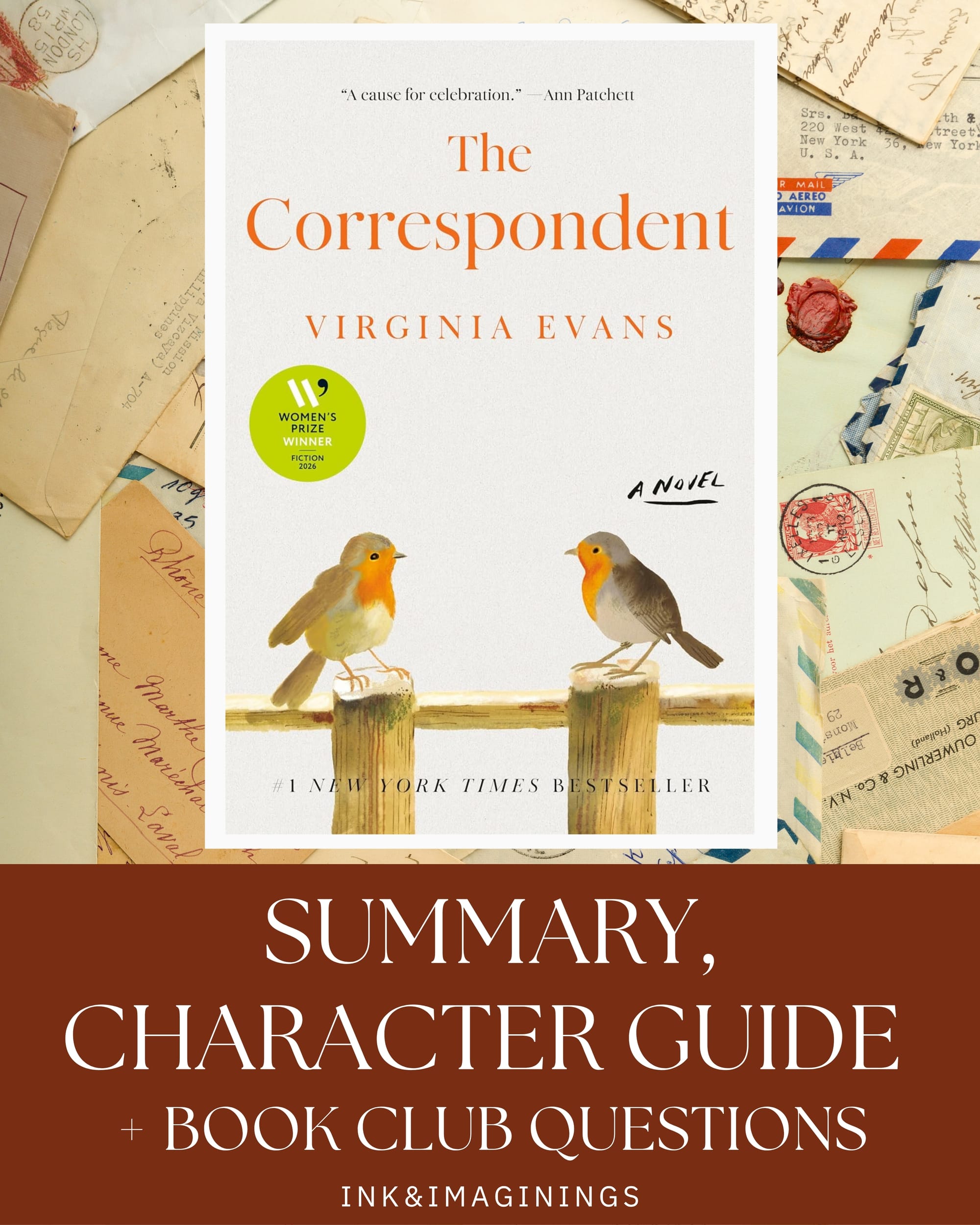
Women's Prize for Fiction winner and PEN/Hemingway Award for Debut Novel.
This book is so beautifully written. The whole story is told through correspondence which is hard to pull off but Evans nailed it. I did not want this book to end!
I listened to this on audio, and it might be the best narration I have ever heard. Sybil is a woman reflecting on her life with honesty, pain, and vulnerability, and it's just so well done.
Below: what it's about (spoiler-free), the full plot, every character worth tracking, the themes worth talking about, the ending explained. Plus twelve discussion questions, and what to read next. Full spoilers once you reach the plot summary.
Quick Facts
- Released: April 29, 2025
- Author: Virginia Evans (her debut novel)
- Publisher: Crown Publishing Group
- Genre: Literary fiction, epistolary novel, book club fiction
- Awards: 2026 Women's Prize for Fiction, PEN/Hemingway Award for Debut Novel, New York Times bestseller
- Format: Told entirely in letters, emails, and postcards
- Audiobook: a standout listen (this was my format, and the narration floored me)
- Content notes: the death of a child, a teen suicide attempt, terminal illness, and grief
- Book Club Verdict: quiet, profound, and devastating in the best way. A slow burn that pays off completely.

The Correspondent by Virginia Evans Book Cover
Where to buy it: 📚 Amazon | Bookshop | 🎧 Audible
What The Correspondent is about (spoiler-free)
Sybil Van Antwerp is seventy-three, twice wounded by life (the death of a young son and a divorce), and she runs her entire existence out of a drawer of English letter paper. She's the retired chief clerk for a distinguished judge, a mother and grandmother. Fiercely devoted to order, rules, and the clean certainty of the law.
Every week she carries her milky tea to her desk overlooking her garden and the river and tends her correspondence: letters to authors, to family, to a lonely boy named Harry. The letters are not her hobby. They are how she stays connected to the world.
Then her eyesight starts to go. For a woman whose whole self is built on reading and writing, the threat of blindness is an existential clock, and it sets everything in motion: an anonymous letter-writer with a decades-old grudge, two very different men courting her by post, a mail-order DNA test she resisted for years, and a confession she has been carrying, and refusing to send, for forty years.
Told entirely through Sybil's letters, emails, and postcards, The Correspondent is a quiet epic about grief, forgiveness, and late-life reinvention. It's a slow build, on purpose, and by the end it earns every tear.
If you love a character study that sneaks up on you this one is for you.
Full Plot Summary (Full Spoilers)
⚠️ Major spoilers ahead. If you haven't finished the book, skip down to the Characters or Discussion Questions.
The crash and the clock
Driving home alone from a library talk in June 2012, Sybil loses her vision for a stretch she can't account for and drives her Cadillac into a low concrete wall. To her brother Felix and her neighbor, she calls it a minor inconvenience. To the son she addresses in pages she never mails, she admits the terror: the degenerative blindness her doctor warned about has begun, and she may have one year of sight or ten. She tells almost no one.
The judge dies and DM appears
That summer Guy Donnelly, the judge Sybil clerked beside for nearly thirty years, dies. A Baltimore Sun columnist resurrects her name, wondering what became of his brilliant collaborator and hinting their partnership might have been romantic. Sybil writes back, off the record, to correct it: they were intellectual equals, never lovers. Days later a far uglier envelope arrives, signed only with the initials DM. The writer calls her a cold metal creature, says her version of justice flattened lives like a tank, and wishes her the worst. She recognizes the type from her courthouse years and tries to dismiss it.
Two suitors by post
At Donnelly's memorial in February 2013, his widow asks Sybil to give the eulogy, and she conquers an old terror to speak about why the law gave her order in a senseless world. A retired Texas attorney named Mick Watts, who once opposed her in court, is so taken that he starts writing to demand she have dinner with him. She refuses; he persists with flowers and loud, funny charm. All the while her courtly German neighbor, Theodore Lubeck, leaves white roses on her porch every birthday and asks for nothing. Meanwhile DM drives to Frederick, spits on the judge's grave, and promises Sybil's is next.
The boy who walks to her door
Sybil has traded monthly letters with Harry Landy, the math-prodigy son of a judge friend, since he was a small bullied boy. In October 2014 the teenager packs a bag, takes his golden retriever, and walks through the night from Washington to her Maryland door. She feeds him chili, hides her phone so he won't bolt, and quietly loves having him there. Around the same time she accidentally runs over Theodore's cat, and the big gentle man kneels in the road and forgives her so completely it disarms her. Two strays, the lonely boy and the widower next door, start slipping past her carefully constructed defenses.
The DNA test she didn't want
Two Christmases earlier, her dependable son Bruce gave her a Kindred DNA kit, a gift she found humiliating, as if her unknown origins were a defect to be solved while her children watched. Adopted at fourteen months, Sybil had always pressed on the mystery of her birth mother like a private bruise. After months of suspicion that it's all a scam, she finally mails her saliva in late 2014, and along the way befriends Basam Mansour, a Syrian refugee and engineer reduced to answering Kindred's support emails. She insists the box that lets other users contact her stay firmly unchecked.
Daan's letter and the accidental click
In May 2015 a letter arrives from Daan, her Belgian ex-husband, dying of cancer. He begs her forgiveness for blaming her in the dark days after their son's death, insists the accident was no one's fault, and tells her he keeps her secrets and loves her still. Shaken, she opens a rare bottle of rum and, fumbling on the Kindred website, accidentally checks the box she swore never to touch. Months later Daan dies. She can't compose a reply in time, and at the last moment she does not board the plane to Belgium. Fiona, who sat at her father's bedside, erupts: her mother, who writes endless letters to strangers, couldn't manage to attend the funeral of her children's father.
A sister in Scotland
The checked box bears strange fruit: Kindred flags a forty-nine percent DNA match, a number that can only mean a sibling. After dead ends, and with Basam quietly slipping her an address, Sybil writes to Henrietta Gleason, a botanist in Fort William, Scotland. Hattie, stunned, consults her brothers and a geneticist before she accepts it. Their mother, Louisa, bore a daughter before fleeing America for Scotland; her father was a drifter killed in a cattle stampede. Sybil, who always had a settled story, struggles to make room for a whole second family.
Harry's crisis and the beheaded garden
In summer 2016 Sybil learns Harry has tried to take his own life with pills, saved only because a maid found him. With his mother institutionalized and his father overwhelmed, the boy comes to convalesce at Sybil's house for nearly a year. Gaunt and silent at first, he slowly revives under her blunt, undemanding care, teaching her card games while she keeps him fed and asks him plainly, every other day, whether he intends to live. Then one April morning, someone shears every bloom from her garden, beheaded stems scattered across the soil.
The stalker has a name
The destroyed flowers force the truth open. Using Harry's internet skills, Sybil traces her tormentor to Dezi Martinelli, son of Enzo Martinelli, a bread-truck driver she and Donnelly sentenced harshly in the early 1980s. In a confession decades overdue, she tells Dezi what she has hidden from everyone: her own son had died only weeks before that case, and grief had hardened her into something cruel. When Dezi's mother knelt begging mercy, Sybil, who held the judge's ear, said nothing, secretly unwilling to let another mother keep her sons when she had lost one of hers. She later wrote Enzo in prison and found him gentle and forgiving. Now she learns he has been dead for decades.
The Correspondent ending explained
The truth about Gilbert. From Scotland, half-blind and steadied by distance, Sybil finally writes Theodore the thing she has never told a living soul. Gilbert did not simply drown on that Canadian lake in 1973. Distracted by legal work she had smuggled into a family holiday, she waved off her eight-year-old's pleas to swim, and when he called for her to watch his dive, she told him without looking up to just go, to jump, using the "Colt" nickname she adored. He climbed a forbidden boulder, hit a hidden rock shelf, and broke his neck. She never told Daan. The guilt had screamed inside her for four decades. Setting it on paper at last, she is astonished to feel the noise finally go quiet. Confession, not absolution, is what releases her, and she does it in the only medium she trusts.
The reckonings and reconciliations. Softening as her sight fails, Sybil repairs what her stubbornness broke. She makes peace with the dean who barred her from auditing classes, absorbs her friend Rosalie's hard truth that she taught her own daughter not to need her, and writes Fiona a blistering, tender confession of her fears and failures. She declines Mick's Texas proposal and chooses the quiet man next door. Her exchange with Dezi turns from vengeance into a strange, halting mutual forgiveness, two people undone by grief and the law.
Crossing the ocean, and the desk. At seventy-nine, the woman who refused to travel for decades flies to London, walks the Yorkshire moors with Fiona, and reaches Hattie's loch, where four half-siblings welcome her as if she'd always belonged. She weeps in a Paris chapel with Theodore beside her, and asks him to stop being merely the neighbor and move in. Theodore transcribes her final letters as her handwriting gives out.
In November 2021, on what would have been Gilbert's fifty-seventh birthday, Sybil dies of a sudden embolism at her writing desk, her tea gone cold, her head resting as though she had only paused before starting a letter. Theodore writes the news to Hattie. Fiona sends Dezi Martinelli a check from her father's money, with her mother's instruction to help his struggling son. And tucked inside a copy of Rebecca, Theodore finds the unfinished, unsent letter to Daan, its margins crowded with crossed-out attempts to confess what really happened to Gilbert. He mails it to Fiona.
Characters
Sybil Van Antwerp. Our narrator: seventy-three at the start, adopted as an infant, twice bereaved, a retired chief clerk who runs her whole life on handwritten letters. Brilliant, acerbic, and rigidly devoted to order and the black-and-white comfort of the law, she uses ink as both a bridge and a shield, keeping even her most intimate relationships at arm's length on paper. Under the imperious wit is a woman convinced she failed as daughter, wife, and mother. Her oncoming blindness threatens the one practice holding her together and forces a late-life reckoning with grief and forgiveness.
Theodore Lubeck. Sybil's tall, gentle German neighbor, a widower who leaves roses on her porch every birthday and asks for nothing. A meticulous gardener and devoted reader who escaped Nazi Germany as a boy and lost his father and brother. His patience is bottomless and his attention total. He listens where everyone else lectures, and over years of small kindnesses he becomes the warmth Sybil keeps almost failing to notice.
Gilbert ("Colt"). Sybil's middle child, who died at eight, nicknamed for his swiftness and their shared love of horse racing. Kind, fearless, quick to forgive. He lives on as the silent addressee of the unsent pages threaded through the book, the absence that shapes his mother's every guarded choice.
Fiona. Sybil's only daughter, a successful London architect who sees her mother once a year and feels chronically held at arm's length. Privately battling infertility and fiercely grieving her father, she carries a lifetime of resentment toward a mother she feels taught her not to need her. Their clashes drive the novel's most painful and necessary reckoning.
Daan. Sybil's gentle, scholarly Belgian ex-husband, who raised their surviving children while she retreated into work and grief. Inclined toward surrender and faith rather than control, he is in many ways her opposite. Dying of cancer, he reaches across thirty years of silence with a letter of forgiveness that reopens everything she sealed away.
Harry Landy. The mathematically gifted, socially isolated son of a judge friend, who has traded monthly letters with Sybil since boyhood. Bullied, anxious, truthful, and quietly brilliant, he is Sybil's mirror across generations and the surrogate child who lets her practice the closeness she fears. His crisis, and his slow recovery under her roof, is the novel's most hopeful thread.
Rosalie. Sybil's friend of sixty years and her former sister-in-law, exhausted by caring for an ailing husband and a son lost to dementia. Patient, devoted, and unafraid to tell Sybil the truth. Her decades of letters form the parallel record of Sybil's life, and her blunt loyalty becomes the conscience that pushes Sybil toward repair.
Felix Stone. Sybil's younger adopted brother, a writer living in France with his partner Stewart. Once a boy so traumatized by their mother's death that he went mute for years, he grew into the warm, funny, openly gay confidant Sybil trusts most, gently pushing her toward courage and travel.
Mick Watts. A retired Houston attorney who once opposed Sybil in court and reappears determined to win her. Loud, funny, hard-drinking, and relentless, he revives the sparring version of herself she misses from her working years, which makes turning down his proposal its own quiet act of self-knowledge.
Hattie Gleason. A botanist near Fort William, Scotland, revealed by DNA to be Sybil's half-sister. Quiet, careful, and kind, she offers Sybil not tidy answers about their shared mother but the unexpected gift of belonging, and a Highland home that feels, improbably, like a return.
Dezi Martinelli. The "DM" of the threatening letters, son of a man Sybil and Judge Donnelly sentenced harshly. A sandwich-shop owner shaped by his family's ruin, he carries decades of hatred for the cold clerk he remembers. He is not a monster but a wounded child grown old, and his reckoning with Sybil is the book's ethical climax.
Basam Mansour. A Syrian engineer who fled his destroyed homeland and works answering Kindred's support emails far below his qualifications. Dignified and devoted to protecting his children, he becomes Sybil's unlikely confidant, and their friendship across a customer-service portal is one of the novel's most quietly moving connections.
Themes Worth Discussing
Grief as the scream you carry. Sybil describes the biggest grief as a scream living inside her, softer over time but never gone. Gilbert's death is the gravitational center of the whole book: her workaholism, her divorce, her emotional withdrawal, and her cruelty in the Martinelli case all orbit that single unbearable moment. Your group will want to talk about how grief shaped every choice she made.
Letters as both bridge and shield. Sybil pours into ink the intimacy she withholds in person. The book's central irony is that its most articulate woman goes mute in front of the people who matter most. Is her correspondence a way of reaching people, or a way of keeping them at a safe distance? The answer is both, and that's the ache.
Justice versus mercy. Sybil built her comfort on the clean, black-and-white certainty of the law. Dezi insists human lives can't be reduced to right and wrong, and the novel sides with him. The reckoning over the Martinelli case asks whether order and mercy can ever be the same thing.
Origins and belonging. Adopted, then a mother, then suddenly a sister, Sybil spends the book circling the question of where a person actually comes from. Set against Basam's refugee story and Theodore's Holocaust history, her private ache is placed inside a much larger human ledger of loss and displacement.
It's never too late. The novel is a study in late-life plasticity: it insists you can still soften, still travel, still be found by family, still love the patient man next door at seventy-nine. That hope, arriving so late and so hard-won, is the whole point.
Book Club Discussion Questions
These are the ones that will get your group talking, ordered from warm-up to heated.
- The whole novel is told in letters, emails, and postcards. How did the epistolary form change your experience of the story? Did you trust Sybil as a narrator?
- Sybil says the letters are who she is, not her thirty years practicing law. What do you make of a person who lives most fully on the page?
- Two men court Sybil: brash, funny Mick and quiet, patient Theodore. Were you rooting for the choice she made?
- Harry walks through the night to Sybil's door. Why do you think she can mother him so well when she believes she failed her own children?
- Sybil resists the DNA kit for years and calls it humiliating. Why is finding her origins so threatening to the self she built?
- She can't reply to Daan's dying letter and doesn't board the plane to his funeral. Was that cowardice, grief, self-protection, or all three?
- The anonymous DM letters turn out to come from a wounded man, not a monster. Did the reveal change how you saw Sybil's career and her certainty about the law?
- Sybil admits she stayed silent while Dezi's mother begged for mercy because she couldn't bear to watch another mother keep her sons. How did you sit with that confession?
- The truth about Gilbert's death is withheld until nearly the end. Did the slow reveal work for you, and did it change your understanding of everything before it?
- Sybil finds relief in confession itself, not in being forgiven. What does the book seem to believe about honesty and release?
- Theodore ends up transcribing Sybil's letters as she goes blind. What did that image say to you about love and about what outlasts us?
- The novel ends with Sybil's unsent letter finally being mailed after her death. Was that the right ending? What would you have wanted her to say while she was alive?
My Honest Take
This book was so different and so beautifully written, and the entire story is told through correspondence. I did not want it to end. The character building is slow, but so perfect. I listened on audio, and it has to be the best narration I have ever heard.
Sybil is a woman reflecting on her life with honesty, pain, and vulnerability. The book is profound, and it wrecked me in the best way. I genuinely hope it becomes part of a series so I can stay in her world a little longer.
One more thing for the book lovers: the new editions they just released are truly stunning. There's a bookmark ribbon (I am such a sucker for a bookmark ribbon) and deckled edges. If you want the shelf-worthy copy, it's worth seeking out.
Pick this for your book club when your group is ready to sit with something quiet and go deep. Bring tissues.
If You Liked The Correspondent, Read These Next
📚 84, Charing Cross Road by Helene Hanff: the beloved classic, a decades-long friendship built entirely through letters between a New York writer and a London bookseller. If the form is what got you, start here.
📚 Olive Kitteridge by Elizabeth Strout: a prickly, unforgettable older woman rendered with the same quiet devastation. For the reader who loved Sybil's sharp edges and hidden tenderness.
📚 The Guernsey Literary and Potato Peel Pie Society by Mary Ann Shaffer and Annie Barrows: another novel told in letters, warmer and lighter, about a community bound together by books.
📚 Tom Lake by Ann Patchett: a reflective, late-life reckoning with the choices that made a life, told with grace and a full heart.
📚 A Man Called Ove by Fredrik Backman: a curmudgeon softened by the neighbors who refuse to leave him alone. For the Sybil-and-Theodore soft spot the ending leaves you with.
Already read one of these? Come back and check out the full guides:
Whistler | Theo of Golden | A Man Called Ove
📚 Looking for your next book club pick? Book of the Month sends you a new book every month for the price of a coffee. Try your first month for $5 →
Want more book club picks like this in your inbox every Tuesday? Subscribe to The Weekly Bookmark, the books I'd text a friend about, plus the new releases worth catching this week.
Frequently Asked Questions
What is The Correspondent about?
It's Virginia Evans's debut, a novel told entirely in letters, about Sybil Van Antwerp, a sharp-witted retired legal clerk whose life is built around the art of letter writing. As her eyesight starts to fail, Sybil is forced to confront her past, including a long-buried secret about her son's death, an anonymous letter-writer with a grudge, a newly discovered sister, and the complicated people she has kept at arm's length for decades.
Is The Correspondent told entirely in letters?
Yes. The whole novel unfolds through Sybil's letters, emails, and postcards, with no conventional narration. Because you only see what she chooses to write, and the "unsent" pages she never mails, she becomes a subtly unreliable narrator whose omissions say as much as her confessions.
What is the secret about Sybil's son?
Her eight-year-old son Gilbert did not simply drown. Distracted by work she brought on a family holiday, Sybil told him without looking up to go ahead and dive. He climbed a forbidden rock, hit a hidden ledge, and broke his neck. She hid the truth for forty years, and finally confessing it, in writing, is what quiets the grief she has carried since.
How does The Correspondent end?
Sybil reconciles with her daughter, her sister in Scotland, and even the man who sent her threatening letters, and she chooses her patient neighbor Theodore. She finally travels the world she long avoided. In November 2021 she dies of an embolism at her writing desk. Afterward, Theodore finds her unsent letter confessing the truth about Gilbert and mails it to her daughter, answering the questions Sybil never found the words to ask aloud.
Is The Correspondent part of a series?
No. It's a standalone debut novel.
Did The Correspondent win any awards?
Yes. It won the 2026 Women's Prize for Fiction and the PEN/Hemingway Award for Debut Novel, and it was a New York Times bestseller.
Who is the author of The Correspondent?
Virginia Evans, an American writer. The Correspondent is her debut novel.