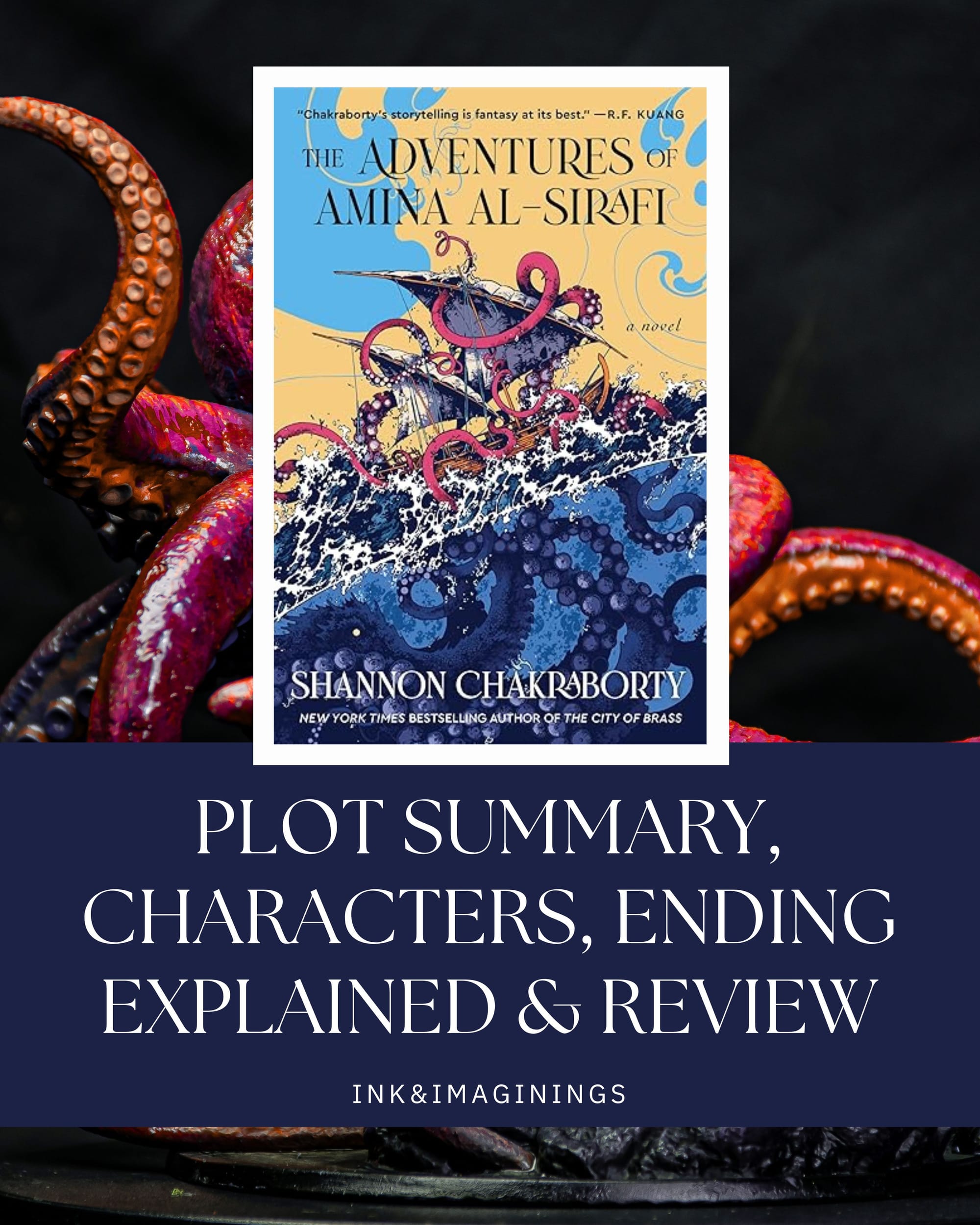
The Adventures of Amina al-Sirafi is the rare fantasy novel that takes a retired forty-something mother and treats her like the most interesting person in the room. Because she is.
Shannon Chakraborty (author of the beloved Daevabad trilogy) gave us a middle-aged ex-pirate, a demon ex-husband she will not be discussing, a quest for a magical washbasin across the medieval Indian Ocean, and somehow turned all of it into one of the most fun, emotionally satisfying fantasy novels of the last few years.
If you read it when it came out and need a refresher before The Tapestry of Fate drops on May 12, 2026 or you want the full spoiler walkthrough because the ending left you with questions this guide has everything. The full plot. Every character. The Moon of Saba explained. The ending broken down. And what to expect from the sequel.
This is one of the books worth talking about on May 12. If you want the full picture of the week, my May 12 new releases roundup covers everything else dropping that day, including the Silver Elite sequel, the All Hail Chaos sequel, and an amazing line up of beach-reads.
Full spoilers for The Adventures of Amina al-Sirafi by Shannon Chakraborty. If you haven't read it yet, this will ruin every reveal. You've been warned.
Some links on our site are affiliate links; we may earn a commission at no extra cost to you if you make a purchase. Thank you for supporting Ink&Imaginings.
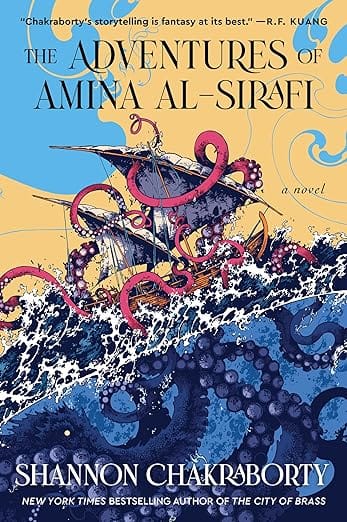
The Adventures of Amina al-Sirafi Book Cover
📖 Buy on Amazon | Buy on Bookshop.org | 🎧 Listen on Audible
The World of The Adventures of Amina al-Sirafi
Before the recap, a quick re-orientation because this book's setting is one of its biggest strengths and one of the things I loved about it.
The Adventures of Amina al-Sirafi is set in a medieval Indian Ocean world of the 12th century, spanning the coasts of East Africa, the Arabian Peninsula, India, and the islands between. This is not your typical Western-medieval-castle fantasy.
This is a world of trade winds, dhow sailing vessels, and monsoons, Arabic poetry and Swahili port cities. It is brimming with the references to the rich culture of the Indian Ocean trade networks. Chakraborty draws from real history and real geography, layered with the myths and traditions of the region.
The result is a fantasy that feels grounded, specific, and alive in a way that generic fantasy world-building rarely manages. If you came to this book through Daevabad and were nervous about leaving Daevastana behind, don't be. Chakraborty's research and atmospheric writing translate seamlessly to the open sea.
The Adventures of Amina al-Sirafi Plot Summary
Amina's Retirement (And Her Refusal to Stay Retired)
Amina al-Sirafi is a retired pirate living quietly on the Arabian coast with her elderly mother and her young daughter Marjana. She is, by her own description, finished. Done with the sea, done with the criminal life, done with the impossible choices her old career demanded. She has tried to leave it all behind for the sake of being present for her daughter.
It does not work.
Adventure keeps finding her. The book opens with two young men hiring her for what should be a simple midnight excursion, and supernatural forces intervene during what was supposed to be a routine treasure hunt. The encounter is a warning shot. Amina's past does not stay buried. She knows it. The reader knows it. And the moment Amina returns home, the real plot shows up at her door.
Salima's Offer
Salima al-Hilli, a wealthy grandmother with old ties to Amina's former crewman Asif, seeks her out with a proposition: rescue her kidnapped granddaughter Dunya. Dunya, a brilliant young scholar, has fallen into the hands of a dangerous Frankish mercenary named Falco Palamenestra. Salima offers a million dinars upfront, with the promise of additional treasure on completion.
Amina is reluctant. She is also, painfully, the only person Salima can hire who has any real chance of pulling this off. The financial offer is enormous. The personal stakes are real. Asif was crew, and Amina's loyalty to her crew is the one principle she has never compromised.
She takes the mission.
The Crew Reassembles
Amina's plan to gather information in Aden goes wrong almost immediately. Her ship is seized. Her crew imprisoned. The mission ends before it begins. Until Dalila, an old friend and one of the most accomplished poisoners and alchemists in the Indian Ocean, helps Amina orchestrate a daring prison break.
The crew is back together, and Chakraborty wastes no time reminding the reader why these people work as a unit. Tinbu, Amina's steadfast first mate and most loyal sailor. Majed, her trusted navigator and the moral compass of the ship. Dalila, who is calmly terrifying. They are middle-aged, scarred, slightly tired, and ferociously good at what they do. Found family fantasy at its best.
Falco's Dark Magic
The quest for Dunya leads Amina to a darker truth than she expected. Layth, one of Falco's former agents, reveals that Dunya did not simply fall into Falco's clutches. She willingly joined him, offering up the legendary Moon of Saba as a bargaining chip in exchange for safe passage out of an arranged marriage.
Before Layth can say more, he dies grotesquely. Not a natural death, not even a violent one in the ordinary sense. His body shows the signature of Falco's magic. Falco is not just a mercenary. He has harnessed supernatural forces, transformed his men into something less than human, and bound creatures to his will. The mission has shifted from a kidnap-rescue into a confrontation with a sorcerer who is genuinely dangerous to the world, not just to Dunya.
Raksh Returns
And then, because Amina's life will not stop happening to her, her past returns in the form of Raksh, the demon she once married during what she will only describe as "a regrettable period."
Raksh's reappearance is one of the most charged emotional beats in the book. Their history is messy, intimate, and unresolved. He is manipulative, self-serving, and bound to Amina in ways neither of them fully understand. He is also the one ally she has who actually understands the supernatural rules of the game Falco is playing. Raksh demands her help to break a mysterious bond, and despite her better judgment Amina agrees to work with him.
Their dynamic carries the second half of the book. He is not a love interest in the conventional sense. He is something more complicated: an ex who knows where every body is buried, a fellow predator, and possibly the only being on the Indian Ocean who genuinely wants Amina to survive this.
Dunya's Escape and the Horror of Socotra
Dunya escapes Falco mid-quest, setting off a chain of events that lead Amina and her crew to the island of Socotra. What they find there is the worst of what Falco has been doing.
The island is a horror landscape. Falco's men have been transformed by his magic into things that are not entirely men anymore. Villages have been emptied. The aftermath of his cruelty is everywhere. And it is here, in the wreckage, that Amina learns the true nature of what Dunya has been bargaining with.
The Moon of Saba is not treasure in the conventional sense. It is a mystical washbasin, an ancient artifact with the power to grant Sight and to control the lunar spirit al-Dabaran. Its true danger is not in being stolen but in being used by someone who understands it. Falco understands it. He has been pursuing it not for wealth but for the power to bind the supernatural world to his will.
The Marid and the Peris
Amina and her crew are pursued at sea by a marid, a monstrous water spirit Falco has bound and weaponized. In the chase, Amina is pushed to a moral edge: Falco offers to call off the marid in exchange for Dunya. Amina refuses. She will not trade Dunya's life for her crew's safety, even when her crew would understand.
In a desperate gambit, Amina and Raksh seek the aid of the peris, magical beings who guard the balance between the mortal and supernatural realms. Most peris want nothing to do with mortal affairs. But one, Khayzur, defies his people to help.
The deal is brutal: Amina agrees to retrieve magical artifacts on the peris' behalf in exchange for their assistance. It is the deal that sets up the entire premise of The Tapestry of Fate.
Dunya's Choice
Before the climax, Dunya finally tells Amina the truth about why she ran. She does not want to be returned to her grandmother. She does not want the marriage that was waiting for her. She wants to live a life true to herself. One of scholarship, freedom, and her own choosing.
Amina is faced with a dilemma she did not sign up for: her contract is to deliver Dunya home. Her conscience is screaming that home is not what Dunya needs. The mother in her, the woman who walked away from her own old life to protect her own daughter, knows exactly what she has to do. The pirate in her knows it will cost her the second half of Salima's payment.
She chooses Dunya.
The Adventures of Amina al-Sirafi Ending Explained
The climax takes place in a hidden cave where Falco attempts to complete the ritual that will let him harness the Moon of Saba and bind al-Dabaran to his will permanently. He has Dunya. He has the artifact. He has every advantage.
He does not, however, have Dunya's loyalty. And he does not have her knowledge of ancient text.
In the moment of the incantation, Dunya reverses Falco's spell turning the magic he summoned back on him. Al-Dabaran, the lunar spirit Falco was trying to control, instead takes possession of him. The cave collapses. Amina and Dunya escape. Falco is left to his fate, consumed by the very power he tried to enslave.
Here is what the ending is doing, five threads to track before the sequel:
1. The Moon of Saba is destroyed. The artifact at the center of the entire book is gone, broken in the ritual's reversal. The mystical washbasin and its connection to al-Dabaran are over. But the world it revealed, the deeper magical reality Amina spent her career pretending wasn't there, cannot be unseen. Amina is now a person who knows.
2. Dunya forges her own path. She does not return to Salima. She does not return to the marriage. She chooses scholarship, autonomy, and the open road of her own life. This is the emotional resolution of the book, and it is the moment that earns Amina's choice. Dunya's escape from her grandmother's plans mirrors Amina's own escape from her old life and it lets the book make its real argument: the women in this story get to choose for themselves.
3. Raksh's bond with Amina is unresolved. They part on uncertain terms. The bond he wanted broken is still there. The history between them is still combustible. Whatever he is to her, the sequel will make it definitional.
4. Khayzur defies his people and there will be consequences. The peri who helped Amina has put himself crosswise with his own kind by intervening in mortal affairs. The peris are not a faction you cross casually. Khayzur's choice will carry weight in The Tapestry of Fate.
5. Amina has signed up for more. Her deal with the peris is not a one-time arrangement. She has agreed to retrieve magical artifacts on their behalf going forward. She is now, effectively, a magical artifact hunter. Which is the entire premise of the sequel.
Does The Adventures of Amina al-Sirafi have a happy ending? Yes, but it is a layered, adult kind of happy. Amina returns home to Marjana. Dunya is free. Falco is defeated. The crew survives. But Amina has been changed by what she saw on Socotra and what she now knows about the magical world. She cannot go back to being retired. And her bargain with the peris means the sea is calling her again whether she wants it to or not.
The ending is satisfying as a standalone, and absolutely a setup for what comes next.
The Adventures of Amina al-Sirafi Characters
Amina al-Sirafi: A retired pirate in her forties, mother to Marjana, captain of the legendary ship Marawati. Resilient, sharp-tongued, and exhausted in the way that only people who have lived three lives already can be. She is not the chosen one. She is not young. She is the most competent person in any room she walks into, and she is doing all of this on roughly four hours of sleep and one strong cup of coffee. A mother first, a pirate always.
Dunya al-Hilli: Salima's granddaughter and the heart of the rescue mission. A clever, independent young scholar with deep knowledge of ancient languages and magical texts. She is the one who reverses Falco's spell at the climax, and she is the one whose choice to forge her own path rather than return to the family that hired Amina gives the book its emotional center.
Falco Palamenestra: A Frankish mercenary turned sorcerer. The book's antagonist. Ambitious, cruel, and fatally arrogant. His underestimation of Amina and Dunya is what dooms him. He is also a sharp commentary on the violent expansion of European powers into the Indian Ocean world during this period — the threat that comes from the West, with its hunger for power and its contempt for the cultures it preys on.
Raksh: A demon and Amina's ex-husband. Manipulative, charming, self-serving, and bound to Amina in ways neither of them fully understand. He is not a love interest in the conventional sense. He is an unfinished sentence. Their dynamic is fraught, charged, emotionally honest in moments and combative in others. It is one of the book's most compelling threads, and it heads into the sequel completely unresolved.
Dalila: A skilled poisoner and alchemist, one of Amina's oldest friends and most lethal allies. Quietly terrifying. She is the kind of woman you want at your back in a fight and at your dinner table afterward, where she will explain in calm detail exactly what she put in the wine.
Tinbu: Amina's loyal first mate. Steadfast, resourceful, devoted to the crew and to Amina specifically. He is the book's emotional anchor for the found-family thread the person who would never leave, never betray, never ask for anything in return.
Majed: Amina's trusted navigator and voice of reason. Knows the sea, the stars, and Amina herself well enough to call her on her worst impulses. He grounds the crew when Amina's instincts run wild.
Khayzur: A peri who defies his people to help Amina. His decision is rooted in a belief in justice and the preservation of life. He will pay for it, and that bill is still coming due.
Salima al-Hilli: Dunya's wealthy grandmother and the woman who hires Amina. Desperate, determined, and willing to use ruthless tactics to get her granddaughter back. Her love for Dunya is genuine even when her methods are wrong. Her offstage choices are a quiet thread of grief running under the whole book.
Marjana: Amina's young daughter. The reason Amina retired. The reason every choice in the book carries real weight. Largely offstage, but the gravitational center of Amina's life.
The Moon of Saba Explained
The Moon of Saba is one of the most important symbols in the book.
What it is: A mystical washbasin from an ancient kingdom, ornate and unassuming in appearance. Most people who hear of it assume it is treasure in the conventional sense like gold, jewels, a relic worth selling. It is not.
What it does: The Moon of Saba grants Sight, the ability to perceive supernatural beings and the deeper magical reality of the world, and it serves as the binding artifact for al-Dabaran, an ancient lunar spirit. In the wrong hands, it does not just reveal the supernatural world. It hands the user control over a being old enough and powerful enough to reshape it.
Why Falco wanted it: Power. Falco's whole arc is about ambition exceeding wisdom. He believed he could control al-Dabaran. He could not.
What happens to it: The Moon of Saba is destroyed at the climax when Dunya reverses Falco's incantation. The artifact is gone. Al-Dabaran is no longer bound. The magical world it revealed, however, remains and Amina cannot un-know what she has seen.
Why it matters for the sequel: The Moon was Amina's introduction to the deeper magical reality of the Indian Ocean world. The Tapestry of Fate is, by all indications, a book about her now operating inside that reality on behalf of the peris. The Moon is gone, but the door it opened is not closed.
What Worked and What Didn't
- Amina herself. A middle-aged mother as a fantasy lead is rare and beautifully handled. She is tired. She is competent. She is not pretending to be twenty. Her body is forty-something years old and the book respects that.
- The setting. The medieval Indian Ocean world is a stunning departure from typical fantasy geography, and Chakraborty's research and atmospheric writing make it feel utterly lived-in.
- Found family. The crew dynamic between Tinbu, Majed, Dalila is one of my favorite parts of the book.
- Raksh. The most unhinged and most interesting demon ex-husband in modern fantasy. Their dynamic is the kind of complicated that feels real.
- Dunya's arc. Her choice to forge her own path is earned, not telegraphed.
What didn't quite work:
- The middle drags slightly between Aden and Socotra. The setup is heavy and the payoff takes its time arriving.
- Some readers (myself included) wanted more time inside Amina's history. The missing years, the things she did, the people she lost.
- The Moon of Saba's mechanics are explained in pieces, sometimes confusingly. If you finished the book unsure exactly how the artifact worked, you are not alone.
None of these are dealbreakers. This is one of the best fantasy debuts of the last few years for adults, and it's one of the rare fantasy novels I press into the hands of friends who say they are "over fantasy."
What's Next: The Tapestry of Fate (May 12, 2026)
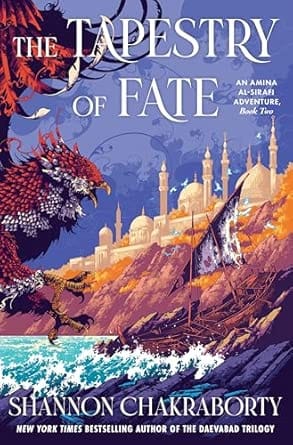
The Tapestry of Fate by Shannon Chakraborty releases May 12, 2026 the second book in the Amina al-Sirafi series.
The sequel follows Amina on her quest to track down magical artifacts on behalf of the peris (the deal she struck at the end of book one), bringing her to the island lair of a sorceress whose woven enchantments are impossible to flee. Raksh remains in the picture. The crew is presumed reassembled. The middle-aged-pirate-running-around-the-Indian-Ocean energy continues.
Tapestry of Fate by Shannon Chakraborty Book Cover
📖 Pre-order on Amazon | Bookshop.org | 🎧 Audible
What to Read While You Wait
If you enjoyed The Adventures of Amina al-Sirafi these will fill the gap until the sequel:
📚 This Week's New Releases 14 more books out this week, including The Calamity Club and Death's Daughter.
📚 Dire Bound Complete Guide Need to revisit book 1? Full plot summary, every character, and the ending that started it all.
📚Silver Elite by Dani Francis: Complete Guide Hidden heir, brutal training program, captor-protector commander. Same DNA, sharper twists. Sequel out May 12.
Final Thoughts
The Adventures of Amina al-Sirafi is the kind of fantasy novel that reminds you why the genre exists. It is funny, fierce, emotionally honest, gorgeously researched, and built around a protagonist who refuses to be young, simple, or anything other than fully herself. It treats motherhood and adventure as compatible. It treats trauma as a fact of life, not a personality. It treats the supernatural as something Amina has to negotiate with rather than be saved by.
If you finished it and immediately wanted the sequel, this is your week. The Tapestry of Fate releases May 12, 2026 which means you've got just enough time to revisit the Moon of Saba, sit with Dunya's choice, and prepare yourself emotionally for whatever Raksh is about to put Amina through next.
If you want to be the first to know when the sequel review drops, drop your email below for The Weekly Bookmark my Tuesday newsletter where I send the books I'd text a friend about. One email a week. No spam. Just books.
Frequently Asked Questions
What is The Adventures of Amina al-Sirafi about?
The Adventures of Amina al-Sirafi is a historical fantasy by Shannon Chakraborty about a retired forty-something pirate captain who is hired by a wealthy grandmother to rescue her kidnapped granddaughter. The mission pulls Amina back into a world of sea adventures, dark magic, demon ex-husbands, and a legendary artifact called the Moon of Saba. Set in the medieval Indian Ocean world of the 12th century, it spans the coasts of East Africa, the Arabian Peninsula, India, and the islands between.
What is the Moon of Saba?
The Moon of Saba is a mystical washbasin that grants Sight and serves as the binding artifact for the lunar spirit al-Dabaran. Falco Palamenestra sought to harness its power to control supernatural forces. Dunya reversed his incantation at the climax, and the artifact was destroyed when al-Dabaran turned on Falco.
Who is Raksh in The Adventures of Amina al-Sirafi?
Raksh is a demon and Amina's ex-husband. Their history is messy and unresolved. He is manipulative and self-serving, but his knowledge of the supernatural world makes him a crucial ally in Amina's quest to rescue Dunya from Falco. Their bond remains unresolved at the end of book one.
Do I need to read The Adventures of Amina al-Sirafi before The Tapestry of Fate?
Yes. The Tapestry of Fate is a direct sequel. The characters, the magical world, Amina's bargain with the peris, Khayzur's defiance of his people, and Raksh's unresolved bond all carry directly from book one into book two. Read book one first, or read this complete recap before diving into the sequel.
What happens to Dunya at the end?
Dunya chooses to forge her own path rather than return to her grandmother and the arranged marriage that was waiting for her. Amina supports her choice. This is the emotional resolution of book one and it costs Amina the second half of Salima's payment.
Does The Adventures of Amina al-Sirafi have a happy ending?
Yes, in a layered, adult way. Amina returns home to her daughter Marjana. Dunya is free. Falco is defeated. The crew survives. But Amina has been changed by what she's seen, and her bargain with the peris means she cannot stay retired. The sequel picks up directly from this setup.
When does The Tapestry of Fate come out?
The Tapestry of Fate by Shannon Chakraborty releases May 12, 2026.