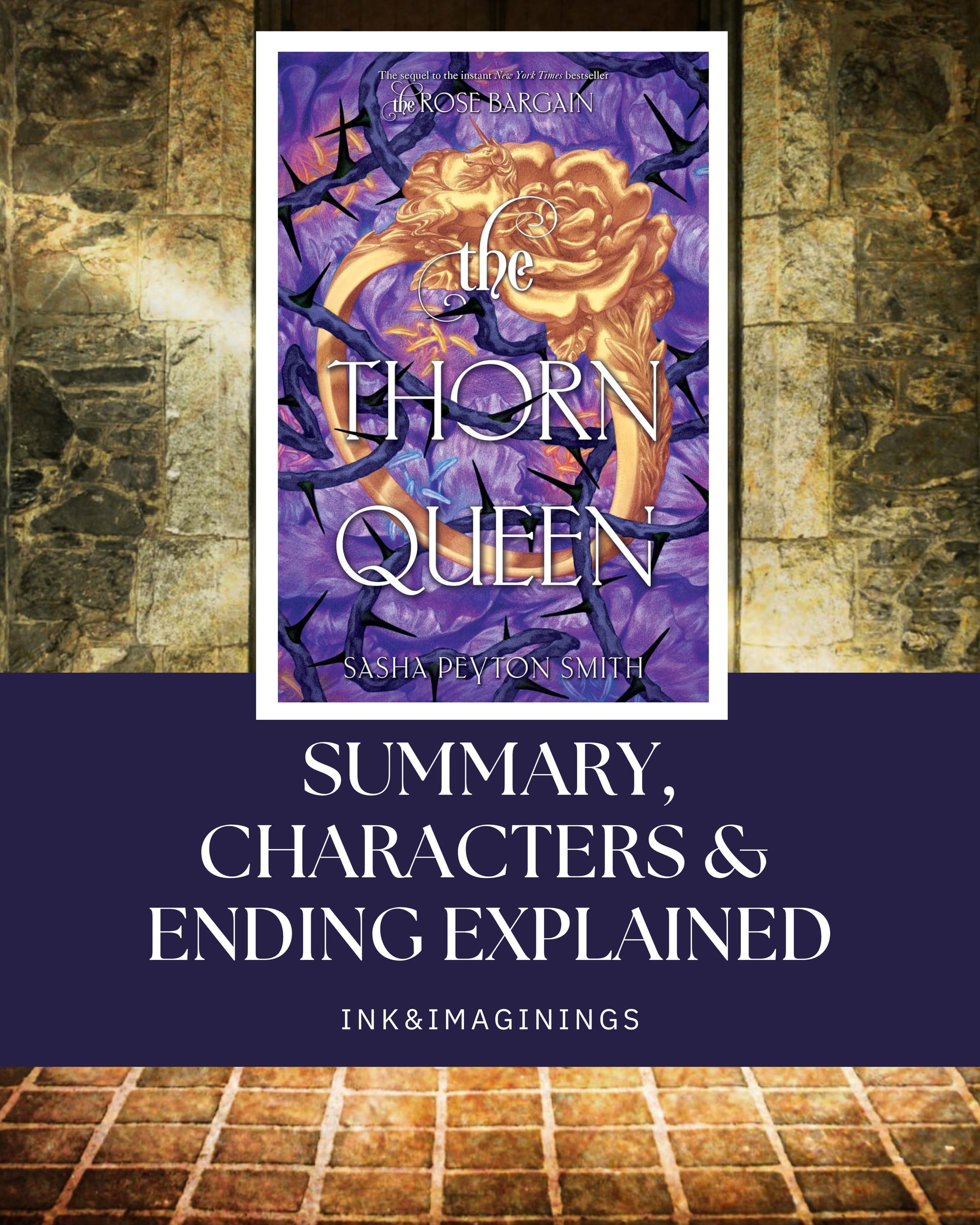
The Thorn Queen picks up right where The Rose Bargain left off and it doesn't let you breathe. Ivy Benton is a queen in name only, trapped in a marriage of political necessity to King Bram, an immortal faerie whose outward beauty masks a chilling emotional void.
While Bram hosts cruel revels and treats humans as toys, Ivy secretly manages the kingdom's crumbling infrastructure and plots to rescue her sister Lydia and her true love Emmett from the Otherworld.
If you need a refresher on book 1, check out our Rose Bargain recap.
⚠️ MAJOR SPOILER WARNING: Full spoilers for The Thorn Queen (The Rose Bargain #2) by Sasha Peyton Smith. If you haven't read it yet, this will ruin everything.
The Thorn Queen Plot Summary
Part I: The Queen of Ashes
It's October 1848. Ivy Benton is trapped in Bath with King Bram, who has moved his winter court to the Royal Crescent. While Bram focuses exclusively on cruel revelry, Ivy secretly manages the mundane bureaucracy of a crumbling kingdom — from railway proposals to feeding starving farmers to managing domestic staff. She hides her hatred behind a dutiful smile as Bram recounts narcissistic tales of his own magnificence.
Bram publicly humiliates courtiers to enforce Ivy's status as queen, but the cruelty isn't performance, it's entertainment. The fae use humans for sport. Ivy observes the horrific treatment firsthand and tries to protect the humans she can reach.
Then the deaths start hitting closer. Ivy finds the dead body of a girl she tried to help, a victim of a faerie game called a "shattered riddle." Rhion, Bram's closest friend and adviser, speaks cryptically about Lydia and asks Ivy a riddle about what can be shattered with one word. Before Ivy can process any of this, Bram's next "present" arrives: her elderly cousin Ethel has been lured to Bath and killed. Blinded by rage, Ivy attempts to attack Bram but is restrained.
Ivy channels that rage into action. She forms a clandestine rebel group with her former competitors for the crown: Marion, Faith, Olive, and Emmy. They follow Olive to a hidden entrance beneath the Roman ruins in Bath and discover something no one expected, an imprisoned Queen Mor, with a magically enchanted Olive acting as her unwitting caretaker.
Rhion confronts the group, but not to stop them. He reveals he wants Bram removed too, and he confesses the reason: he loves Lydia and grieves the friend Bram once was. His critical intel changes everything: "Bram is the door." The portal between worlds is the king himself. No artifact, no spell, just Bram's unique faerie biology, which allows him to become the conduit between England and the Otherworld when overwhelmed by intense human emotion.
The Gateway
Rhion explains that faeries can get "drunk" on intense human emotion, and that this drunkenness is the key to forcing Bram to become the portal. Ivy steels herself for what this requires. She endures an intimate encounter with Bram, channeling her love for Emmett to generate the kind of overwhelming emotional intensity that triggers Bram's biology. It works. A gateway to the Otherworld tears open.
Ivy arrives in a meadow and is immediately captured by faerie guards. In a grand opalescent ballroom, she sees Lydia and Emmett seated on twin thrones and the shock is mutual. Two years have passed in the Otherworld, though only months have passed in England. Lydia has become a cold, pragmatic survivor who kills without hesitation when survival demands it. She reveals she was Bram's first wife, a detail that reshapes everything Ivy thought she understood about the bargain.
Emmett, scarred by his time in the dungeons, initially refuses to believe Ivy is real. Shapeshifting tricks are common in the Otherworld, and he's been fooled before. When he finally accepts it's her, the reunion is complicated by resentment. He resents her bargain to forget him, and she struggles with the knowledge that Emmett and Lydia's bond deepened during two years of shared captivity.
The sisters argue about who suffered more, then reconcile through shared laughter. This was a moment that captures their relationship perfectly. No matter how deep the wound, the sisterly bond holds.
Bram's Three Trials in The Thorn Queen
Bram announces three deadly trials to determine which sister will be his one true queen. He captures Marion and Faith to ensure participation.
Trial 1 The Unicorn Hunt: The sisters must hunt a creature marked with Bram's seal. The "monster" is a baby unicorn. Lydia kills it to win, horrifying Ivy.
Trial 2 The Isern Caves: The caves inflict "pure pain" forcing Ivy to watch memories of Emmett's political marriage to Lady Thalia. But the caves serve a secret purpose: Ivy and her allies use the trial to retrieve Ferrinus, a legendary cold iron blade capable of killing a faerie king.
Trial 3 The Coliseum Duel: Bram forces the sisters to fight to the death. They refuse, attempting to sacrifice themselves instead to save each other.
The Thorn Queen Ending Explained
Enraged by the sisters' refusal to fight, Bram murders Lydia himself, stabbing her before the crowd.
The Otherworld, a sentient realm that loved Lydia, erupts. An earthquake shakes the coliseum. Sentient branches pin Bram to a tree. Ivy finds him trapped and executes him with the cold iron sword Ferrinus.
Lydia's resurrection: Glowing vines wrap around Lydia's body and bring her back to life. The Otherworld has chosen her as its sovereign. But the cost: Lydia is now tied to the Otherworld's magic and cannot return to England. She holds her first audience as queen, promising an end to human torture.
Ivy and Emmett's coronation: Ivy returns to London with Emmett, Marion, and Faith. Emmett gives an impassioned speech to Parliament defending Ivy's right to rule. They prepare for their coronation and wedding, reflecting on the work ahead to build a better government.
The epilogue: Twenty years later, Ivy and Emmett are doting parents. Ivy reads her youngest daughter the story of the faerie king. A nightmare transformed into a bedtime tale.
The ending subverts the "Faerie King" archetype. Bram is literally discarded by the land he claimed to rule. Lydia is resurrected by the world itself. And Ivy kills the king not with magic or cleverness, but with cold iron and the conviction that she has earned the right to rule in a way he never did.
The Thorn Queen Characters
Ivy Benton
The Rose Bargain's winner, now queen in name only. She moves from feeling like a "queen of ashes" to a just ruler who earns her throne through sacrifice and governance. While Bram focuses on revelry, Ivy quietly manages the kingdom's crumbling infrastructure. She forms the rebel group, manipulates Bram's biology to open the gateway, retrieves the cold iron blade, and ultimately executes the king.
Lydia Benton
Ivy's sister, trapped in the Otherworld for two years. She evolves from a victim into a cold, pragmatic survivor, and ultimately the resurrected sovereign of the Otherworld. The land itself loves her and chooses her as its queen. She cannot return to England, sacrificing one world for another.
Prince Emmett De Vere
Ivy's true love. He begins as a broken prisoner plagued by PTSD from the dungeons and refuses to believe Ivy is real when she first arrives. He becomes a steadfast partner who defends her right to rule before Parliament. Their twenty-year marriage in the epilogue is the quiet reward.
King Bram
An immortal faerie king who views people as entertainment and cannot comprehend love or human suffering. He forces the three trials, murders Lydia when the sisters refuse to fight, and is executed by Ivy with cold iron while pinned to a tree by the sentient Otherworld.
Rhion
Bram's closest friend who secretly aids Ivy's rebellion because he loves Lydia and grieves the friend Bram once was. He provides the critical information that Bram himself is the portal between worlds.
The Three Trials Explained
Bram announces the trials in the Otherworld's central square, framing them as a spectacle to determine which sister will be his "one true queen." He captures Marion and Faith to ensure participation, if either sister refuses, their friends die.
Trial 1: The Unicorn Hunt
The sisters must hunt a creature marked with Bram's seal. The twist: the "monster" is a baby unicorn, trembling and terrified. The trial is designed to reveal character. Who has the stomach for cruelty? Lydia kills the unicorn without hesitation to win, horrifying Ivy. The gap between who Lydia was and who she has become opens wider. Two years in the Otherworld taught Lydia to do whatever survival requires, even when it breaks the people watching.
Trial 2: The Isern Caves
The caves inflict "pure pain" not physical but emotional. Ivy is forced to watch memories she never wanted to see: Emmett's political marriage to Lady Thalia, a desperate alliance made to protect Lydia during the years Ivy was gone. The memories are designed to break Ivy's trust in Emmett, and they nearly work.
But the caves serve a secret purpose. Ivy proposes using the trial to retrieve Ferrinus, a legendary cold iron blade hidden deep in the Isern Caves the only weapon capable of killing a faerie king. With Bram's permission for them to enter the caves (via the trial), Ivy and her allies search for the blade while enduring the caves' psychological assault. They find it. This is the gambit that changes everything.
Trial 3: The Coliseum Duel
The final trial takes place in a crumbling coliseum. Bram forces the sisters to fight to the death. Ivy is dressed in a replica of her Pact Parade gown, a deliberate cruelty, reminding her of the woman she was before all of this.
The sisters refuse to kill each other. Instead, they each attempt to sacrifice themselves to save the other. Ivy trying to die so Lydia can live, Lydia trying to die so Ivy can return to England. The mutual self-sacrifice is the trial's most powerful moment: proof that their bond is unbreakable and that Bram's cruelty cannot manufacture the submission he demands.
Supporting Characters
Marion, Faith, Olive, and Emmy
Ivy's former competitors from The Rose Bargain. In The Thorn Queen, they form the core of Ivy's rebel group. Marion and Faith are captured by Bram in the Otherworld and used as leverage to force participation in the trials. Olive is found enchanted in the Roman ruins, unknowingly serving as Queen Mor's caretaker.
Books Like The Thorn Queen
If you loved the fae court politics, enforced marriage, and sisterly bonds in The Thorn Queen, these books give you that plus so much more! They need to be on your TBR:
- Once Upon a Broken Heart by Stephanie Garber: whimsical yet terrifying magical bargains and a love interest who might be the villain. The high-stakes game structure is similar to Bram's trials.
- Belladonna by Adalyn Grace: gothic atmosphere, a heroine caught between worlds, and a mysterious, dangerous male figure who represents death. The Victorian setting overlaps with The Thorn Queen's 1848 England.
- Caraval by Stephanie Garber: high-stakes games where the line between performance and reality blurs, and a central sisterly relationship drives the plot. The trials structure is very similar.
- Kingdom of the Wicked by Kerri Maniscalco: dark romantic tension, the uncovering of ancient secrets, and a heroine who must navigate a world of demons and bargains. Ivy's manipulation of Bram has the same energy as Emilia's navigation of the demon courts.
- Serpent & Dove by Shelby Mahurin: an enforced marriage built on secrets and magic, with a heroine who must hide her true nature from her powerful husband. The Ivy/Bram dynamic is the dark mirror of this.
- Emily Wilde's Encyclopaedia of Faeries by Heather Fawcett: a scholarly approach to the dangerous fae, with a slow-burn romance and immersive world-building. A lighter read but the fae worldbuilding is comparable.
- The Bear and the Nightingale by Katherine Arden: a dark, atmospheric fairy tale with strong sisterly bonds and a clash between old magic and new religion. If Ivy and Lydia's relationship was your favorite part, start here.
- The Stolen Heir by Holly Black: a return to the world of Elfhame, focusing on the brutal politics of the faerie court. If Bram's court politics fascinated you, Holly Black does this better than almost anyone.
- An Enchantment of Ravens by Margaret Rogerson: faeries who are fascinated by human emotion and the danger of falling in love with an immortal. The power dynamic between Ivy and Bram echoes here.
My Honest Take
I picked this up because of how much of a gut punch the ending of The Rose Bargain was. Sadly, this sequel left me with mixed feelings.
My biggest issue was the multiple POVs. While I liked the addition of Lydia's perspective her dynamic with Ivy was the emotional core of this book and the only relationship the story truly got me to care about. I don't think Emmet was really interesting enough to warrant his own chapters.
The time jump also highlighted how shaky the Emmet/Ivy foundation is. Their entire love story rests on a very brief relationship from the first book, which made their desperate yearning for each other feel more comical than enthralling. Emmet's love for Ivy still felt disproportionate to the time they actually spent together, and most of this book is them feeling betrayed, jealous, and fighting each other.
The best parts: the sisterly dynamic between Lydia and Ivy is genuinely so well done. The mix of envy and love between them felt real and complicated. And the atmosphere works. The portrayal of the fae and the faerie world and its truly ruthless nature kept me engaged even when the romance didn't.
But the central romance was so lacking that the atmospheric highs weren't enough to carry it. There were moments where the vibes and the drama worked, but those moments couldn't overcome a love story I never fully bought into.
If you loved The Rose Bargain for the fae world-building and the sisters, the Thorn Queen delivers more of that. If you loved it for the romance, this one might disappoint.
What to Read Next
📚 Books Like ACOTAR If the fae courts and morally grey kings are your thing, this list has 15+ picks.
📚 Books Like Shield of Sparrows If you loved the sisterly bond and political intrigue.
📚 This Week's New Releases See what else dropped this week.
Frequently Asked Questions
What is The Thorn Queen about?
The Thorn Queen is the sequel to The Rose Bargain. Ivy Benton is trapped in a marriage to King Bram, an immortal faerie, while secretly managing the crumbling kingdom and plotting to rescue her sister Lydia and her true love Emmett from the Otherworld. Bram forces three deadly trials to determine which sister will be his queen.
Does Lydia die in The Thorn Queen?
Yes and no. Bram murders Lydia when the sisters refuse to fight each other, but the Otherworld — a sentient realm — resurrects her. Lydia becomes the sovereign of the Otherworld but cannot return to England.
Does Bram die in The Thorn Queen?
Yes. After the Otherworld pins him to a tree with sentient branches, Ivy executes him with Ferrinus, a cold iron sword. The land he claimed to rule literally discards him.
Do Ivy and Emmett end up together?
Yes. After Bram's death, Ivy returns to London with Emmett. He defends her right to rule before Parliament. They are crowned together, and the epilogue — twenty years later — shows them as doting parents reading their daughter the story of the faerie king.
Do I need to read The Rose Bargain first?
Yes. The Thorn Queen is a direct sequel. The characters, world, and political stakes all carry directly from book 1. Check out our Rose Bargain recap if you need a refresher.