Grab a coffee, because we have a lot to talk about.
The Pirate Queen by Ariel Lawhon is so well written and researched. It's also a lot to keep straight. There are thirty chapters, three timelines running side by side, and what feels like half of Ireland named Donal. So I put together the guide I wish I'd had next to me while I was reading. Every chapter, what happens in it, and the little details that come back later.
If you're reading along you can check in after each chapter to help you get your bearings. If you've already finished and you just need someone to talk to about it, read it straight through and leave your thoughts in the comments.
⚠️ MAJOR SPOILER WARNING: Full spoilers for The Pirate Queen by Ariel Lawhon, including every reveal, the meeting with Queen Elizabeth, and the final chapter.
How The Pirate Queen Is Structured (And the Knot You Are Meant to See)
Before we get into it, let me explain how the book is put together, because it makes everything easier to follow.
Lawhon tells Grace's life in three timelines at once. Maiden is Grace as a girl, from five years old up to the morning after her forced wedding. Mother is the long middle of her life: two husbands, the fleet, her children, and the only marriage she chose for herself. Matriarch is Grace in her fifties and sixties, going up against the English governor who's determined to take everything from her.
The chapters rotate through all three, one after another, the whole way through. That's on purpose. The timeline is meant to work like a Celtic knot, three loops woven into one with no real beginning or end. So instead of reading Grace's life in order, you're seeing the girl, the mother and the grandmother side by side, and you start to notice how each one explains the other two.
I'll be honest, I desperately wanted more of her time with Richard. But the balance between the timelines is intentional, and Lawhon explains why in her author's note at the back. Don't skip it. Just save it for the end, because it has spoilers.
And if you can, read this one in print. The character list and the glossary of Celtic terms in the front were immensely helpful.
Where to Buy The Pirate Queen
If you haven't picked up your copy yet, here's where to find it.
📖 Buy on Amazon | Buy on Bookshop.org | 🎧 Listen on Audible
Get the physical copy if you can. There's a cast of characters and a pronunciation guide in the front, and maps on the endpapers. You'll want all three within reach.
How to Read Alongside This Guide
Here's how to use it. Finish a chapter, come find it here, then go back to the book. Try not to run ahead of yourself. Lawhon holds specific things back on purpose, especially about Grace's first marriage and about what Richard Bourke actually promised her. These notes are meant to fill in what you've just read, not to spoil what's coming.
Reading it after the fact does something different. Once the chapters sit next to each other, the braid, the compass, the phantom horses and the Latin all come into view, and the ending lands even harder when you can see how early Lawhon planted it.
And if you're listening on audio, lean on the chapter headers here to keep your place. Strand, year and Grace's age, every time.
Quick Navigation
- Cycles 1 to 3, Chapters 1 to 9
- Cycles 4 to 7, Chapters 10 to 21
- Cycles 8 to 10, Chapters 22 to 30
- What Is True and What Lawhon Invented
- FAQ
- What to Read Next
Cycles 1 to 3, Chapters 1 to 9: The Three Openings
The first three chapters introduce you to all three versions of Grace, one right after the other. It can feel like whiplash at first. Stick with it, because by chapter three you'll know exactly who this woman is at every stage of her life.
Chapter 1: Storm Born (Maiden, 1535)
We meet Grace at five years old, standing on the dock at Clare Island with a knife she's stolen from the kitchen. She wants to sail with her father so badly that she cuts off her long auburn braid to prove she's ready. It doesn't work. Eóin tells her the sea is no place for a girl and sails off to Galway without her, and she throws her hair into the harbor and watches it sink.
That night she sits on the stairs, listening to her parents talk about the storm she was born in. Her mother, Maeve, says Grace's grey eyes belong to the sea. Grace goes to bed with the knife under her pillow.
Keep that braid in the back of your mind. It comes back at the very end of the book, and when it does, you'll feel it.
Chapter 2: Lady of the House (Mother, 1550)
Now we jump fifteen years. Grace is twenty and married to Donal O'Flaherty, running his castle at Bunowen while he's off raiding. The Irish term for her role is Bean an Tí, the lady of the house, and she's very good at it.
Her brother shows up on the Niamh with a secret letter from Richard Bourke. (If you're wondering who Richard is, hang tight. Young Richard doesn't properly appear in the Maiden chapters until Grace's fosterage.) The letter ends in Latin: Ego te expectabo. I will wait for you. She takes the tiller herself and steers out into the Atlantic.
Then her husband comes home, furious that she collected the village rents without his permission. What follows is hard to read. He forces her to strip and wash in front of him, then demands sex, and Grace turns her face to the wall, crying silently and repeating Richard's promise to herself.
It's a painful chapter. But it tells you exactly what this marriage is, and why one line of Latin means so much to her.
Chapter 3: A New Pair of Gallows (Matriarch, 1586)
And now we're at the other end of her life. Grace is fifty six, and her eldest son, Young Eóin, has been murdered by John Bingham. She goes after Bingham anyway, even though her crew begs her not to, and walks straight into an ambush at Burrishoole with nothing but a dagger.
It goes about as badly as you'd fear. She's stabbed in the ribs, the four men with her are killed, her cattle are stolen and her safe conduct letter is torn up. She's hauled off to Dublin Castle, where the governor, Sir Richard Bingham, tells her he's going to take everything she's built.
Quick heads up, because this trips a lot of people up: there are two Richards in this book. Richard Bourke is the love of Grace's life. Richard Bingham is the English governor who spends the rest of the novel trying to destroy her. They could not be more different.
The chapter ends in the courtyard, where four young men are hanged in front of her. They're her late husband's nephews, boys she raised as her own. As they drop, Bingham pulls her head back by the hair and promises to hunt down the rest of her children.
Notice the hair again, in the worst possible register. In chapter one she cuts it herself, as an act of will. Here a man uses it as a handle.
So that's all three Graces. A little girl who wants to go to sea, a young wife who's trapped, and a grandmother watching the English take everything. Now Lawhon starts weaving them together.
Chapter 4: To Sea (Maiden, 1538)
Grace is eight now, and finally aboard Niamh bound for Galway. Her father's plan is simple. A rough crossing and a rough crew will cure her of wanting this. It does the opposite. A storm hits, and Eóin shuts both children in his cabin to wait it out. Donal admits he hates sailing. Grace spends it working out that she intends to be Chief of the Name.
In Galway, Eóin shows her a Latin inscription warning the city against the O'Flahertys. Then, at the merchant's office, they meet an English merchant named Bingham and his young son Richard, who looks at Grace with open contempt. On the way out, Eóin lets each child choose one thing. Donal takes Uilleann pipes. Grace takes an ivory and silver pocket compass.
Two of the book's most important objects land in the same scene, and so does its villain, aged about eight. That Bingham meeting is Lawhon's invention, and it's the one liberty here that's easiest to argue with. It's also very good structure. Keep the compass in mind, because it does real work three chapters from now.
Chapter 5: A Murder at Moycullen (Mother, 1554)
Grace is twenty four here, pregnant with her third child and stuck in a cramped cabin on the way to the clan games at Moycullen. Up on deck, Gutty tells her plainly what everyone can see. She's a better captain than her husband is.
At the lakeshore, sixteen year old Richard Bourke has news, and it's bad. Donal O'Flaherty murdered Walter Bourke in the forest, on the orders of his own sister, Finola. Grace does the math fast. Gutty saw it, which makes Gutty a dead man, so she arranges to have him sent to her father.
Then O'Flaherty confronts her and hits her, and she drops to her knees. And then she puts Richard's dagger under his chin until he bleeds, and banishes him from her bed for good.
Notice whose dagger that is. Every time Grace defends herself in this first marriage, she does it with a weapon another man handed her. The book knows exactly what it's doing with that.
Chapter 6: The Devil's Hook (Matriarch, 1586)
Grace is ill in the Dublin cell after the executions. Then Richard Bourke turns up, and by now everyone calls him Hook. He has a release warrant, which he got by blackmailing a magistrate, so Bingham has to let her go.
Hook walks her down to the Liffey, where Gutty, Ultan and the Murray twins are waiting with Niamh. She sails to Howth Castle, and the guards open the gates on her name alone. Lord Howth receives her warmly. His grandson Christopher is thrilled to see her. After dinner she heads back to the ship and orders Ultan home to gather the fleet and raise an army.
Hold on to this chapter. That warm welcome at Howth is a setup, and the payoff is seventeen chapters away, in 1577.
Chapter 7: Donal of the Pipes (Maiden, 1540)
Grace is ten, and she's led her fourteen year old brother deep into the ash woods on Achill. She picks flowers while he plays ballads. Then they realize they're lost.
Donal's solution is to climb an oak and look for Achill Sound. Grace's solution is the compass. She walks them downhill to the shore and gets them to Kildavnet Tower by sunset. Their father comes out drunk, puts them on a two mast yawl and falls asleep on deck. So Grace takes the tiller and steers Clew Bay in the dark, by compass, at ten years old.
Afterward, Donal sits in the dirt outside the tower and silently swears to protect his sister. The compass earns its keep twice in one chapter. And that vow gets made where nobody can hear it. Lawhon builds the same moment again in chapter nineteen.
Chapter 8: Hen's Castle (Mother, 1565)
A wounded messenger brings the news. Seán Joyce ambushed Donal O'Flaherty at Hen's Castle on Lough Corrib and beheaded him.
Grace raises seventy O'Flahertys and sails out to hold the island. Her prep work is worth watching. She has peat fires covered with pelts so the water approach stays lit. Joyce comes at midnight. Her archers work from the battlements, her men pour melted lead through the gaps in the roof, and when Joyce breaks into the Great Hall, she's the one who meets him there. Her men finish off his force. She cuts the throats of three captives herself, then sinks them in the lake.
Then she gets back to Bunowen and finds Rory O'Flaherty has taken the chieftainship. He'll let her stay on one condition. She marries him. So she walks off the estate instead, with a hundred and fifteen followers and the captured Mary Fortune.
She defends her dead husband's castle better than he ever defended her, and she's dispossessed for it immediately. That sequence is the engine of the whole Mother strand.
Chapter 9: Nurse to All Rebellions (Matriarch, 1587)
Grace is fifty seven, bringing three hundred Scottish gallowglass home from the Inner Hebrides. Far out at sea, she hears it. The phantom gallop of Manannán's steed. The sky is clear, and she orders every sail up anyway.
Within the hour a black wall of cloud arrives, and it's a hurricane. It snaps Caoimhe's masts and wrecks Róisín Dubh, and eleven mercenaries drown. On the sand afterward, she admits to Ultan what the hearing really is. A curse handed down from her father.
Four days later she meets Hugh O'Neill and Hugh O'Donnell. O'Donnell will grant her safe passage on one condition: she has to unite the O'Malley, O'Flaherty and Bourke clans behind a coming Spanish invasion.
This is the Sense getting its first full demonstration, and its first bill. She's right, and eleven men die anyway. She's the one who has to live with having been right.
Cycles 4 to 7, Chapters 10 to 21: The Gift, the Marriage, the Fleet
This is the widest stretch of the book, and it's where most people lose the thread. All three strands escalate at once. The Maiden chapters carry Grace out of childhood and into fosterage and the marriage market. The Mother chapters build her fleet and finally hand her Richard. The Matriarch chapters run from the Armada to the betrayal that breaks her. It's also where Lawhon does her best work on the Sense. It stops being weather and atmosphere and turns into something Grace inherited, with a price attached. Take these twelve slowly.
Chapter 10: The Test (Maiden, 1541)
Grace is eleven, and her father decides to find out what she can do. Eóin takes both children out into the open Atlantic on a small ketch and asks each of them to call the day's weather. Donal says clear skies. (That's her brother Donal, not the husband she gets later.) Grace smells wet tilled earth and hears the distant thunder of running horses, and she begs him to turn back.
Something in her face convinces him. He backs the mizzen and runs for Clare Island, and a hurricane hits just as they reach shore. That night he tells Maeve that Grace has the Sense. Then he weeps.
His reaction is the part to sit with. Not pride. Grief. He has the Sense too, so he knows exactly what he's handed her, and what it's going to cost.
Chapter 11: The O'Malley (Mother, 1565)
Grace comes home to Clare Island with a hundred and seventeen refugees from Bunowen. Sivney, Gutty and her three children are waiting for her. Inside, her father is bedridden with a wet lung and isn't getting up again. He tells her the entire O'Malley fleet has to be hers alone, because she has the Sense. Donal takes it well. He'll hold the title while Grace commands at sea. Maeve, practical as ever, tells her to foster the children out for alliances.
That evening Eóin stands in front of the clansmen and names Donal Chief of the Name, then leads the long dance across the lawn with Grace. At his funeral she runs into Richard Bourke again. He introduces his four year old son, Edmund, and she gives him a cold nod.
Notice that the fleet gets split off from the title on purpose. Donal gets the name. Grace gets the ships. Everyone in that room knows which one is the real inheritance.
Chapter 12: The Spanish Armada (Matriarch, 1588)
Grace is fifty eight, and the Armada has come apart on her coast. El Gran Grin has broken up, and she's dragging thirty seven drowned Spanish sailors off the beach at Clare Island. More than a hundred survivors are gathered on the rocks under their commander, Don Pedro de Mendoza. Gutty warns her this will bring Bingham. It does.
Bingham turns up with twelve guards, and Grace lies to his face. All two hundred and fifty drowned, she tells him, and they're buried above the tide line. She waves off his claim that the cargo belongs to the Earl of Ormond. That night she walks Mendoza and a hundred men over the hills to Lough Creggan and gets them aboard Niamh. Then she delivers the men and the salvaged cargo to Hook and Margaret at Burrishoole, to pay for the rebellion.
This is the most dangerous thing she does in the whole book, and it's grounded in the record. Bingham's standing order was that Armada survivors on the Connacht coast be taken to Galway and put to death. She knew exactly what she was hiding them from.
Chapter 13: Terra Marique Potens (Maiden, 1543)
Grace is thirteen. On the way home from Galway, Eóin moves to block a Portuguese caravel, the Esperança, for a transit fee. While the Latin negotiation is going on, two of the Portuguese sailors get into her cabin and attack her. Donal hears her screaming and kills one of them. The other ends up bound on deck.
Eóin doubles his demand, then gives Grace the right to execute the prisoner. She can't do it. Her hands shake too badly, so Donal takes the man by the hair and cuts his throat himself. After that her father decides she isn't safe aboard and sends her to fosterage at Rockfleet. Maeve packs for her, gives her a silver fede ring and explains her first period.
The chapter takes its title from the clan motto, powerful by land and sea. Then it hands you a girl whose hands won't work. Lawhon isn't being subtle here, and she doesn't need to be.
Chapter 14: The Dark Lady of Doona (Mother, 1566)
Grace is thirty six, and she pulls a charming shipwrecked nobleman out of the water. He calls himself Hugh de Lacy, and the serving girls are delighted with him. Gutty isn't. He notices the man taps his right thumb three times every time he lies. So Gutty and Finn trail him to Achill and watch him take a purse from three MacMahon clansmen.
The next afternoon shepherds carry his body back to Clare Castle. He's been murdered. Grace puts on sailing trews, takes Niamh to Caher Island, burns three MacMahon hookers and surrounds the stone church during mass. Then she cuts the throats of the three assassins with Richard Bourke's dagger. After that she takes Doona Castle in Blacksod Bay.
That dagger again. She's been widowed a year at this point, and she's still carrying the knife of a man she hasn't married.
Chapter 15: The Truce at Galway (Matriarch, 1589)
This is the chapter where Grace stops being hunted and starts negotiating. Lord Deputy Sir William FitzWilliam reprimands Bingham. The Bourkes and O'Flahertys have burned Mayo strongholds, he points out, and Grace has sacked the Aran Islands. The Queen orders a truce and bars Bingham from the negotiations.
A month later the chieftains gather in St Nicholas Collegiate Church in Galway. Grace arrives in green silk with a decorative scabbard and sits down beside her brother. Quietly, she confirms she got Mendoza and his men back to Lisbon. Then FitzWilliam lays out the crown's terms, and she steps forward and drops a heavy book on the stone floor at his feet. Five years of Bingham's atrocities, written down. She demands his removal as Governor of Connaught.
Hold on to the green silk and the scabbard. Both come back at Greenwich in chapter twenty seven. She's been building this performance for four years.
Chapter 16: Fosterage at Rockfleet (Maiden, 1543)
Grace arrives at Rockfleet on a three year fosterage contract, bought with thirty head of cattle. She'll be taught Latin, mathematics, household management and combat. At the welcome feast she meets The MacWilliam's sons. Walter is twenty and handsy. Richard is sixteen. And there's Richard at last.
Her brother Donal is immediately taken with Nora, a serving girl who's secretly David Bourke's illegitimate daughter. Then Walter catches Grace alone in a hallway and forces a kiss on her, and Richard steps in and stops him. Later Richard sends her a note asking her to meet him in the byre, which is the cow shed. At dawn he starts teaching her knife throwing and hand to hand. He builds every lesson around her left handed stance, and he promises to make her formidable.
Notice what he actually promises. Not to protect her. To make her good at this. Lawhon keeps that distinction clean, and it holds for the rest of the novel.
Chapter 17: Richard in Iron (Mother, 1566)
It's the winter solstice, and Grace is widowed now. She turns up at Rockfleet uninvited, because she wants an answer about a four year old boy. Richard is The MacWilliam these days, and he has a son by Aoife. He tells her he kept his promise and never married. Edmund was clan duty. Then he tells her he loves her, and he proposes.
She says yes, but on her own terms. A Brehon trial marriage. A year and a day, and either one of them can end it by saying so out loud. Bald Alec draws up the contract, she signs it, and Richard announces it to the clan. That night they spar with knives, cutting the ties of each other's clothing. Then they consummate the marriage.
She negotiated an exit clause into her own wedding. After chapter two you know exactly why she wanted one. After chapter twenty you'll know what she does with it.
Chapter 18: Betrayal (Matriarch, 1590)
Grace is sixty, and the news has reached her that her second son Merrick has sworn fealty to Bingham. So she anchors off Bunowen. She comes ashore with Gutty, Finn and Murray, her archers drop two of Merrick's guards, and Finn and Murray tie him to a hitching post in front of the castle.
What he shouts at her is the part that lands. She hid him away at Bunowen. She denied him his father's chieftainship. She looks at her son and understands that the hatred is real and permanent. So she leaves him tied to the post and goes back to her ships.
An hour later Bingham reaches Rockfleet with a thousand soldiers and finds nothing. Grace has moved her people, her livestock and her whole fleet out into the Atlantic. At sea she sits on her cabin bed and cries over her son.
She doesn't kill him. She doesn't forgive him either. That refusal to tidy it up is the most honest thing in the Matriarch strand.
Chapter 19: Training (Maiden, 1544)
Grace is fourteen and under Finola Bourke's supervision. The lessons are household management, how to entertain allies, and how to ride while holding a burning torch. Which tells you plenty about the job she's training for.
Her brother gets into a fistfight with a young O'Flaherty out in the rain. Richard ties the horses under an oak and watches it with Grace. Donal turns up at breakfast the next morning with two black eyes. At the target stump Richard moves her on to advanced grips and longer throws. He asks which suitor she'll take. Neither, she says. She wants her own ship and a life bigger than any tower house. And Donal, silently again, swears to protect her freedom.
That's the second silent vow, built the same way as the one in chapter seven. Nobody ever tells her. She spends the whole novel not knowing she has an ally.
Chapter 20: Corsairs from Algeria (Mother, 1567)
Grace goes into labor aboard the Niamh near the Aran Islands, which would be plenty on its own. An Algerian corsair galley called Sahara is running them down, and the corsairs ram and board. Grace is confined to the cabin, so she labors alone while the fighting goes on over her head. She delivers a boy with soft yellow curls and names him Tibbot Bourke.
Then she hears her crew being overwhelmed. So she wraps a blanket round her bleeding torso, takes a blunderbuss up on deck, and shoots the Algerian captain dead. The galley is taken and renamed Róisín Dubh.
Back at Rockfleet, Finola tries to claim the newborn for a political scheme, and Grace throws her out. Then Richard arrives. It's day three hundred and sixty six of the trial marriage. Grace stands on the ramparts and shouts, Richard Bourke, I divorce you.
Look at that number again. The contract was a year and a day. She waited for it to lapse, and then she performed the dismissal anyway, up on the wall, in front of everyone. It's theater, and it's aimed at Finola.
Chapter 21: Tibbot (Matriarch, 1593)
Grace is sixty three and cutting hawthorn near Rockfleet when twelve English warships come into Clew Bay. They burn Caoimhe and Róisín Dubh where they sit at anchor. She sends Gutty to warn Hook to hide Margaret and the children.
Then Bingham gets to work. He marches on Westport and picks a fight, then arrests her brother Donal on a false murder charge. He brings a hundred soldiers to Rockfleet and confiscates the castle. He has sixteen year old Tibbot arrested on fabricated charges, and when Grace objects he shoves his riding crop into her chest. Tibbot is taken to Athlone to join Donal, and Bingham promises to hang them both.
She's left with twenty soldiers. So she decides to sail to England and petition the Queen herself.
And look at what he burned. He burns the ship she gave birth on. Lawhon doesn't point at it, and she doesn't have to.
Cycles 8 to 10, Chapters 22 to 30: Latin, London, and the Braid
The last third is where the braid pulls tight. The Maiden chapters hand Grace the Latin lessons, the first kiss, and then the wedding she never agreed to. The Mother chapters close out Richard. The Matriarch chapters take her to London. At some point, read chapters twenty two and twenty four back to back. Fifty years of story sit between them, and about two pages of real insight.
Chapter 22: A Dead Language (Maiden, 1545)
Grace is fifteen now, stuck in compulsory Latin at Burrishoole Abbey. Her teacher, Father MacKenna, bans English and makes her write with her right hand, which is the wrong hand for her. So she adapts. She learns to sit quiet and gather information. She learns to hide how good her left hand really is. When MacKenna demands family mottos, Richard gives the Bourke motto in Old French, and the priest strikes his hand with a stick for it. Grace is on her feet to confront him. Richard steps between them and says it again in Latin.
That afternoon in the byre, he ambushes her with his knife. They spar. He wipes the blood from her nose with his cuff and tells her she's perfect, and they kiss for the first time before the steward walks in on them.
Two skills come out of this chapter. Latin, and a left hand nobody knows about. They're the exact two things that win the book, so keep this one in your head.
Chapter 23: A Famous Feminine Sea Captain (Mother, 1577)
Grace is forty seven, and she brings Niamh in near Howth Castle expecting the usual Gaelic hospitality. A meal, a bed, an open door. Instead Lord Howth's steward shuts the gate in her face and says he won't disturb his lord for a woman.
Outside the walls she finds a nine year old boy, Christopher St Lawrence, Howth's own grandson, exiled for stealing sweet rolls. She invites him aboard, sails for Clew Bay, and leaves a note. At Rockfleet he plays with her Tibbot, who's also nine. Then, standing on the shoreline, Tibbot suddenly hears phantom horses. When Howth turns up to ransom the boy, Grace refuses his money. What she wants instead is that Howth's gates stay open to travelers forever, with an extra plate laid at the table. He swears to it and gives her his blue aquamarine ring.
Two things go off quietly here. The Sense has passed to Tibbot, which changes how every scene he's in afterward reads. And that warm welcome at Howth back in chapter six? That was a debt being paid.
Chapter 24: The Eighteen Interrogatories (Matriarch, 1593)
Grace reaches London, and London is full of plague. She stays at Blackfriars, the Earl of Ormond's residence, and spends a week being put off before she gives up on waiting. She tracks Thomas Butler down in a tavern, intercepts his dinner tray, drinks his whiskey, and demands an audience with the Queen. He tells her plainly that Burghley and Walsingham see her as a dangerous rebel. Then he arranges a meeting at Cecil House anyway.
There William Cecil hands her the Eighteen Interrogatories. She takes them back to Niamh at Billingsgate and spends the whole day writing her answers. In Latin. With her left hand. She documents Bingham's murder of Young Eóin, the illegal seizures, the false imprisonment of Tibbot and Donal. And then Ultan brings word that Bingham has quietly arrived in London to argue against her.
This is chapter twenty two paying off fifty years later. A priest hit her for being left handed and made her learn a dead language. She's now using both of those things to take an English governor apart.
Chapter 25: Betrothal (Maiden, 1546)
Finola calls Grace in and tells her that female sexuality is a game of chess. Sound advice, and a little rich coming from her, because she's quietly scheming with Donal O'Flaherty to have Walter Bourke murdered so Richard becomes The MacWilliam. Richard, meanwhile, pulls Grace into the cellar and begs her to run away and marry him now.
Then Eóin and Maeve arrive, and O'Flaherty puts an offer on the table. A joint fleet alliance, in exchange for Grace. At the feast her brother stuns the room by introducing Nora, the wife nobody knew he had. On the voyage home Grace confronts her father. He tries to backhand her in front of his own crew and she blocks it. Embarrassed, he gives her one week to choose between Walter Bourke and Donal O'Flaherty.
The week is a lie. At Clare Castle, Nora dresses her in blue silk, and Maeve walks her to the Great Hall, where O'Flaherty and a priest are already waiting. The choice was never offered, and the last thing you see is her mother leading her into it.
Chapter 26: The Bermingham Tower (Mother, 1579)
Grace is forty nine. She's spent eighteen months in the Limerick dungeons, and now she's moved in chains to Dublin Castle with Black Tom and Lord Drury as her escort. Then FitzWilliam has her shackles struck off and offers her port and cakes, which tells you the tone of the conversation before he even opens his mouth.
He lays out what the Privy Council knows about her. Her influence at sea. Her Spanish trading runs. Then comes the offer. Immediate release and dismissed charges, if she'll work as a naval spy and report Spanish ship names, captains and cargoes. She sees it for what it is, the only road back to Richard and Tibbot. She signs the contract, takes the coin and an escort to the docks, and sails for Clew Bay.
Now, the tower. Grace is held in the Bermingham Tower at Dublin Castle, and that's the same tower where Hugh Roe O'Donnell was really imprisoned, from 1587 until his escape in December 1591. Lawhon has put her in a cell Irish readers will recognize on sight.
One oddity worth a second look. The year and Grace's age here, 1579 and forty nine, sit inside the Mother years, and the cycle pattern calls for a Mother chapter in this slot. So if your copy carries a different strand label on this one, I'd like to know.
Chapter 27: The English Queen (Matriarch, 1593)
This is the scene the whole book has been walking toward. Grace arrives at Greenwich in an unadorned green silk gown, leather boots and loose hair. She's refused court dress. The guards find the dagger in her boot and set it on a tray. Then she walks into the presence chamber and stands in front of Elizabeth I, with Butler, Cecil and Bingham watching.
Here's the surprise. The two women like each other on sight, and they talk in Latin. Cecil reads out her complaints. Bingham can't help himself and interrupts to call her a pirate and a rebel, and the Queen silences him. Then Elizabeth rules. The confiscated Bourke and O'Flaherty estates go back to Tibbot and Donal, and she orders both men released from Athlone. Grace picks up her dagger on the way out and puts it against Bingham's throat.
Look at the gown again. That's the same green silk she wore to drop the book at FitzWilliam's feet in 1589. The plain dress isn't humility. It's a costume, and she's worn it before.
Chapter 28: A Woman at the Helm (Maiden, 1546)
The Maiden chapters end here, twelve hours into the thing they spent twenty seven chapters dreading. Twelve hours after the forced wedding, Grace is standing inside Bunowen watching her husband ride away. She tries to walk outside and the steward stops her. O'Flaherty has left orders that she doesn't leave unless two guards go with her.
That lasts about a second. She draws the knife from her boot and puts the point under his chin until it draws blood. If he ever gives her an order again, she tells him, she'll separate his head from his neck. He nods. She wipes the blade on his shoulder and walks out. Then she goes down to the half moon beach, faces the Atlantic and swears she won't be tamed.
One more thing before you turn the page. Finn Murray watched all of it from the stairwell, in awe and in terror. Remember where he's standing. Chapter twenty nine is about to tell you what he was feeling.
Chapter 29: Ego Te Expectabo (Mother, 1583)
Grace is fifty three, in bed at Rockfleet with Richard, and Richard is dying. It's a winter lung illness, and he knows what it's doing to him. A goldfinch sings outside the window while he calls Finn Murray in and asks him, straight out, about his forty years of unrequited love for Grace. Finn doesn't dodge it. He's loved her since she was sixteen, and he's always known she only ever loved Richard. Richard makes him promise to protect Grace and Tibbot.
Then Bald Alec sits down and counts what she owns. Five castles, a thousand cattle, a thousand horses, twenty five ships and two hundred soldiers. He warns her Bingham will come for all of it. In his last hours Richard tells her that running away would have stolen her birthright from her. His final words are Ego te expectabo.
That's the loop from chapter two closing. She got through her first marriage by repeating a promise a boy once made her, and the man who made it dies still making it. Go back to what he says about the cellar in chapter twenty five, too. He's telling her he was wrong to ask.
Chapter 30: The Pirate Queen (Matriarch, 1603)
Here it is. Grace is seventy three, in her bed at Rockfleet, with her family around her. Donal and Nora have filled the castle with daughters and grandchildren. Ultan, Gutty, Finn and Murray won't leave the room. Only Merrick doesn't come, and she thinks she'd have forgiven him just to see him once.
She asks Gutty to open the window so she can see the sky and Clew Bay. Then she combs out her long silver hair with her mother's ivory comb and works it into a loose braid. And then she hears it. A single horse, galloping. She takes the blade out of her boot and cuts the braid off. She throws it into the channel, where it flaps like a sail before it sinks. And she dies.
That's the braid. Sixty eight years after she cut it off on the dock at Clare Island, she does it again. Same gesture, same knife logic, same hair going down into the water. At five she cut it to be allowed onto a boat, and she was refused. At seventy three she cuts it to be allowed off one, and she isn't. Manannán doesn't send a storm this time. He sends one horse. He isn't warning her. He's come to collect her.
What Is True and What Lawhon Invented
This is the part worth reading before you argue with anyone about what's real.
Documented. The 1593 petition and the voyage to England. The Eighteen Interrogatories. William Cecil, Lord Burghley, genuinely drafted them in July 1593, and Grace genuinely answered them in writing. They survive in the State Papers in London, and Anne Chambers reproduced them in her 1979 biography Granuaile. The Greenwich audience, around the sixth of September 1593. The murder of her eldest son in English custody. Bingham's confiscations, and the imprisonment of Tibbot and her brother Dónal. Elizabeth's later orders to release both men and restore the estates. And the son who went over to the English. Historically that's Murrough, who becomes Lawhon's Merrick.
Documented, and better than the novel needed. Sir Henry Sidney met her in 1576 and described her in writing as a most famous feminine sea captain. Lawhon uses the phrase as a chapter title. It's real.
The legend that's truer than it looks. Tibbot born at sea. Chambers found a Latin document confirming the shipboard birth, which is why he's historically Tibbott na Long, Toby of the Ships. The corsair attack the following morning isn't corroborated. But the birth itself has paper behind it.
Folklore. The Howth Castle abduction, and the standing promise about the open gates and the extra plate. Lovely story, no source, and Howth still lays the place. The trial marriage of a year and a day, and the dismissal from the battlements. The handkerchief at Greenwich, the refusal to bow, the offered title. And the Latin conversation with Elizabeth. Chambers thinks they most likely spoke English, since every indication is that Grace had it. There's no transcript, so nobody can prove it either way. But the Latin version has nothing behind it.
And the braid. The nickname Gráinne Mhaol was read for centuries as Bald Grace, which is where the haircut story comes from. Chambers worked out that Ó Máille is pronounced locally as something close to Maolya. So Gráinne Ní Mháille slides into Gráinne Mhaol by simple mishearing. The name was always the family name. Somebody heard it wrong and invented a haircut to explain it.
Which means Lawhon opened and closed a five hundred page novel on a gesture that almost certainly never happened. She'll have known that. It isn't a flaw. It's the whole point. Grace O'Malley survives in the record almost entirely through documents written by the government dismantling her. Everything warm or defiant about her reaches us through folklore. So Lawhon builds the book's spine out of the most famous invented moment in her legend. That's an argument about who gets to keep their own story.
And don't read the author's note early. Lawhon says so herself, and she's right.
FAQ
How many chapters does The Pirate Queen have?
Thirty, arranged in ten cycles of three. Each cycle gives you one Maiden chapter, one Mother chapter and one Matriarch chapter. Every chapter header tells you the strand name, the year and Grace's age.
Is The Pirate Queen told in chronological order?
No. Three strands run side by side, each moving forward in its own time. Maiden covers roughly 1535 to 1546. Mother covers roughly 1550 to 1583. Matriarch covers 1586 to 1603. Lawhon has said you can reread the book chronologically: all the Maiden chapters, then all the Mother, then all the Matriarch.
What is the structure of The Pirate Queen?
A Trinity Knot. Maiden, Mother and Matriarch are the three loops of a Celtic triquetra, so there's no beginning and no single dominant strand. Penguin Random House's reader's guide uses the same framing, and it invites readers to imagine their own life as three strands of one knot.
Did Grace O'Malley really meet Queen Elizabeth I?
Yes. The audience took place at Greenwich Palace around the sixth of September 1593, and it lasted several hours. Nobody recorded what was said. What survives is the outcome. Elizabeth ordered the release of Tibbot and Dónal, and told Bingham to let the family hold their lands.
What were the Eighteen Interrogatories?
Eighteen written questions, drafted by William Cecil, Lord Burghley, in July 1593. They asked Grace to account for what she owned, how she earned a living, whom she'd married and what each marriage brought her. She answered all eighteen in writing. The originals are in the State Papers in London, and Anne Chambers printed them in Granuaile.
Should I read this chapter-by-chapter recap alongside The Pirate Queen or after?
Either works. Alongside, stop in at the end of each chapter and use the notes to catch what Lawhon is planting. Afterwards, read it straight through. The braid, the compass, the Latin and the phantom horses are much easier to see when the chapters sit side by side.
What to Read Next
If The Pirate Queen got its hooks into you, here are a few places to go next.
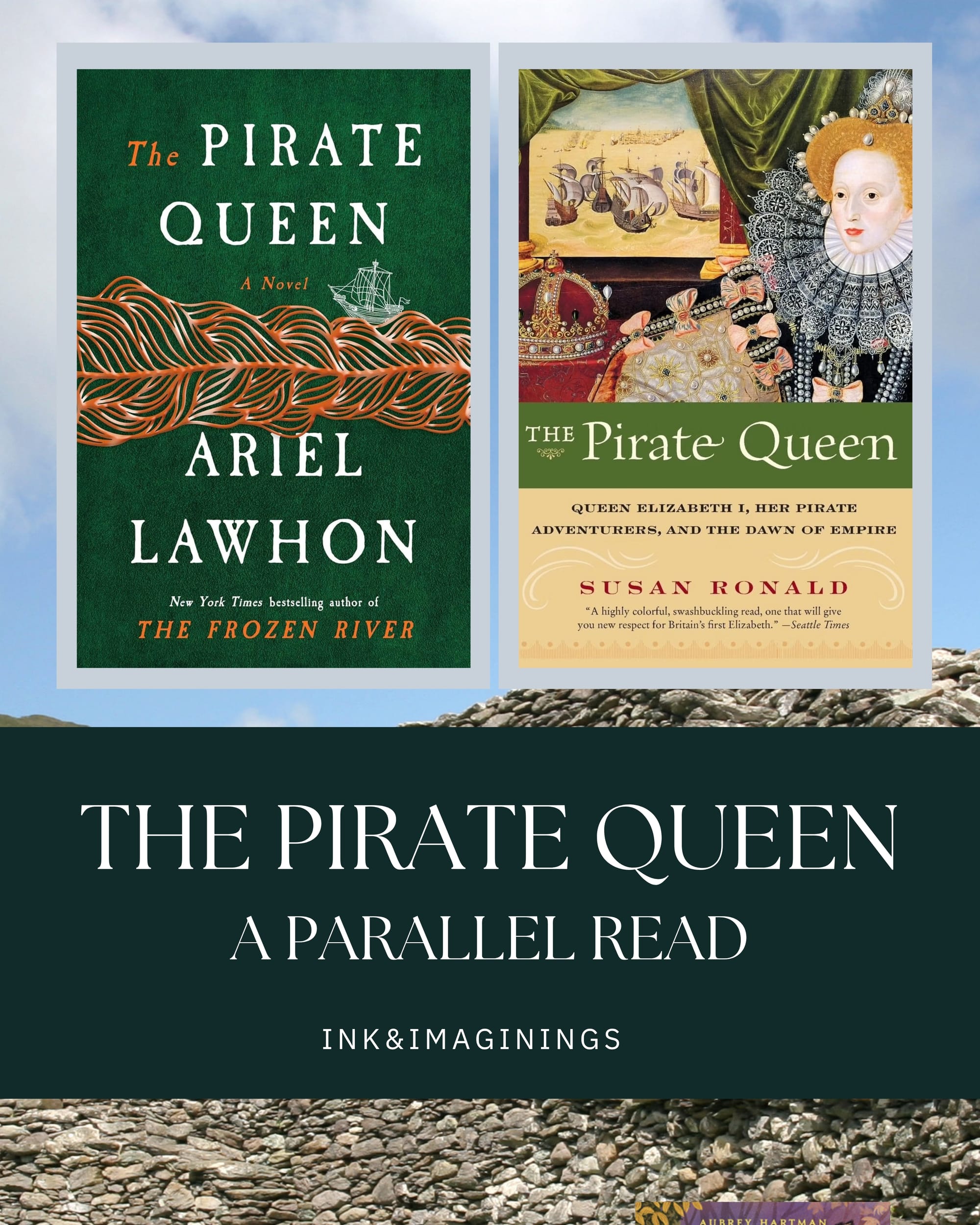
- The Pirate Queen Parallel Read pair it with Susan Ronald's history of Elizabeth's privateers and read the same ocean from both sides.
- This Month's New Releases see what else is out this month across every genre.