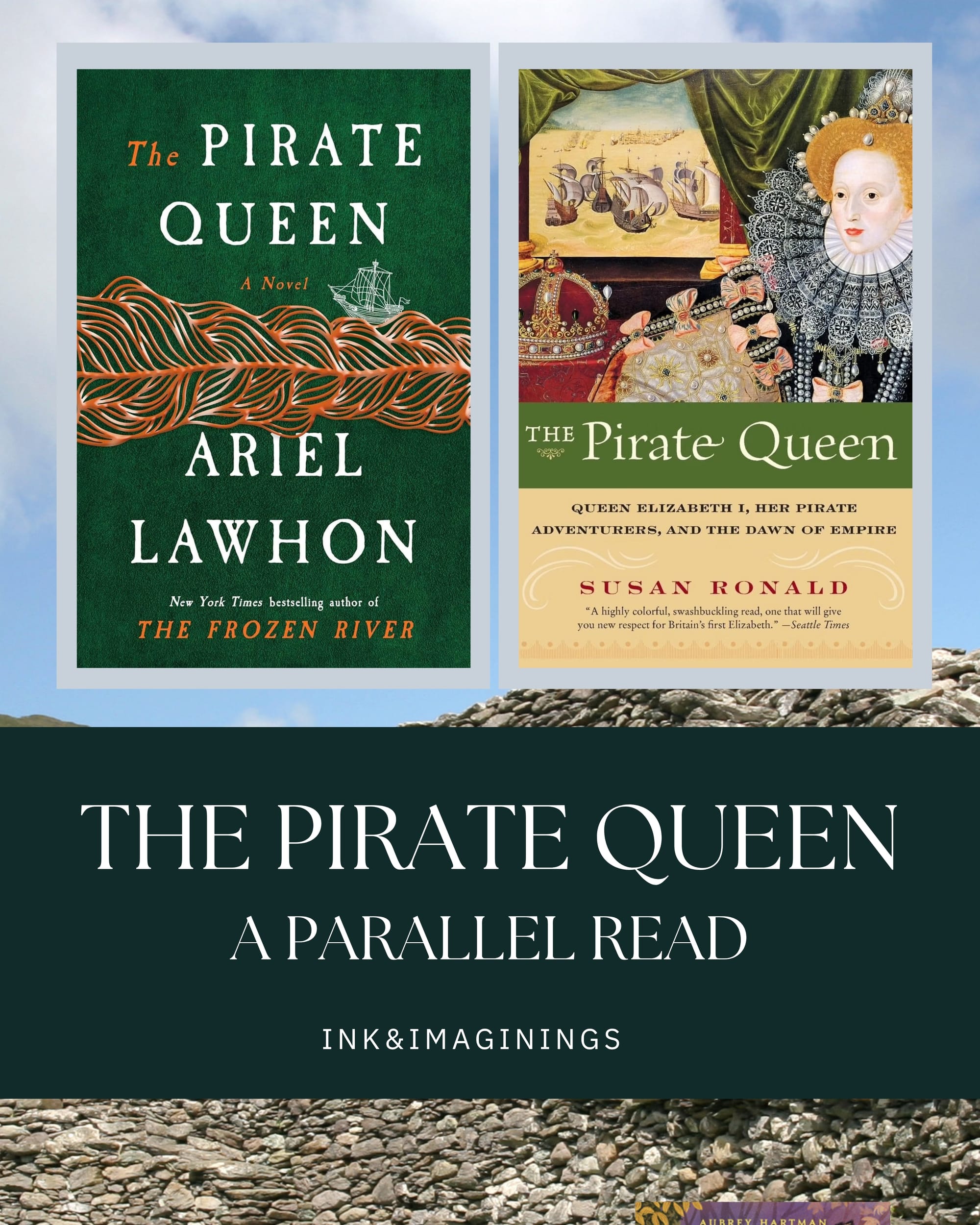
There are two books called The Pirate Queen. They were published nineteen years apart. They're about two different women who were alive at the same time, on opposite sides.
Ariel Lawhon's 2026 novel is about Grace O'Malley, the Irish chieftain who commanded a fleet out of Clew Bay. Susan Ronald's 2007 history is about Elizabeth I and the licensed sea raiders who made her solvent. Read either one alone and you get a great story. Read them together and you get a much fuller picture. You also get a fairly uncomfortable argument about who gets called a pirate.
This was the first of my fall parallel reads and it made me even more excited for the next one! Up next is The Birthing Tree and A Midwife's Tale: The Life of Martha Ballard.
The Two Books
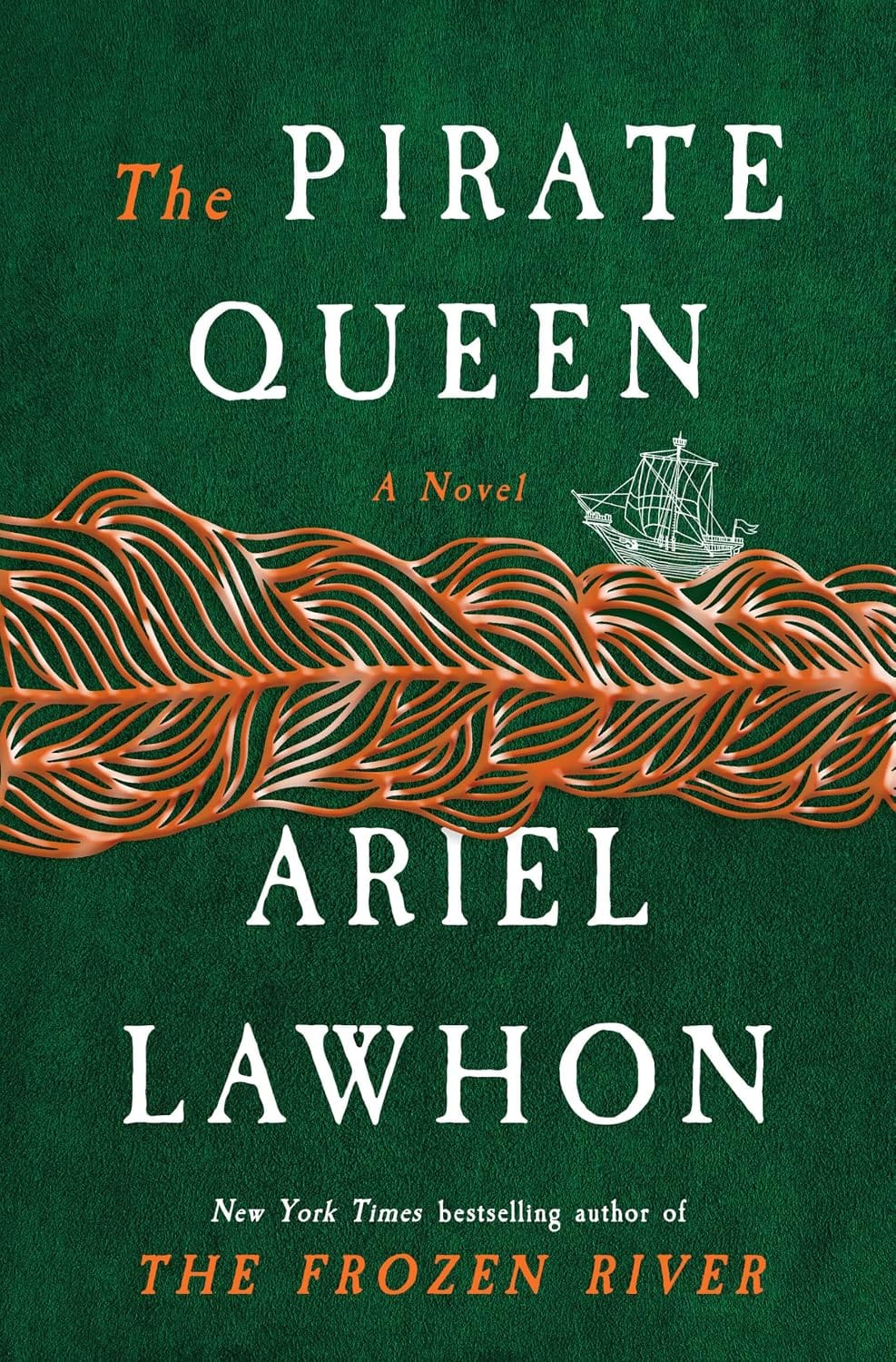
The Pirate Queen by Ariel Lawhon (Doubleday, 2026)
Historical fiction based on the life of Grace O'Malley told in three strands labelled Maiden, Mother and Matriarch. They're braided in the shape of a Trinity Knot. She's born into a seafaring lordship on the Mayo coast. Married twice. Widowed twice. She spends her sixties watching an English governor take apart everything she built. If you want the plot, I've got the full chapter-by-chapter recap with spoilers (coming soon).
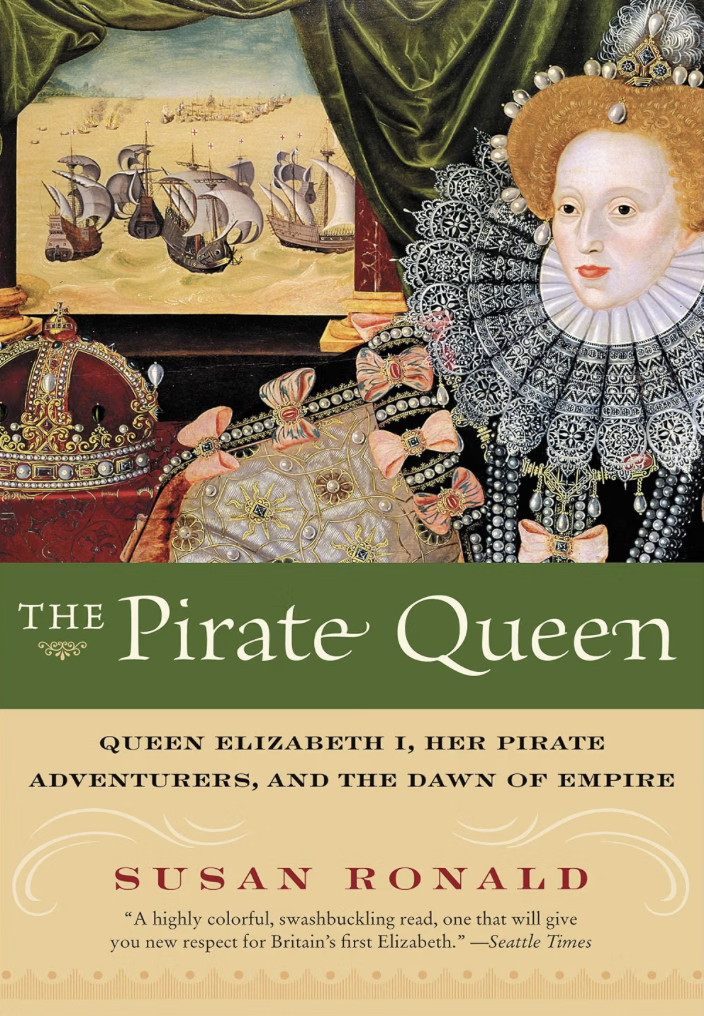
The Pirate Queen by Susan Ronald (HarperCollins, 2007)
Narrative history, and the queen in this title is Elizabeth. Ronald argues that England went from a broke island on the edge of Europe to the seed of a global empire. It got there on the back of state sanctioned piracy. And Elizabeth knew exactly what she was buying. Drake, Hawkins, Frobisher, Raleigh. Ronald worked from the state papers and from thousands of letters between Elizabeth and the men she was quietly funding.
📖 Buy on Amazon | 🎧 Listen on Audible
What Ronald Teaches Us
England inherited weakness. Elizabeth came to the throne in 1558. The treasury was close to empty. Calais had just been lost. The religious settlement was in pieces, French troops sat in Scotland, and Ireland was unstable. There was no dependable standing army, and the navy had been neglected. So, two needs: peace at home and money to defend it.
So she bought time. She played France and Spain against each other. She kept each one more frightened of the other than of England. Marriage negotiations became decoys. The 1559 religious settlement was deliberately imperfect. It didn't fully satisfy either side, but it limited civil war. "Elizabeth's early advantage wasn't strength. It was time, spent making weakness less visible."
Then she licensed the plunder. Merchant Adventurers, naval officers, courtiers and younger sons put their own fortunes into voyages. Those voyages might return trade, intelligence or prizes. A letter of reprisal was a royal license to seize foreign property after you'd failed to get justice abroad. In practice, it blurred compensation into organized robbery. On the same voyage, a merchant could carry cloth, sell weapons, raid a rival and call it patriotism. Admiralty officials and investors took shares of registered prizes. So everyone who could've stopped it was paid not to.
And the hybrid became an empire. Not by design. Commerce, naval defense and piracy kept reinforcing each other. Eventually the thing they'd built was too profitable to dismantle.
Ronald's proof that the lines had already collapsed is the Primrose. In 1585, English merchants accepted Philip II's invitation to bring corn to Bilbao. Spanish officials then tried to seize their ships under an order against Protestant shipping. The Primrose fought its way out. It carried off the Spanish officials and their written commission. Commerce, diplomacy and war were already the same activity. Now Elizabeth had the paperwork to prove it.
📖 Buy on Amazon | 🎧 Listen on Audible
Why the Pairing Works
Same decades. Same sea. Two completely opposite verdicts on the same behavior.
In Ronald's book, raiding is policy. Elizabeth issues the license, takes her cut and knights the men who bring home Spanish silver. The word pirate is a matter of paperwork. If the Crown licensed you, you were a privateer. And a hero.
In Lawhon's book, the same activity gets a woman's family destroyed. Grace levied tolls on ships fishing her own waters. That's closer to a coastguard collecting a fee than to anything piratical. The English administration in Connaught called it rebellion. Nobody was going to knight her.
So you've got two books using one word to mean two opposite things. The difference isn't what the women did. It's who had the authority to name it.
Where the Two Books Touch
1. Ireland, which is the real hinge
Ronald's Ireland chapter is what makes this pairing more than a novelty. Ireland is where her argument stops being a story about clever statecraft.
English rulers treated Ireland as the back door. Spain, the papacy or Scotland might come through it. That fear justified plantations, military campaigns and the replacement of Irish law with English rule. Sir Humphrey Gilbert used terror as an explicit method. He lined paths with the severed heads of the people he'd killed. In July 1575, English forces under Sir John Norreys took Rathlin Island. The garrison surrendered on terms. The terms were honoured for the constable and his family. Roughly six hundred other people were killed anyway. About two hundred defenders, and more than four hundred civilians who'd hidden in the caves. They were Sorley Boy MacDonnell's people, largely women and children. He watched from the mainland and couldn't reach them.
The Lord Deputy, Sir Henry Sidney, ordered the operation, together with Walter Devereux, the first Earl of Essex.
Hold that name. In 1576, one year after Rathlin, the same Sir Henry Sidney met Grace O'Malley. He wrote her down admiringly as a most famous feminine sea captain. He noted she'd offered him three galleys and two hundred fighting men.
Same administrator. Same island. Twelve months apart. One of the most quoted compliments Grace ever received came from the pen of a man who'd signed off on Rathlin. That's the whole relationship between these two books in a single sentence. Lawhon uses the phrase as a chapter title. It's real. And knowing where it came from does something to it.
2. The Armada, from both ends
Ronald's privateers are the men who fought the Armada. Lawhon has a chapter set in 1588. In it, Grace is dragging thirty seven drowned Spanish sailors off the beach at Clare Island. Then she's smuggling a hundred survivors over the hills to fund a rebellion.
That isn't novelist's license. Bingham's actual standing order was that Armada survivors washing up on the Connacht coast be brought to Galway and put to death. So the same event is a national deliverance in one book. In the other, it's a hundred men on a beach who'll be executed if anyone talks.
3. Greenwich, 1593, and the handoff
In September 1593, Grace sailed to England. Elizabeth received her at Greenwich. She was in her sixties. Her eldest son had been murdered in English custody. Her youngest son and her brother were imprisoned at Athlone. Bingham had taken her herds and lands.
Before the audience, Lord Burghley sent her eighteen written questions. Not an interview. Not a trial. An audit of what she owned and how she'd come by it. She answered all eighteen in writing. The questions and her answers survive in the State Papers in London.
The meeting lasted hours. Nobody wrote down a word of it.
What we have is what Elizabeth ordered afterwards. Release Tibbott and Dónal. Make provision for Grace from her sons' estates. Instruct Bingham to let them hold their lands in peace. Then comes the part the stories leave out. Bingham stonewalled the order. Grace had to threaten to sail back to England to force compliance. And he stayed Governor of Connaught until 1596. A Tudor grant and a Tudor governor were different instruments. The second didn't always obey the first.
Here's the handoff. That same year, 1593, the Nine Years' War began. Hugh O'Neill, Earl of Tyrone, eventually led it with Hugh Roe O'Donnell. The second Earl of Essex, son of the man who ordered Rathlin, arrived in 1599 with seventeen thousand men. He made an unauthorised truce with O'Neill and left Ireland without permission. He was executed after a failed coup. Charles Blount, Lord Mountjoy, replaced him and won, mainly by starving Ulster. Three and a half thousand Spanish troops finally landed at Kinsale in 1601. Wrong end of the country. The Irish had to march the length of Ireland in winter to reach them, and they were routed.
O'Neill signed the Treaty of Mellifont on 30 March 1603. Elizabeth had died on 24 March. Nobody told him. He surrendered to a dead queen's authority. He's said to have wept when he found out, because he'd have had far better terms from her successor.
Grace O'Malley died the same year. Ronald's book carries the policy all the way to its end. Lawhon's stops with one woman in a bed at Rockfleet. They finish within months of each other.
The Drake Problem
Read the Ronald first and you'll come away liking Francis Drake. You should. He was extraordinary. He learned the Spanish silver route by watching it and by questioning prisoners. He also learned it from the Cimarrones, escaped Africans who knew the jungle and the Spanish defences. In 1573, a small mixed English and Cimarrone force hit the mule trains crossing the Isthmus of Panama. They took a fortune, though many men died. In 1579, the Golden Hind took the Cacafuego with silver, gold and jewels. The circumnavigation was partly strategic necessity. After raiding the Pacific coast, sailing home through Spanish waters would've meant capture.
He was also at Rathlin.
Drake commanded the naval side of the operation. He blockaded the island so no Scottish relief could reach it. That's what the serious Drake biographers put him there doing. He did not storm the castle, and he didn't hunt people in the caves. I want to be accurate about that. But Sorley Boy MacDonnell watching helplessly from the mainland is a description of Drake's blockade working. Norreys later gave up the island, because it couldn't be held without intercepting Scottish galleys. So around six hundred people died to take a place that was abandoned by September.
Twelve years later, in April 1587, Drake sacked Cádiz and set the Armada back by a year. It's one of the genuinely decisive acts of the reign.
Both of those are the same man. And that's the whole point of Ronald's book: England couldn't have had the second without being the kind of state that did the first. That's the argument the pairing puts in front of you. I don't think the novel alone quite gets you there.
What Is Actually Documented
Reading Ronald trains you to notice what a source is for. That matters enormously on the Irish side. Almost everything known about Grace O'Malley comes from English administrative records, written by the government dispossessing her. There's no Irish annal entry for her. There are no letters in her hand.
So a lot of what gets repeated is folklore. Some of it is folklore built backwards out of a mistake.
- The haircut. The story goes that she cut her hair to shame her father into taking her to sea. Supposedly that gave her the name Gráinne Mhaol, Bald Grace. Anne Chambers showed that Ó Máille is pronounced locally as something close to Maolya. So Gráinne Ní Mháille slides into Gráinne Mhaol by simple mishearing. The name was always the family name. Somebody heard it wrong and invented a haircut to explain it.
- Howth Castle. The closed gates, the abducted heir, the ransom of a standing promise that a place is always laid for a stranger. No source. Howth still lays the plate.
- The handkerchief at Greenwich, the refusal to bow, the concealed dagger, the declined title. All folklore.
- Latin with the Queen. Chambers thinks they most likely spoke English, since every indication is that Grace had it. No transcript exists either way. But the Latin version has nothing behind it.
- Born at sea. The one everyone assumes is invented is the best documented of the lot. Chambers found a Latin document confirming Tibbott was born aboard ship. That's why he's Tibbott na Long, Toby of the Ships. The pirate attack the next morning isn't corroborated. The birth is.
None of this makes the novel worse. It makes it better, because you can watch Lawhon choosing.
Reading Order
Fiction first.
Lawhon gives you a person to care about. Ronald gives you the machine that person was standing in front of. In that order, the history reads like the answer to a question you've already got. Reversed, the novel risks feeling like it's correcting you.
The exception is if you already know the Elizabethan material well. Even then, start with Lawhon and use Ronald as the chaser. Either way, don't read Lawhon's author's note early. She says so herself, and she's right.
Get the Lawhon physically if you can. There's a cast of characters and a pronunciation guide in the front, and maps on the endpapers. It was immensely helpful.
Who This Pairing Is For
You'll love it if you like historical fiction that doesn't tidy its heroine up. Or if you've ever wanted to know how the British Empire actually started. Or if you're the kind of reader who finishes a historical fiction novel and have to know what really happened.
Frequently Asked Questions
Are the two Pirate Queen books related?
No. Ariel Lawhon's 2026 novel is about Grace O'Malley. Susan Ronald's 2007 history is about Elizabeth I and her privateers. Same title. Different queens, different publishers, nineteen years apart. They just cover the same decades from opposite sides.
Do I need to read them in order?
No, but I'd read Lawhon first. The novel gives you a person to care about. Then the history explains the system she was up against.
Did Grace O'Malley really meet Queen Elizabeth I?
Yes. The audience took place at Greenwich Palace around 6 September 1593 and lasted several hours. Nobody recorded what was said. What survives is the outcome. Elizabeth ordered the release of Grace's son Tibbott and her brother Dónal. She instructed Bingham to let the family hold their lands. Bingham then ignored the order and stayed Governor of Connaught until 1596.
What were the eighteen articles?
Eighteen written questions, drafted by William Cecil, Lord Burghley, in July 1593. They asked Grace to account for what she owned, how she made her living, whom she'd married and what each marriage brought her. She answered all eighteen in writing. The originals are in the State Papers in London. Anne Chambers reproduced them in her biography Granuaile.
Was Francis Drake really involved in a massacre in Ireland?
He was at Rathlin Island in July 1575. He commanded the naval element of an operation in which around six hundred people were killed after surrendering. His documented role was the blockade that stopped any relief reaching the island. He didn't lead the attack itself. Twelve years later, he sacked Cádiz and delayed the Spanish Armada by a year.
Which book should I buy if I only want one?
Lawhon if you want a story. Ronald if you want the argument about where the empire came from. They're doing genuinely different jobs.
One Last Thing
Grace O'Malley almost certainly never called herself a pirate queen. That framing is Victorian and modern. People put it on her afterwards, because they found her easier to enjoy as a character than to reckon with as a chieftain. Elizabeth never called herself one either.
Two women, one ocean. The only real difference between a pirate and an admiral was whose paperwork you were holding.
If you try this pairing, come and tell me which one you read first. And whether you'd do it that way again.
