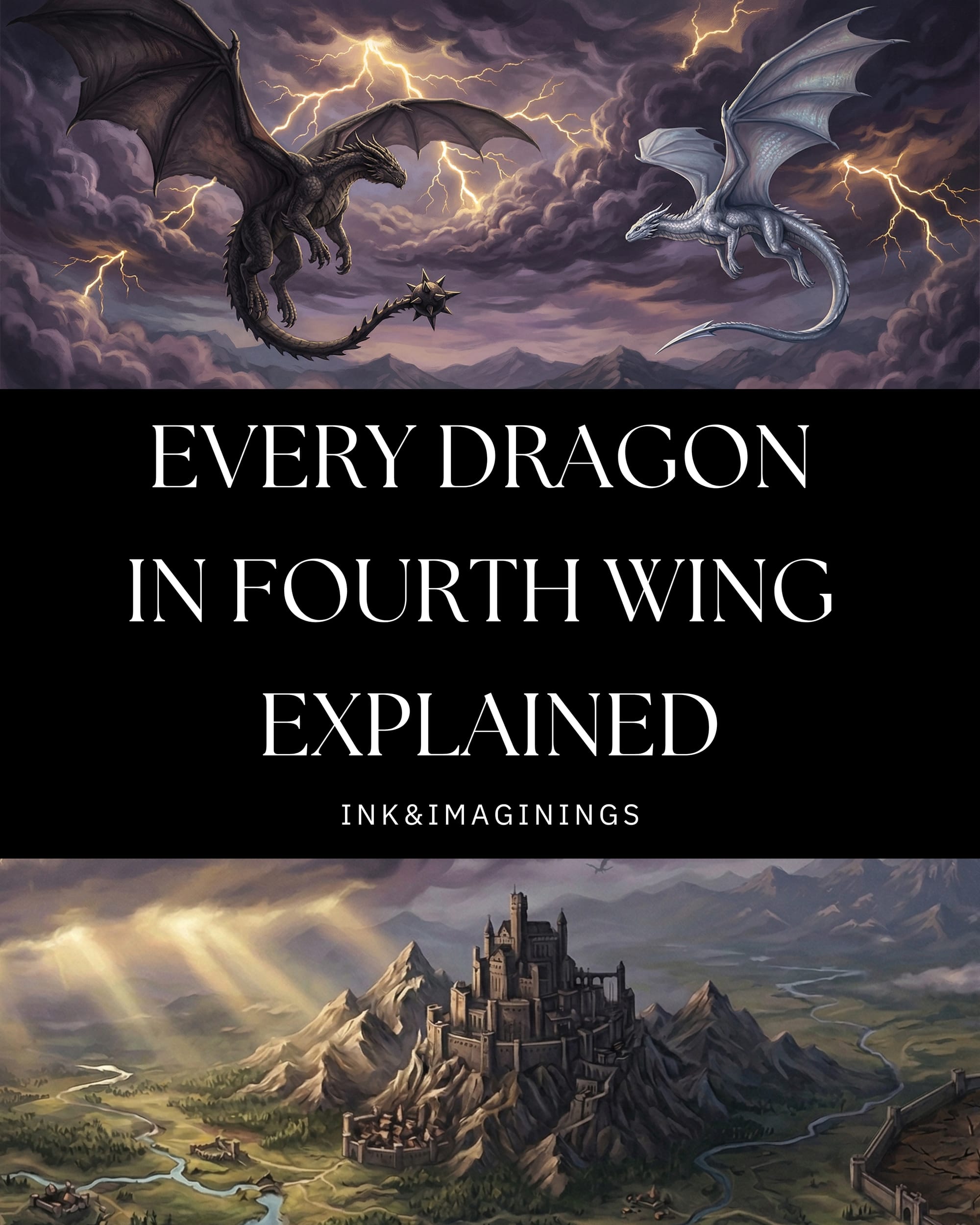
The dragons of the Empyrean series are not pets. They are ancient, intelligent, and politically organized. They choose whether a human is worthy of surviving their presence and most of the time the answer is no.
If you're reading Fourth Wing and trying to keep the colors, tail types, bonding rules, and Gaelic names straight, this guide is for you. If you've already read the series and want a reference you can come back to, bookmark this page. This guide covers every dragon breed, tail type, and bonding in the Empyrean series through Onyx Storm (Book 3).
And if you're brand new to the series, start with our Fourth Wing reading order first.
Caught up on Onyx Storm? Our ending explained post breaks down every major reveal from Book 3, including what happened to Andarna's bond.
Spoilers ahead for all three books.
Fourth Wing by Rebecca Yarros Book Cover
📖 Buy on Amazon | Buy on Bookshop.org | 🎧 Listen on Libro.fm
This post contains affiliate links. If you sign up or make a purchase through these links, I may earn a commission at no extra cost to you. Thank you for supporting Ink&Imaginings.
Quick navigation
- How bonding works
- Dragon colors, and what each one means
- How to approach each color
- Every tail type
- The dragon lineages
- Every named dragon and their rider
- How signets work
- What the names mean
- FAQ
The history of dragons and riders: the First Six
Six hundred years before the events of Fourth Wing, a group of six humans approached dragon-kind and proposed an alliance. Together they created the wards, magical barriers protecting the kingdom of Navarre from external threats. Dragons needed humans to physically weave the wards. Humans needed dragon magic to power them.
That mutual need became the foundation of the rider system, Basgiath War College, and everything that follows in the series. Without the First Six, there would be no riders, no signets, no war college and of course no story.
This history matters, because it establishes something critical about the dragon-human relationship: it was never about domestication. It was a negotiation between equals.
The dragons agreed to bond with humans because they needed something from them, not because they were tamed. That distinction is made very clear throughout the series.
What is the Empyrean?
The Empyrean is the political governance of dragon-kind. It operates entirely independently of human politics. Humans have no knowledge of what happens within Empyrean meetings and no influence over dragon law. When a meeting of the Empyrean is called, bonded dragons do not communicate with their riders about what was discussed. This is a hard rule with no exceptions. Even Tairn, who is generally forthcoming with Violet, goes completely silent when it comes to Empyrean business.
There is a clear hierarchy among dragons based on power and age, with deference paid to elders, but the specifics of how they make laws and govern themselves remain largely unknown to human characters and to us the readers. This is one of the biggest open mysteries heading into Book 4.
How dragon bonding works in Fourth Wing
Dragons choose riders. Riders do not choose dragons. This happens during Threshing, the annual event at Basgiath War College where dragons who are willing to bond evaluate the cadets and decide whether any are worthy.
"Worthy" is subjective and varies by dragon. Some value courage. Some value intellect. Others value temperament. What's consistent is that the human has no say. A dragon will either bond with you, ignore you, or incinerate you. In Violet's Threshing year, approximately 100 dragons were willing to bond, down from 137 the year before and 163 the year before that.
Once a dragon bonds with a rider, several things happen. The dragon leaves a relic on the rider's skin. A tattoo-like mark, often in the shape of the dragon itself, representing the bond. The dragon begins channeling its power through the rider, which eventually manifests as a signet. And the bond becomes permanent: if the dragon dies, the rider almost always dies too. The reverse isn't always true, but the loss of a rider can devastate a dragon and each subsequent bond a dragon forms with a new rider is stronger than the last.
One critical detail: Violet Sorrengail is the only known rider in history to bond with two dragons simultaneously. Tairn and Andarna. As far as the professors at Basgiath know, this had never been done before Violet's Threshing.
If you're curious about how Violet's double bond plays out across the series, our Fourth Wing Book 4 news page tracks every confirmed detail about what's coming next.
Mated dragon pairs
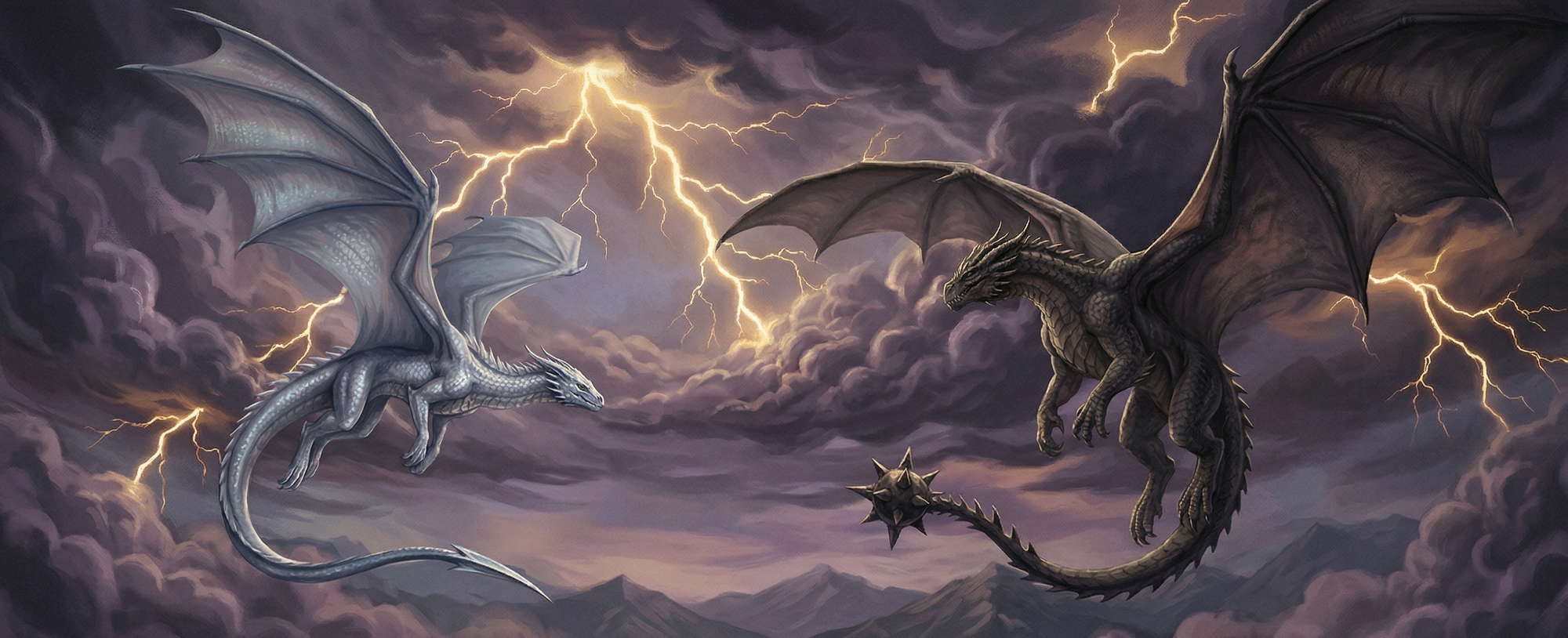
Some dragons are mated to each other. This is the strongest bond in the dragon world. It is stronger than the rider bond and stronger than any human equivalent. Colonel Kaori's Field Guide to Dragonkind notes that there is no stronger bond than that between two mated dragons. It goes beyond love or adoration to something primal and undeniable.
Mated dragons cannot be separated for extended periods, roughly three days, without their health deteriorating. They mate for life. When mated dragons bond with riders, they typically choose cadets in the same year so the riders can graduate together and be stationed at the same post. This means if two mated dragons choose two riders, those riders' lives become permanently entangled, whether they want to be or not.
Tairn and Sgaeyl are the strongest mated pair in centuries. It is believed that over time, they will be able to communicate from any distance. Their bond is so strong that the forced proximity between Violet and Xaden is essentially a dragon-mandated arrangement, which creates one of the most compelling romantic dynamics in the series.
Violet and Xaden are one of the best enemies to lovers pairings in romantasy, forced together by their mated dragons long before they trust each other.
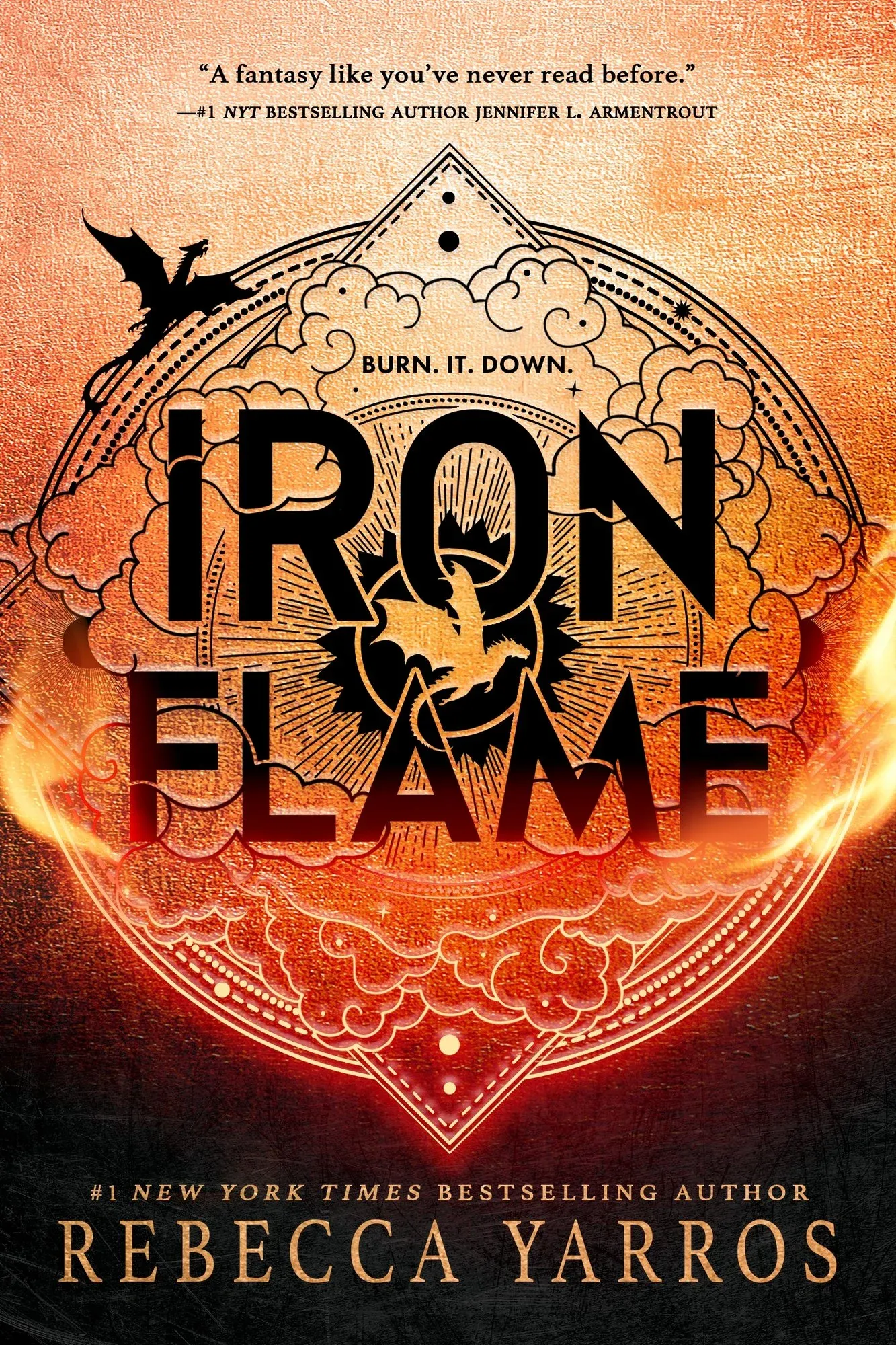
Iron Flame by Rebecca Yarros Book Cover
📖 Buy on Amazon | Buy on Bookshop.org | 🎧 Listen on Libro.fm
Dragon colors: what each color means
Dragon color isn't just cosmetic, each color comes with distinct temperamental traits, reputations, and approach protocols that riders are expected to know. Misreading a dragon's color can get you killed before Threshing even starts. Here's what the series tells us about each color.
Black dragons: the rarest and deadliest
The rarest, smartest, most cunning, and most deadly dragons in Navarre. No black dragon had been born in a century before the events of the series. Black dragons are considered the most discerning in choosing riders, and bonding one is an extraordinary event that sends ripples through the entire war college.
The only known black dragons in the series are Tairn (a Morningstartail bonded to Violet) and Codagh (a Swordtail bonded to General Melgren). Codagh is the only dragon in active service larger than Tairn. Which tells you something about the power structure at the top of Navarre's military.
Blue dragons: ruthless and powerful
Blue dragons are ruthless and among the most dangerous in the series. Blue Daggertails are the rarest subcategory of blues, and Sgaeyl, Xaden's dragon, is the most powerful blue in active service. No blue dragons were willing to bond during Violet's Threshing year, though several are serving along the Esben Mountains where fighting is the most intense.
Sgaeyl is a particularly fascinating dragon. She doesn't abide by rules. She bonded the relative of one of her previous riders, which is typically forbidden. Her last rider before Xaden was fifty years earlier. She is fierce, independent, and doesn't defer to anyone except Tairn, her mate. Her personality mirrors Xaden's in many ways.
Green dragons: the intellectuals
Known for keen intellect, green dragons descend from the honorable Uaineloidsig line and are considered the most rational and reasonable of all dragon types. This makes them excellent siege weapons. Especially Green Clubtails, whose combination of intelligence and devastating tail power is prized in combat.
When approaching a green dragon, lower your eyes in supplication and wait for their approval. And never back down from one. They respect strength and will test you. Notable greens include Teine (bonded to Mira Sorrengail, Violet's sister) and Feirge (a Green Daggertail bonded to Rhiannon Matthias, Violet's best friend).
Red dragons: quick to temper
Reds are the quickest to temper in the Empyrean world, especially Red Scorpiontails. The approach protocol for reds is specific: never look a red dragon in the eye, and approach from the left and from the front. They are fierce and aggressive but intensely loyal once bonded.
Notable reds include Deigh (a Red Daggertail bonded to Liam Mairi, whose signet was farsight), Sliseag (a Red Swordtail bonded to Sawyer Henrick), and Cath (a Red Swordtail bonded to Dain Aetos).
Orange dragons: the unpredictable ones
The most unpredictable dragons in the series. They descend from the Fhaicorain line and come in shades from apricot to carrot. Orange dragons are considered risky bonds, and fans have developed a compelling theory about them: many of the series' least trustworthy characters like Jack Barlowe, Varrish, and Amber, are bonded to oranges.
However, not all orange riders are villains. Brennan Sorrengail (Violet's brother, presumed dead for most of Book 1) is bonded to Marbh, an Orange Daggertail, and Imogen is bonded to Glane, also orange. Whether the "orange dragon = untrustworthy rider" theory holds up or Yarros is deliberately subverting it is one of my favorite ongoing debates in the fandom.
Brown dragons
Brown is the color Yarros has told us the least about, and after three books plus Threshing Day that starts to look deliberate.
Browns have no named lineage. No stated reputation. No approach procedure. The only characterization in the entire series is a warning not to show one fear, and the sentence doesn't even finish itself.
What we do have is riders. Aotrom is a Brown Swordtail bonded to Ridoc Gamlyn, and his Threshing story is the one where a dragon tests a cadet's wit by splashing him with water and sap and then climbing a redwood to see if he'll follow. Aimsir belongs to General Lilith Sorrengail, which puts a brown under the most powerful officer in Navarre. And Threshing Day gave us Chradh, a Brown Scorpiontail who sought Garrick Tavis out specifically for his bloodline and his willingness to put himself in front of other people.
Three browns, three riders nobody would call unimportant. If you've been reading browns as the ordinary ones, that's a habit imported from other dragon books. Yarros hasn't written them that way. She just hasn't written them much at all yet.
Gold dragons and the feathertail reveal
This is where things get complicated, and it's one of the biggest reveals in the series.
For most of Fourth Wing and into Iron Flame, feathertails were believed to be their own breed. Small, golden dragons who abhor violence and are unsuitable for bonding. They are kept in the Vale, far from humans, which created the misconception that they were a separate species entirely.
The truth is different: feathertails are the juvenile stage of all dragons. They are golden because they haven't matured enough to take on the color of their den. Every dragon starts as a feathertail before developing into their adult color and tail type. This means Andarna, who bonded with Violet as a feathertail, will eventually grow into an adult dragon of unknown color and tail type.
Feathertails don't have claws, can't breathe fire, and can't carry a rider. They also can't form a traditional dragon-rider bond with a signet. But they possess a unique ability: they can gift their full power to a bonded human. This power is unpredictable and unstable, and the feathertail risks draining itself completely in the process. What Andarna will become when she fully matures is one of the biggest mysteries heading into Book 4.
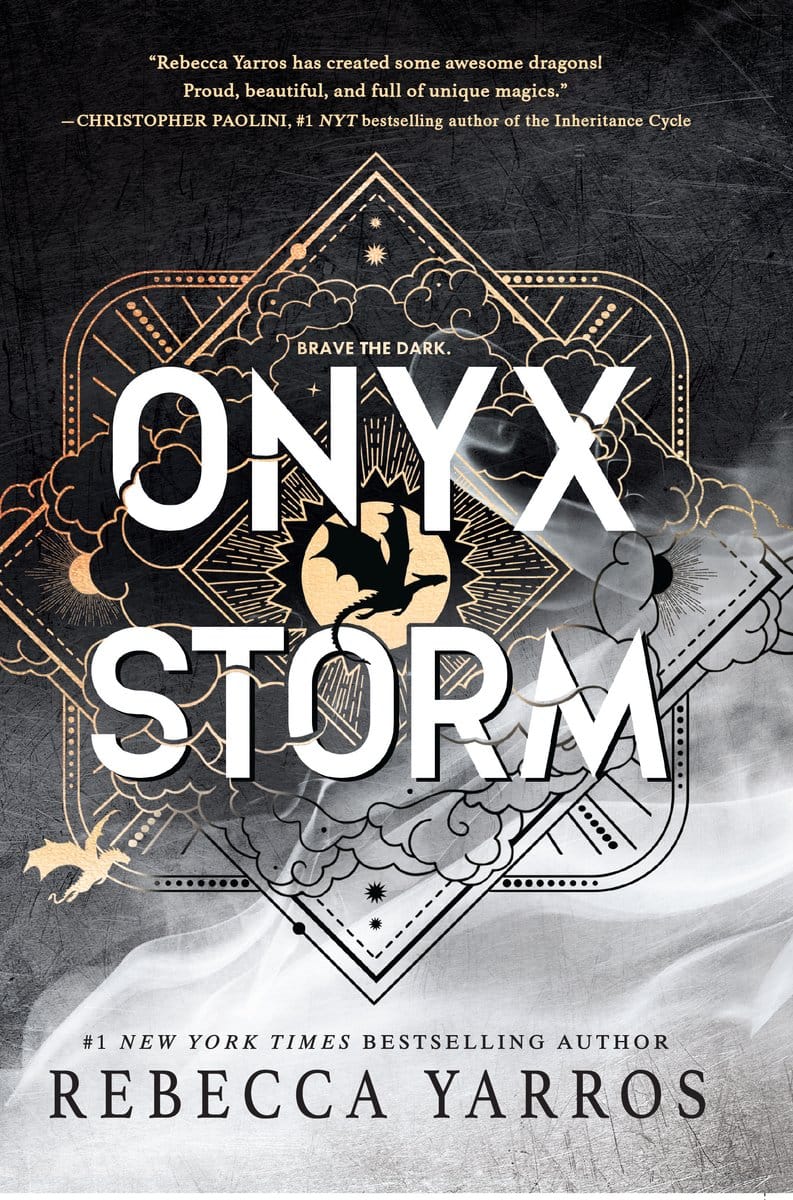
Onyx Storm by Rebecca Yarros Book Cover
📖 Buy on Amazon | Buy on Bookshop.org | 🎧 Listen on Libro.fm
How to approach each dragon color
This is the question I get asked most, and the honest answer is that the field guide gives you less than you'd expect.
Colonel Kaori's Field Guide to Dragonkind hands cadets exactly one line of real procedure, and it covers three colors at once: never look a red in the eye, never back down from a green, and if you show fear to a brown, don't. That's it. That's the whole published protocol.
Everything else riders know is temperament, not procedure. Professor Kaori says as much in class: keep each breed's temperament in mind when you decide which dragons to approach and which to run from. He's telling cadets to read the animal, not follow a checklist.
So here's what's actually written down, color by color, and where the guide goes quiet.
Green: lower your eyes
The only color with a full positive procedure. Lower your eyes in supplication and wait for approval. Then never back down.
Those two instructions sound contradictory and they aren't. You defer first, and once you've been acknowledged you hold your ground. Greens are the most rational of dragonkind, so they're reading you for judgment, not for fear.
Red: never meet their eyes
Never look a red in the eye. That one's absolute.
The left-and-front rule you'll see quoted everywhere is real, but it's narrower than people repeat. In Dragonkind class it comes up about Red Scorpiontails specifically, the quickest to temper of any breed, not reds as a whole. Worth knowing if you're the kind of reader who likes the rules precise.
Brown: don't show fear
A prohibition rather than a procedure, and the whole entry is a shrug. Don't show trepidation to a brown. The guide doesn't finish the sentence, which tells you what happens if you do.
There's no positive instruction for browns anywhere in the books. No posture, no angle, no eye contact rule.
Black, blue and orange: nothing
Here's the part worth sitting with. The books give you no approach protocol for black, blue or orange dragons at all. Only temperament.
Blacks are the smartest and most discerning, and there's no outsmarting one. Blues are the most ruthless, and Blue Daggertails can disembowel with a flick. Oranges are the most unpredictable of dragonkind and always a risk.
All true, all useless at the moment one walks toward you.
If you've read that Blue Daggertails "should not be approached," that line comes from fan guides, not from Yarros. And for blacks it makes a grim kind of sense that no procedure exists. Only two have been alive in a century, and neither of them was ever in the ordinary Threshing pool.
Gold: a different rule entirely
Feathertails get a prohibition instead of a protocol, and it's about bonding rather than approaching. Feathertails are the breed riders know least about, they reportedly abhor violence, and they aren't suitable for bonding.
Iron Flame explains why that warning exists. A feathertail is a juvenile, and a juvenile's power is unstable. Bond one too young and it can hand you everything it has, which is exactly what burns a rider out.
The dragon lineages explained
Lineage is the part of the lore that gets mentioned constantly and explained almost never, so let's do it properly.
A line isn't just a bloodline. It's a bloodline attached to a place. Each named lineage traces back to specific ancestral hatching grounds, and because scale color is hereditary, each line runs to a single color. The Dubhmadinn hatched in the thermal valley above Riorson House. The Uaineloidsig came out of the Steelridge range. Reds nest in the limestone cliffs at the edge of the Dunness River, though that line never gets a name.
Lines also carry a reputation. The books attach adjectives to them the way you'd describe a family: the honorable Uaineloidsig, the cunning Dubhmadinn, the extraordinary Gormfaileas.
The five named lines
Dubhmadinn is the black line, and it's the only one with named members. Codagh and Tairn both descend from it, which is why two of the greatest dragons of their generation share an origin. Note the spelling: one h, not two.
Gormfaileas is the blue line. Formidable size, the most ruthless temperament, and the rare Blue Daggertail at the top of it.
Uaineloidsig is the green line. Honorable, keen intellect, the most rational of dragonkind.
Fhaicorain is the orange line. Apricot through carrot, and the most unpredictable of dragonkind.
Cruaidhuaine is the one almost nobody mentions, and it's the most interesting. It's a line inside green. Greens from the Cruaidhuaine have an unusually stable connection to magic, which some riders put down to their defensive nature. That's not trivia. It's the reason greens hold the wards at Basgiath.
What the books don't tell us
No line is named for brown or red. There's no count of how many lines exist. And nothing explains whether a line can cross colors, or what else travels down one besides scales.
Individual dragons are almost never assigned to a line on the page. Codagh and Tairn are the exceptions. Everyone else gets sorted by color, which is probably right given that color is hereditary and lines are color locked, but the books don't actually say it.
One housekeeping note, since I keep seeing it asked. If you've come across a lineage called Berradhyr, I can't find it anywhere in the first three books, and I'd rather tell you that than make something up. If you've got a page number, send it to me and I'll add it.
Every dragon tail type explained
| Tail type | What it does | Known example |
|---|---|---|
| Morningstartail | A spiked ball of a tail, and a killing machine. Tairn is the only one we've met. | Tairn |
| Daggertail | Knifelike spikes at the tip. A Blue Daggertail can disembowel with one flick, which makes it the rarest and most lethal combination in the quadrant. | Sgaeyl, Feirge, Deigh |
| Swordtail | A long blade edge. Common, and brutally effective. | Codagh, Sliseag, Aotrom |
| Clubtail | Blunt force. Green Clubtails make superb siege weapons. | Teine, Molvic |
| Scorpiontail | Venomous barbs and a sting that kills fast. Red Scorpiontails are the quickest to temper of any breed. | Baide, Chradh |
| Feathertail | Not a breed at all. It's the juvenile stage, before claws, fire and the strength to carry a rider. | Andarna |
How signet powers work
A signet is the magical ability a rider develops after bonding with a dragon. It's the result of the unique chemistry between rider and dragon. Yarros repeatedly emphasizes that the signet says more about the rider than the dragon. The stronger the bond and the more powerful the dragon, the stronger the signet.
Signets are not instant. A rider may bond with a dragon and wait weeks or months before their signet manifests. Violet took longer than most first-years to develop hers, the ability to wield lightning, but when it arrived it was worth the wait. Some riders develop a rare second signet, which indicates an exceptionally strong bond. This is remarkable enough to draw attention from the highest levels of Navarre's military.
Dragons also channel lesser magic through their riders. Smaller abilities that don't constitute a full signet but are still useful. These include opening doors without touching them, preternatural speed, manipulating mage lights, powering ink pens, and placing runes. Lesser magic is available to all bonded riders, not just those with powerful signets.
Every named dragon and their rider
Nineteen dragons now have names, riders or both. Threshing Day added six of them and filled in tail types for two more.
| Dragon | Color and tail | Rider | Signet |
|---|---|---|---|
| Tairn Tairneanach | Black Morningstartail | Violet Sorrengail | Lightning wielding |
| Andarna Andarnaurram | Gold feathertail, maturing to scorpiontail | Violet Sorrengail | Second bond |
| Codagh | Black Swordtail | General Melgren | Sees the outcome of battles |
| Sgaeyl | Blue Daggertail | Xaden Riorson | Shadow wielding |
| Molvic | Blue Clubtail | Aaric Graycastle | Not stated |
| Teine | Green Clubtail | Mira Sorrengail | Shielding |
| Feirge | Green Daggertail | Rhiannon Matthias | Not stated |
| Cuir | Green Swordtail | Bodhi Durran | Not stated |
| Deigh | Red Daggertail | Liam Mairi | Farsight |
| Thoirt | Red Daggertail | Sloane Mairi | Not stated |
| Sliseag | Red Swordtail | Sawyer Henrick | Metal manipulation |
| Cath | Red Swordtail | Dain Aetos | Reading memories |
| Marbh | Orange Daggertail | Brennan Sorrengail | Mending |
| Glane | Orange Daggertail | Imogen Cardulo | Not stated |
| Baide | Orange Scorpiontail | Jack Barlowe | Not stated |
| Bregh | Orange Clubtail | Unbonded | Not stated |
| Aotrom | Brown Swordtail | Ridoc Gamlyn | Ice wielding |
| Chradh | Brown Scorpiontail | Garrick Tavis | Not stated |
| Aimsir | Brown | General Lilith Sorrengail | Storm wielding |
Two of Tairn's relatives get named in passing as his sire and dam, Murtcuideam and Fiaclanfuil, though I've only ever seen those on the fandom wiki rather than on the page.
The Gaelic names and what they mean
One of the details fans love most about the Empyrean series is that dragon names are drawn from Scottish Gaelic, and the meanings often hint at the dragon's nature or their rider's signet.
Tairneanach roughly means "thunder," fitting for a dragon whose rider wields lightning.
Andarnaurram roughly means "the second honor," fitting for a dragon who is Violet's second bond.
Sgaeyl relates to concepts of shadow or concealment, fitting for a dragon whose rider controls shadows.
The Gaelic connection suggests Yarros is embedding meaning into every dragon name, which the fandom loves to use to theorize about unrevealed signets and future plot developments. If you want to go deep on the naming patterns, it's one of the most rewarding rabbit holes in the fandom.
Gryphons: the other side of the war
While this guide focuses on dragons, Iron Flame and Onyx Storm introduce a crucial wrinkle to the world-building: gryphons. These half-eagle, half-lion creatures can channel power to their riders (called "fliers" rather than "riders") and come from Poromiel, the nation across the border.
The existence of gryphon riders challenges everything the cadets at Basgiath were taught about who their enemies really are, and about the nature of the wards they've been fighting to protect. We won't go deeper here to avoid major spoilers, but gryphons represent one of the most significant expansions of the Empyrean world.
For readers who love the dragon rider fantasy and want more while waiting for Book 4, our Books Like Fourth Wing list is built around the same energy, dragon bonds, military academies, and enemies-to-lovers tension.
What we still don't know heading into Book 4
Several dragon-related mysteries remain open going into the next book, and they're some of the biggest questions in the entire series.
For the latest on the series, see our Fourth Wing Book 4 tracker.
Andarna's maturation. We've seen her begin the transition from feathertail to adult, but we don't know her eventual color, tail type, or what her full bond with Violet will look like once she's mature. This could fundamentally change Violet's power level.
The Empyrean's internal politics. We know dragons govern themselves but have almost no insight into how decisions are made, who leads, or what they're planning. The fact that this has been kept hidden from readers suggests it matters enormously.
The Gaelic naming patterns. Do they predict future events? Are there dragons whose names hint at signets or roles we haven't seen yet?
The missing twelve hours. The biggest open question from Onyx Storm's ending: what happens to the bond, and to the dragons, during the twelve hours Violet can't remember? Our Fourth Wing Book 4 news page tracks every hint and theory as they develop.
And the question the TV adaptation will eventually have to answer: how do you put Tairn on screen? Our Fourth Wing TV Show tracker follows everything we know about Prime Video's plans.
In the meantime check out our list of Books to Read While You Wait For Book Four.
What Threshing Day added
Threshing Day is thirteen short stories about the day each rider bonded, and for anyone tracking dragons it's the biggest lore drop since Iron Flame. Six new dragons, two corrected tail types, and the first real brown dragon material in the series.
The new names are Chradh, Cath, Cuir, Thoirt, Molvic and Bregh. Teine and Glane finally get tail types. And because every story is told from the rider's point of view, you watch each bond happen from the human side, which is the one angle the novels never gave us.
No dragon has a point of view in it, before you ask. Thirteen stories, thirteen riders.
👉 All thirteen Threshing Day perspectives, and why Violet isn't one of them
Frequently asked questions
What types of dragons are in Fourth Wing? Dragons in Fourth Wing are classified by color (black, blue, green, red, orange, brown, and gold/feathertail) and tail type (clubtail, daggertail, swordtail, scorpiontail, morningstartail, and feathertail). Each color has distinct temperamental traits and approach protocols, and each tail type functions as a different kind of weapon.
How does dragon bonding work in Fourth Wing? Dragons choose their riders during an annual event called Threshing at Basgiath War College. The rider has no say in the process. A dragon will either bond with you, ignore you, or incinerate you. Once bonded, the dragon channels its power through the rider, eventually producing a signet (a unique magical ability). If the dragon dies, the rider almost always dies too.
How many dragons are in Fourth Wing? There are over a dozen named dragons across the three Empyrean books, and approximately 100 dragons were willing to bond in Violet's Threshing year. The total dragon population is much larger. They live in the Vale and only a fraction choose to bond with humans in any given year.
What is a signet in Fourth Wing? A signet is a magical ability that develops in a rider after bonding with a dragon. It results from the unique chemistry between rider and dragon. For example, Violet Sorrengail's signet is lightning wielding, while Xaden Riorson's is shadow manipulation. Some riders develop a rare second signet, indicating an exceptionally strong bond.
What is a feathertail dragon in Fourth Wing? Feathertails are the juvenile stage of all dragons, not a separate breed. They are golden, cannot breathe fire or carry riders, and are kept in the Vale away from humans. They possess a unique ability to gift their power directly to a bonded human, though this drains them dangerously. Andarna, bonded to Violet, is the most important feathertail in the series.
What are mated dragons in Fourth Wing? Mated dragon pairs share the strongest bond in the dragon world. They mate for life and cannot be separated for more than roughly three days without their health declining. When mated dragons bond with human riders, those riders' lives become permanently entangled. Tairn and Sgaeyl are the strongest mated pair in centuries.
What is the Empyrean in Fourth Wing? The Empyrean is the political governance and leadership structure of dragonkind. It operates independently of human politics. Humans have no knowledge of or influence over Empyrean affairs. When the Empyrean meets, bonded dragons do not share what was discussed with their riders.
Want more Empyrean content? Here's everything we've got:
- Fourth Wing Reading Order: Every Book in the Empyrean Series
- Fourth Wing Book 4: Everything We Know
- Books Like Fourth Wing: 15 Picks for Dragon Rider Fans
- Fourth Wing TV Show: Cast, Trailer & Everything We Know
- Books Like ACOTAR: 15 Reads Sorted by What You Loved Most
Want more deep dives into the Empyrean series? Sign up for the Ink & Imaginings newsletter for new posts straight to your inbox.