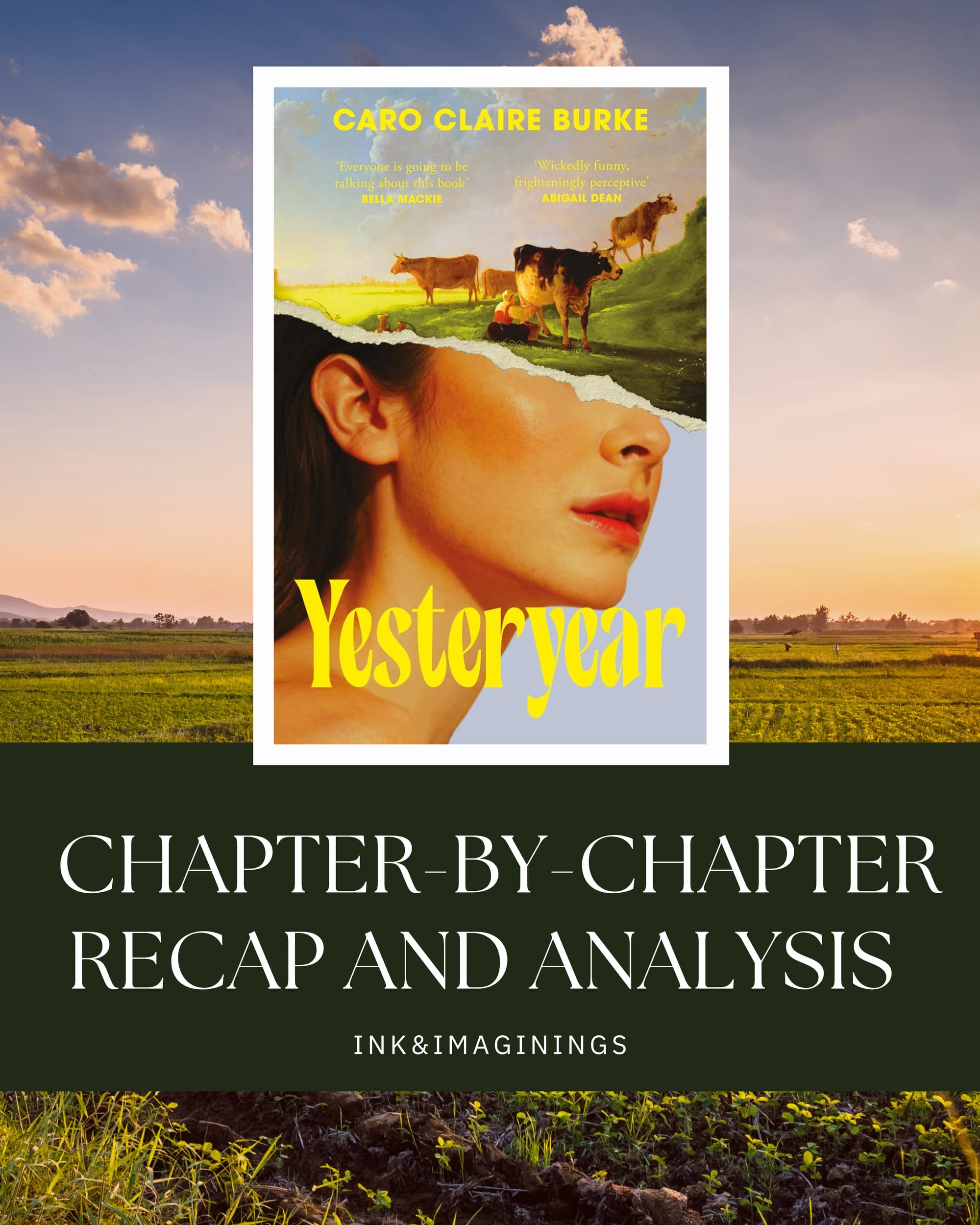
This is the chapter-by-chapter companion for Yesteryear by Caro Claire Burke the GMA Book Club April 2026 pick that eveyone has been talking about. I built this post the way I wish someone had built it for me when I read it.
If you're reading along, treat this as a chapter-by-chapter footnote you can dip into when you want to confirm what just happened. If you've already finished, you can read this start-to-finish as the retrospective walkthrough. A desperate attempt to figure out what just happened.
⚠️ MAJOR SPOILER WARNING: Full spoilers for Yesteryear by Caro Claire Burke, including the central twist, every major reveal, and the ending.
This guide is built for two use cases: 1. reading alongside the book chapter by chapter, or 2.catching up after finishing if you want to retrace the structure. If you haven't finished and want the high-level plot and ending without going chapter by chapter, my full Yesteryear guide is a better fit.
How Yesteryear Is Structured (And the Label Trick You Probably Missed)
Yesteryear is divided into four parts:
- Part One: The Past A short opening section showing Natalie at the peak of her brand: six months pregnant with her sixth child, married to Caleb, running a ranch that is more political backdrop than actual home. The Shannon affair is already in motion. Doug Mills is already pushing Caleb toward office. Everything Natalie is about to lose is already cracking.
- Part Two: The Present The bulk of the novel. 57 chapters that alternate between two timelines on a perfectly regular pattern. Odd chapters (1, 3, 5…) drop us into Natalie's 1855 captivity. Even chapters (2, 4, 6…) are flashbacks that trace her life from Harvard to the moment everything broke. This is where Burke does most of her best work.
- Part Three: The Future The aftermath of the truth. Short. Devastating. Quiet.
- Epilogue: Five Years Later Natalie in prison, interviewed by an old roommate, handed a book.
The label trick: the chapters labeled "Past" in Yesteryear are the 1855 chapters the narrative present where Natalie wakes up trapped. The chapters labeled "Present" are the modern flashbacks. Burke has inverted the labels because Natalie has inverted reality. She believes she's been transported to the past. She hasn't. She's been here the entire time. By the time you figure out which timeline is "actually" past and which is "actually" present, you've already accepted Natalie's version of events as the frame, and Burke has you exactly where she wants you.
Watch for that inversion as you read. It's quiet, but it's an intentional piece of the architecture that I really enjoyed.
This post contains affiliate links. If you purchase through them, I may earn a small commission at no additional cost to you. Thank you for supporting Ink & Imaginings.
Where to Buy Yesteryear
If you haven't picked up your copy yet:

yesteryear by Caro Claire Burke book cover
📖 Buy on Amazon | Buy on Bookshop.org | 🎧 Listen on Audible
How to Read Alongside This Guide
If you're actively reading Yesteryear: I'd recommend stopping by here at the end of each chapter rather than reading ahead. The novel's pleasures depend heavily on Burke's pacing of the reveals, and the "watch for" callouts above are meant to enrich what you've just read, not preempt what's coming.
If you've already finished and you're using this as retrospective analysis: read it straight through. The motifs are easier to track this way, and the structural inversion of the Past/Present labels lands harder once you know how the timelines resolve.
Quick Navigation
- Part One: The Past
- Part Two, Chapters 1–19: Waking and First Theories
- Part Two, Chapters 20–38: Brand-Building and Slow Captivity
- Part Two, Chapters 39–57: Recognition and Collapse
- Part Three: The Future
- Epilogue: Five Years Later
- FAQ
- What to Read Next
Part One: The Past
The novel opens with Natalie Mills at the apex of her constructed life. She's a top-tier Christian tradwife influencer six months pregnant with her sixth child, presiding over a ranch run by nannies and production staff and documented around the clock by her producer, Shannon. The Mills family brand is enormous, and it is also already broken: Caleb is having an affair with Shannon. Senator Doug Mills is pushing Caleb toward a congressional run, with the "legendary" ranch positioned as the political backdrop. Shannon has resigned. Natalie reads the resignation letter and chooses to suppress what she knows, because the brand requires it.
The most useful detail in Part One isn't the affair — it's the framing of the ranch itself. The ranch is described as a "heavily manufactured set funded by Doug Mills's political machine to bury his son's career failures." Hold onto that. By the time you reach the end of the novel you'll understand the ranch isn't a place. It's a containment strategy. Part One ends with Natalie and Caleb praying together for a "legendary" future as a PR catastrophe gathers around them.
Watch for: the word legendary. Burke uses it twice in Part One. Once Natalie wakes in 1855, you won't hear it again for a long time. The brand language goes silent the moment Natalie loses the audience.

Part Two, Chapters 1–19: Waking and First Theories
Chapters 1 through 19 are the disorientation phase. Natalie wakes up in a primitive cabin and spends the first third of the book trying to understand what has happened to her. We also get lots of flashbacks to Natalie's Harvard years, her marriage, and the early years of her brand. By Chapter 19, Natalie has settled on a working theory (this is a reality show) and a survival strategy (perform for the imagined cameras). She's wrong. But the wrongness is the point.
Chapter 1: The Cold Awakening
Natalie wakes up freezing beneath a hand-stitched quilt instead of her luxury duvet. The cabin smells of wood smoke. Children she doesn't recognize file in wearing rough homespun clothes and call her Mama. The hallway has the same floor plan as her real house. Except for the height markings carved into the doorframe, the tallest of which reads MAMA 1855. An older Caleb appears, and when she tries to flee, he knocks her unconscious.
Watch for: the snooze-button detail Burke plants here. Natalie was born with "spades of discipline" and has never used a snooze button in her life. That's not a personality note. That's the trait that makes Yesteryear possible.
Chapter 2: The Departure
Flashback to Natalie's disciplined childhood and her departure for Harvard at seventeen. Her mother Eliza keeps a closely guarded secret: Natalie's father didn't die. He abandoned the family for another woman. Natalie has always felt like an outsider but relishes the prospect of a world where intellect matters more than likability. She waits at the gate determined never to look back.
Chapter 3: The Doctor's Tonic
Back in 1855. Natalie wakes with a pulsing eye and a body that feels old. A girl named Maeve enters. Natalie realizes she is no longer pregnant. Mary — a daughter she does not recognize — is making lavender soap using a technique Natalie once posted as an influencer recipe. Mary insists Natalie is her mother and demands she pull herself together.
Watch for: the lavender soap. Mary knows the exact recipe Natalie posted online.
Chapter 4: The Roommate
Flashback. Natalie's first night at Harvard with roommate Reena Magliotti is filled with loneliness, revulsion at the "modern" girls who drink and mock her traditional clothing. Listening to Reena have sex with a boy in the same room. Natalie vomits strawberry-jam-colored alcoholic punch and prays for the boy to leave.
Remember Reena. She'll be the news anchor in the epilogue.
Chapter 5: The Outhouse
Natalie explores the ramshackle cabin and notes it has the exact same floor plan as her modern home. She sees a horse that looks like her real horse Snickers but with different white markings. She clicks her heels three times in a desperate Wizard of Oz attempt to get home. It fails.
Watch for: : Natalie and Caleb previously paid half a million dollars to renovate their ranch into a "time machine." Underline that.
Chapter 6: The Church Group
Flashback. Natalie's hatred of secular college life and her "Heaven" in isolation. She gets into a physical altercation with Reena after calling her a "whore" for lying about a sexual encounter. Reena punches her in the face. Natalie is moved to a single room. She frames the punch as divine intervention and starts attending a church group in the basement of the Harvard library where she will eventually meet Caleb.
Chapter 7: The Steel Trap
Mary forces Natalie into household chores with cold suspicion. Natalie recalls the day Caleb suggested the name "Mary" for their unborn sixth child. She tries to escape through the woods at sunset and her ankle is mangled by a heavy steel trap. Old Caleb carries her back to be stitched up.
Watch for: Natalie realizing the pioneer children have the names she had planned for her actual family.
Chapter 8: The Engagement
Flashback. Natalie meets Caleb at the church group and sees his Mills-family wealth as a divine mission. They discuss marriage on their third date. Her mother warns her that marrying Caleb means becoming his "smiling shadow." Natalie is seduced by status and accepts the four-carat antique ring. Doug Mills was always in the middle of a political campaign.
Eliza's warning here is one of the few honest things any character says in the entire novel. Natalie ignores it.
Watch for: The smiling-shadow line will be echoed in Chapter 32 when Natalie teaches six-year-old Clementine to smile so people feel "safe."
Chapter 9: The Fever Dream
Mary treats Natalie's mangled foot with bacon grease and primitive stitches while Natalie screams. Maeve climbs into bed for warmth. Natalie eats a biscuit she fears is poisoned and finds it is the best thing she has ever tasted. She asks Maeve what they call their home. Maeve says Yesteryear.
This is the chapter where the reader is supposed to feel the first chill. The ranch's name in the modern timeline is Yesteryear Ranch. Natalie hasn't traveled anywhere.
Chapter 10: The First Year
Flashback. The lavish wedding at the Mills estate. The underwhelming reality of sex with Caleb (described, memorably, as "mushy-penised"). A year later, Natalie encounters a miserable Reena while Natalie is glowing and pregnant and gloating about leaving Harvard to spend pre-baby time in Paris. She wiggles her ring at Reena and skips happily toward her future.
Note what Burke does with the word victory. Natalie's entire self-understanding is built on having beaten her peers at a game she invented in her own head. The novel is in part a slow exposure of how that game required her to lose herself.
Chapter 11: The Birth Dream
Natalie dreams of a horrific cycle of births. A doctor, a husband, and a midwife stand over her. None of the babies have feet. They all scream MAMA. The dream captures Natalie's feeling of being a "relay of God's glory" without a personal identity. Burke quietly drops that Natalie eventually had five children before the pioneer experiment began.
Five children. Pre-pioneer. This is the only place in the first third of the book where Burke quietly steers you toward the truth. It's easy to miss it on the first pass.
Chapter 12: The First Child
Flashback to Clementine's birth. Natalie's immediate detachment. The feeling of "malevolence" radiating off the baby. Eliza encouraging Natalie to "get her endorphins up" by jogging around the hospital two weeks postpartum. Natalie rips her stitches and collapses into a nurse's arms. She tells her mother the baby is "a mistake" and "doesn't look like her." Clementine cries. Eliza commands Natalie to get up and be a mother.
Watch for: how Eliza's "performative motherhood" advice is the seed of everything that follows. The cure Eliza offers, pretend until you feel it , becomes the audience-coping mechanism, becomes the Instagram brand, and eventually becomes Yesteryear.
Chapter 13: The Microphone Nub
Mary forces Natalie out of bed to tend to the chickens. Natalie finds a hand-carved walking stick by her door. While walking to the coop, she finds a small black plastic nub half-buried in the dirt and recognizes it as a broken lapel microphone, the kind she has worn thousands of times. She tucks the nub into her pocket like a talisman and pretends to be obedient.
The microphone nub is the basis for Natalie's reality-show theory. It is also, like everything else in 1855, something she put there herself.
Chapter 14: The Idiot Husband
Flashback. Caleb buys Natalie turquoise running shoes and a baby carrier for a newborn. Natalie realizes Caleb is "a dumb rich kid" who only got into Harvard on his last name. She walks for hours watching "assembly-line functional" families and wishing she had one. She decides to "fake the emotions" of motherhood until she genuinely feels them. She confronts Caleb about getting a job.
Natalie's first conscious decision to perform her own life. The performance was supposed to be temporary.
Chapter 15: The Reality Show
Natalie limps toward the chicken coop with Maeve and decides she is being filmed. She theorizes the slap and the trap were "manufactured" moments for a scummy reality show. She wonders if the producers have paramedics on-site, whether they will win an Emmy for her pain. She tells the wind, this reality show blows.
Watch for: the line "America hates women and a show would gladly break her for ratings." Burke is having Natalie articulate exactly what is being done to her. She just doest realize she is the producer.
Chapter 16: The Project Husband
Flashback. Caleb argues he doesn't need to work. They have money. They could move to Rome or buy a farm. Natalie is horrified. They move to the Mills estate in California where Natalie sees the family's coldness up close. Caleb asks his father for a glass of milk and Natalie realizes she married and was impregnated by "a toddler." She will not complete her degree.
Chapter 17: The Sourdough Ritual
Natalie finds comfort in the familiar ritual of kneading bread using a well-kept sourdough starter. Mary changes her bandages and reveals the wound has begun to heal. Natalie grips the microphone nub in her pocket. She pats the dough and reminds herself she is being watched. She silently asks America if they are entertained.
Chapter 18: The Divine Mission
Flashback. Natalie walks in on Caleb watching porn and realizes her "wagon is hitched to a sex pervert." Doug and Amelia intervene, asking Natalie to "be the man in the family" and force Caleb into a job. Natalie reframes Caleb as her divine mission. She makes a bet with Doug that she can turn his son into a man. "May the best man win," she tells him.
Chapter 19: The Spoiled Path
Natalie's bread fails, hard as a rock, and mealy. She goes on a walk with Noah until he refuses to continue, citing "evil out there" and "Indians." He runs from Natalie, calling her useless, a stupid woman. Natalie falls to her knees and prays to Old Caleb's boots for forgiveness.
Watch for: Noah saying "horses aren't meant to be ridden." That sentence is doing two things. It tells you what the children have been indoctrinated to believe. It tells you what Yesteryear has cost them.

Part Two, Chapters 20–38: Brand-Building and Slow Captivity
The middle third is where Burke quietly tightens both timelines simultaneously. In the modern flashbacks, Natalie weaponizes her mother's audience-coping advice into an Instagram empire while Caleb drifts into chemtrails-and-forums territory. In the 1855 timeline, the captivity narrows. House arrest, drugged tonics, mandatory sex with Old Caleb framed as divine test. By Chapter 38 both timelines are mature, and Shannon has entered both stories.
Chapter 20: The Audience Hack
Flashback. Natalie tweaks Caleb's resume and submits it to jobs while he snores. Amelia gives Natalie a white pill "Mother's little helper." Eliza confesses that her secret to housework was pretending she had a little audience. Natalie begins to "conjure an audience" of judges to manage her daily misery. Her reflection grins sharply back at her.
This is the foundational chapter for the audience motif. Every subsequent reference to Natalie performing for an imagined audience, including all of the reality-show theorizing in 1855, traces back to Eliza's advice here. The mother's coping mechanism becomes the daughter's prison.
Chapter 21: The House Arrest
Natalie is officially placed on house arrest with her ankles tied with towels. She realizes she is losing the daily battle against the farm's dirt. Mary tells her she should be grateful to have a family to save her from the wolves. Natalie tells Mary she is "not my family." Mary responds with a chilling silent command. Natalie finds drug-induced peace in churning butter.
New information drop: Natalie was laundering her Instagram earnings into a private account to escape Caleb. Underline that. Her exit plan was real. It's the reason Yesteryear had to be built around her.
Chapter 22: Creating the Cowboy
Flashback. Caleb wants to be a substitute kindergarten teacher. Natalie finds the idea humiliating and manipulates him into the cowboy persona by buying the ranch. He doesn't need to be a farmer. He just needs to learn how to pretend. Natalie hears "a chorus of angels" finalizing the plan.
Caleb's childhood dream was to be an actor or a cowboy. Burke lets you sit with the fact that Natalie's whole life is built around making her husband's fantasy a reality.
Chapter 23: The Bitter Sleep
Old Caleb unties Natalie's ankles after she promises not to run. Mary gives her a bitter mug of tonic. Natalie realizes she is dropped into a "pencil sketch of a maze" with no way out but sleep. She drinks the tonic. Maeve whispers sleepy time. Natalie's eyelids flutter shut.
Chapter 24: The Five Million Dollar Deal
Flashback. Natalie secures five million dollars from Doug to buy the Idaho ranch on one condition. She must have "a big American family" with his son. Caleb agrees on condition they grow vegetables, because he doesn't want to eat "terror" from cows. Natalie names the new home Yesteryear Ranch.
Doug Mills is using Natalie's uterus as another tool for his dynasty. This is the chapter where the entire Mills political machine becomes visible underneath the marriage. The deed is in Caleb's name only. Hold onto that fact.
Chapter 25: The Cleaning
The tonic settles Natalie's nerves into a "peachy fuzz." Mary washes her in a tin basin with ice water and homemade soap. Natalie cries from the relief of being clean. She sees a cloud that looks like a chemtrail and laughs. She beams at her family and shouts that dinner is ready.
Chapter 26: The Empire of Six Pictures
Flashback. Natalie posted only six photos in the first three years of the ranch's existence. Caleb becomes obsessed with soil acidity and dark sky protections. Natalie discovers the laws of social media are like the laws of physics, invisible and accumulative. She begins using a sauce baster to ensure she gets pregnant when Caleb is too exhausted. She announces her fourth pregnancy with a God bless this growing family caption.
Chapter 27: Good Days and Bad Days
Natalie describes the cycle of good days where she performs obedience and bad days where she wishes for death. She wages a daily battle against lye soap that makes her fingers bleed. She keeps reminding herself she is being saved by an audience. She admits she can "bear this life" as long as she is being watched.
Note: the structural mirror. In Chapter 20, the imagined audience was Natalie's coping mechanism for early motherhood. In Chapter 27, it is her coping mechanism for actual captivity.
Chapter 28: The Sister's Visit
Flashback. Abigail and her five children visit the ranch. Natalie is horrified by how "old" and "deflated" her sister looks. Abigail announces she is leaving Bryce. Natalie lashes out, calls her a single mother on food stamps. Natalie realizes she has no legal rights to the ranch. She signs a financial agreement giving Caleb exclusive ownership.
The deed is now legally his. Burke also drops that Natalie was using illegal pesticides at night to save their "organic" reputation. The brand is a fraud on every level.
Chapter 29: The Bed Sharing
Old Caleb informs Natalie he is moving back into their bedroom because he "doesn't like hitting her." Natalie realizes her role is to bear as many children as possible until she dies. They have a violent encounter that Natalie treats as a religious test. She reframes the assault as a divine mission and promises herself she will not allow herself to get pregnant here.
Chapter 30: The Thirst Trap
Flashback. Eliza warns Natalie she has "bitten off more than she can chew" and her friends are gossiping. Clementine begs to live at Auntie Abigail's house. Natalie responds by taking 300 selfies and posting her most successful thirst trap to date. She decides to stop working on the farm and start working on the performance of herself.
Vanessa from the track team saw a pesticide barrel in Natalie's photos. Burke is setting up the leak that will eventually feed Shannon's exposé.
Chapter 31: The Ghost in the Woods
Maeve and Natalie sew little hats for the chickens. Mary returns from the woods looking like she has seen a ghost. She claims she saw a mink in a trap. Natalie senses Mary is lying. Mary calls her by her real name Natalie for the first time, then snaps at her to get out of the way.
Watch for: the use of "Natalie" instead of "Mama." The pioneer illusion has a crack in it, and Mary is the one who opened it. This is the moment Mary starts trying to communicate with the mother who isn't there.
Chapter 32: The Lioness Within
Flashback. Natalie takes a $1,500 social media course run by a woman named Tammy Lane. A mentor tells her her brand is stiff and she needs to practice smiling in the mirror. Natalie trains a six-year-old Clementine to smile so she can make people feel safe. She teaches her daughter that a smile must reach the eyes to be believable.
This chapter is the answer to every "why" question about Clementine that the novel will eventually pose. The cruelty of teaching a six-year-old how to perform authenticity for an algorithm is the cruelty Clementine spends her adult life undoing.
Chapter 33: The Confession
Mary acts strangely for a week. Natalie follows her to the porch and undergoes a "test" in which she believes the Lord is speaking through Mary. Natalie confesses the names Shannon, Caleb, and Clementine to the shimmering light. She realizes Mary has never heard the name Clementine. Mary asks, Who is she? Clementine? Natalie denies saying it.
This is one of the most quietly devastating chapters in the book. Mary doesn't recognize her own sister's name. Natalie has erased Clementine so completely from the pioneer reality that the children she still has don't know the child she lost.
Chapter 34: The Viral Explosion
Flashback. Reena posts a video about being laid off from her consulting job. Caleb brings Natalie to the barn to show her a manosphere talk show host praising her as a "wholesome Aryan wife." Natalie gains over 300,000 followers in twenty-four hours. The host praises her for not using microwaves when she has one hidden in her pantry. She and Caleb scroll through thousands of angry-woman comments together.
Chapter 35: The Man's Journey
Abel turns thirteen and Old Caleb takes him to the "far woods" for an initiation. Noah is devastated to be left behind and calls Natalie a useless mother. Natalie realizes the men can go everywhere because they are the ones who set the traps. Mary carries a sleeping, hay-covered Noah back from the barn at sunset.
Watch for: the casualness with which Burke reveals the men go into the far woods. They go there because that's where the MANOSPHERE cabin is. Stetson and Samuel the "neighbors" have already been part of the family infrastructure for years.
Chapter 36: The Producer and the Nanny
Flashback. Natalie struggles with a cheap Amazon tripod while filming cooking tutorials at 5 a.m. She hires Louise, who refuses to be called "Nanny Louise" or appear on camera. Natalie discovers she would never be alone with her children again and feels a rush of pleasure. She creates a private bank account to hide 20% of her earnings from Caleb.
Caleb eventually discovers Natalie hid $220,000 in a "pregnancy brain" bank account. The pregnancy itself was being used to cover the financial escape.
Chapter 37: The Absent Period
Natalie has been finding the Lord's presence in her "animal and satiating" bedroom encounters with Old Caleb. She watches Mary make sock puppets for Maeve. She realizes it has been two months since her injury and she hasn't had her period. She believes she is Saint Natalie. She wakes with the realization that she is likely pregnant.
She is not pregnant. She is fifty years old and going through menopause. Burke is letting Natalie wear the sainthood frame for now because it makes the eventual reveal land harder.
Chapter 38: The Maze and the Machine
Flashback. Natalie hires Shannon, who views her as a feminist icon who escaped the "maze" of corporate life. Shannon's videos are 20 percent better than Natalie's, but Shannon grows suspicious of the hidden staff. Clementine asks Shannon What's an ocean? revealing total isolation. Shannon films the ranch workers, creating a cla-chink sound Natalie recognizes as a prison gate. Natalie demands Shannon film her during a homebirth.
Part Two, Chapters 39–57: Recognition and Collapse
The final third is the unraveling. In the modern flashbacks, Natalie's brand and marriage detonate. Shannon's exposé, the assault, Doug's "car accident" suggestion. In 1855, Natalie's reality theories begin to crack against evidence she cannot reconcile: the "neighbors" who look like her sons, Mary's lies that turn out to be protection, Maeve's fever, and the cabin in the woods with a hot plate and a son who calls her Mama. By Chapter 57, both timelines have collapsed into a single horrifying truth.
Chapter 39: The Failed Prayer
Natalie begs the Lord not to let her be pregnant in the pioneer reality. She feels the Lord has stopped answering. She wonders what will happen if she "passes the test." She asks for a new assignment. She receives only silence. She begins a one-woman strike of staying in bed.
The direct line to God goes silent at the moment Natalie needs it most. Burke is removing her coping mechanisms one at a time.
Chapter 40: The Political Plagiarism
Flashback. Natalie attends Doug's presidential rally described as "a carnival." Shannon realizes Doug's speech is quoting Natalie's Instagram captions word for word. Shannon tells Natalie this ranch is cursed. They argue in the car. Shannon crawls into the passenger seat, taking Natalie's usual spot next to Caleb.
Doug's political brand is Natalie's content laundered into politics. The rally crowd carries posters about "rats" and "the coming plague." Burke is making it very clear who Yesteryear's audience always was.
Chapter 41: The Recognition
Natalie sees the two bearded neighbors working on a fence and feels a "clicking in her mind." She recognizes their eyes. A "flooding warmth" makes her vomit. She realizes she might have missed her only chance at freedom.
Watch for: the vomiting as physical recognition. Natalie's body knows the neighbors are her sons. Her mind isn't ready to accept it.
Chapter 42: The Filming Lesson
Flashback. Shannon makes Natalie turn her chin "ten degrees" and smile for the camera during bread baking. Natalie feels like a marionette taking orders from a nineteen-year-old. Shannon edits a picnic video to make it look like Clementine is laughing with Natalie when she was actually miserable. Natalie tells Shannon to film her during labor.
Chapter 43: The Watchful Eye
Natalie admits she "can't help but look" at the other people on the ranch. She reminds herself that only the Lord can retrieve her. She acknowledges that there are "other people in Yesteryear" and that they matter to her. She watches them from the window unable to look away.
This is the chapter where the isolation cracks. Once Natalie admits other people exist and matter, the audience theology cannot survive long. The neighbors are real. The reality show is not.
Chapter 44: The Rally and the Disappearance
Flashback. Doug confronts Shannon for filming him in the VIP room. Natalie gets lost in the parking lot and is swarmed by fans who want to touch her. She realizes "the love of strangers is much more terrifying than the hate." She feels like her battery is low. Caleb tells Shannon about his online forums on the drive home.
Doug calls his son disappointing in a private moment with lawyers. The Mills inner circle is already discussing how to manage Caleb's failures. Watch for whose name comes up.
Chapter 45: The Dinner Guest
Mary invites the "neighbors" for dinner because she has a crush on the taller one. Natalie blurts out to the guests that she is being held against her will. The neighbors ignore her and continue talking with Old Caleb about a chicken coop. Old Caleb sighs and asks Mary to pass the peas.
Watch for: the indifference. This is the cruelest moment in the captivity timeline. Natalie's plea for help is heard by her own grown sons and produces no reaction whatsoever. They are in on it.
Chapter 46: The Seduction of Staff
Flashback. Natalie realizes Shannon is seducing everyone on the ranch except her. Caleb asks if they really need two nannies. Natalie ignores the touches between Shannon and Caleb because she needs Shannon to maintain the brand. Caleb walks into the bedroom and tells Natalie, We need to talk.
Clementine starts begging to go to the Pacific Ocean after talking to Shannon.
Chapter 47: The Bed Strike
Mary tells Natalie that Maeve is sick and coughing nonstop. Natalie refuses to get out of bed, claiming Maeve is just mourning the dead chickens. Natalie plans "one last great magnificent escape" before her pregnancy becomes obvious. She closes her eyes and tells herself her family will do just fine without her.
Something killed all the chickens except for Captain Eggerton.
Chapter 48: The Act of Violence
Flashback. Caleb tells Natalie he is in love with Shannon and moving to New York. Natalie confronts Shannon in her bedroom, calls her a whore and a homewrecker, then loses control and straddles her and squeezes the air out of her throat. Shannon, on the way out, tells Natalie this ranch is cursed. Natalie calls Doug from the dark pantry and admits she put her hands on Shannon's neck.
This is the assault that becomes the criminal charge that becomes the reason Yesteryear has to exist. Without this chapter, Doug's political career survives. With it, the Mills family needs Natalie to disappear into a fabricated reality where she cannot testify or be served. Yesteryear is the cover-up.
Chapter 49: The Test of Death
Maeve's fever won't break. She clutches a single iridescent feather from her favorite chicken. Natalie asks Mary if she knows where to find a doctor. Mary hesitates, then whispers yes. Natalie realizes that if birth is possible in this world, then so is death. She decides she must leave.
Watch for: Mary's yes. Mary has been protecting Natalie all along. She knows where the doctor is. She knows where the highway is. She knows the truth. She has been waiting for Natalie to be willing to leave.
Chapter 50: The Last Day
Flashback. Natalie wakes on the last day of the life she imagined. She recalls the nausea and the PR firm questions. She realizes she missed something essential about her own life. She begs the Lord to show her the way. She used a sauce baster to get pregnant when Caleb was too tired.
The baster reappears here as confession. The pregnancies were always engineered. The brand always required them.
Chapter 51: The Triangle Markings
Mary packs a bag for Natalie with water, fish, and preserved peaches. She reveals there was only ever one trap in the woods. Mary lied about the others to keep Natalie safe inside. She tells Natalie to follow triangles carved into the birch trees to reach the neighbor's house. Natalie walks into the woods feeling Mary willing her forward.
Mary has been Natalie's protector and her warden. She has been keeping the younger children alive. She has been waiting for Natalie to be strong enough to escape. This chapter is when we learn that Mary has been the moral center of the book the entire time.
Chapter 52: The Mother's Sin
Flashback. The legal fallout of the Shannon assault. Eliza confesses over the phone that she was the one who cheated, not Natalie's father. She screams WHY IS IT SO HARD FOR YOU TO BE KIND? Natalie's father left because Eliza "boredly" cheated with a lawyer who could salsa dance. Doug has threatened to kill Natalie in a staged car accident to solve the family's legal problems.
The foundational lie of Natalie's life collapses in a single phone call. So does the marriage. So does the brand. Doug's car-accident threat is the moment Yesteryear becomes the only remaining option.
Chapter 53: The Manosphere Cabin
Natalie finds a modern log cabin in the woods with a blue truck parked behind it. Inside: a mini-fridge, a hot plate, plastic packs of ramen, an electrical outlet, a framed family photo. She finds the "neighbor" whistling Lamb of God while peeling grocery store stickers off vegetables. He turns and calls her Mama. It's Stetson, her grown son. The word MANOSPHERE is etched above the cabin door.
Chapter 54: The Televised Betrayal
Flashback. Natalie and the Mills family watch Shannon's prime-time interview on ABC. Shannon plays footage of the children being miserable and crying. The world watches Natalie choke Shannon on a grainy recording. Shannon looks directly at the camera and says I forgive you, Natalie. Doug tells Natalie all of us are fucked. Amelia calls her a bad girl.
Clementine used a hidden phone Shannon gave her to gather evidence. The teenager has been the witness inside the house. The brand is destroyed. The criminal case is irrecoverable. Doug needs Natalie gone.
Chapter 55: The Grocery Store Sticker
Natalie returns to the ranch and sees a red Subaru roll up the driveway. A woman identical to Natalie steps out in modern clothes. It's Clementine. Grown. She tells Natalie, I sure love what you've done with the place.
The pioneer reality was a decades-long performance. Natalie and Caleb stripped the ranch of modernity and raised toddler Mary in a fabricated pioneer world after the Shannon scandal. The grown sons have been smuggling them supplies. The shared delusion has lasted long enough that Natalie's mind eventually forgot building it.
Chapter 56: The Last Day of Imagining
Flashback. Natalie swallows three expired pills to numb her fear. Caleb admits his father wants to kill her in a car accident. Natalie realizes she is biblically familiar with a husband who hates her. Caleb tells her he should've divorced her years ago and calls her a devil bitch. Natalie walks toward Doug's office wondering if she is marching toward salvation or imminent death.
Chapter 57: The Return of Reality
Natalie walks through the woods for hours and realizes she is circling. She returns to the ranch exhausted and starving. Clementine tells Mary that her sisters Jessa and Junebug "aren't doing well" but are alive. Natalie realizes she is fifty years old and her "pregnancy" is menopause.
The younger children were told their older siblings were dead and had "gone to heaven."
Part Three: The Future
Clementine reveals that the Mills family has been living a "psychotic snow globe" experiment for nearly twenty years to evade legal charges for Natalie's assault on Shannon. Natalie learns she is fifty years old. Samuel and Stetson her grown sons, have been keeping the family alive by smuggling grocery-store food to the ranch. Stetson called the police after Natalie stumbled into his house during her escape attempt.
Clementine possesses a warrant to remove the younger children. They are undernourished and illiterate. Caleb finally admits he went along with the fantasy because it was an "ideal" escape from the pressure of his father's legacy.
The children are driven away. Natalie kisses each one goodbye and tells them she loves them. The novel notes it is the first time. She and Caleb stand together in the empty house. They tell each other they should have divorced years ago. They walk away from Yesteryear Ranch holding hands. The two villains of the book.
Watch for: the staging of this exit. Burke does not let you have either of them as redeemable. She also does not give you the catharsis of separation. They walk out holding hands.
Epilogue: Five Years Later
Natalie is serving a thirty-year sentence for aggravated child abuse. She is being interviewed on a television set designed to look like her old kitchen, a deliberate visual reference to the brand that made her notorious. The interviewer is Reena Magliotti. Reena, the Harvard roommate Natalie called a whore. Reena, who has built a real career while Natalie built a fake life. Reena, who finally gets to ask the questions on her terms.
During the interview, Reena presents Natalie with The Book of Mary, a bestselling memoir by her daughter. The book reveals that Mary and her siblings have found a "God who is different" in Santa Monica, living with Clementine and Eliza the grandmother whose lie started the entire chain. The novel concludes with Mary merging onto a California highway and feeling, for the first time in her life, a world that is so much better than the one Natalie tried to fabricate.
Mary writes herself out. Yesteryear was built to hide a family from the consequences of one woman's violence. The closing image is Mary, smiling for the first time. Not for an audience. For herself.
FAQ
How many chapters does Yesteryear have?
The novel is structured in four parts: a short opening Part One titled "The Past," a 57-chapter Part Two titled "The Present," a brief Part Three titled "The Future," and an Epilogue. The 57 chapters of Part Two alternate strictly between 1855 captivity scenes (odd chapters) and modern backstory flashbacks (even chapters).
Is Yesteryear told in chronological order?
No. Part One shows Natalie at the apex of her brand just before the collapse. Part Two opens with her waking up in 1855 and alternates throughout between the 1855 timeline and flashbacks to her earlier life. Part Three resolves the present. The Epilogue jumps forward five years.
What is the structure of Yesteryear?
Four parts, with the bulk of the novel in Part Two's alternating 57 chapters. The book uses a deliberate label inversion: chapters labeled "Past" depict Natalie's 1855 captivity (which she believes is literally the past), while chapters labeled "Present" are modern flashbacks. The labels reflect Natalie's perception, not the actual timeline.
Should I read this chapter-by-chapter recap alongside Yesteryear or after?
Either works. If you're reading along, stop here at the end of each chapter to confirm what just happened and pick up the editorial callouts about motifs and foreshadowing. If you've already finished, read this straight through as a retrospective walkthrough.
Is Yesteryear a quick read?
Not in the page-turner sense. The alternating timeline structure rewards careful attention, especially in the first half but the chapters are short, the prose is propulsive, and most readers finish in 8–12 hours. The pacing tightens significantly in the final third.
What to Read Next
If Yesteryear hit you the way it hit me, three rabbit holes worth pursuing:
- My full Yesteryear guide for the deeper character bios, the ending explained in one place, and my honest take on the book as a whole.
- Books Like Yesteryear what to read next if you're chasing the tradwife-influencer-meets-literary-horror lane.
- Yesteryear Book Club Download built around the motifs and reveals tracked here, designed for book clubs that want to dig past the surface.
- This Month's New Releases See what's dropping this month across every genre.