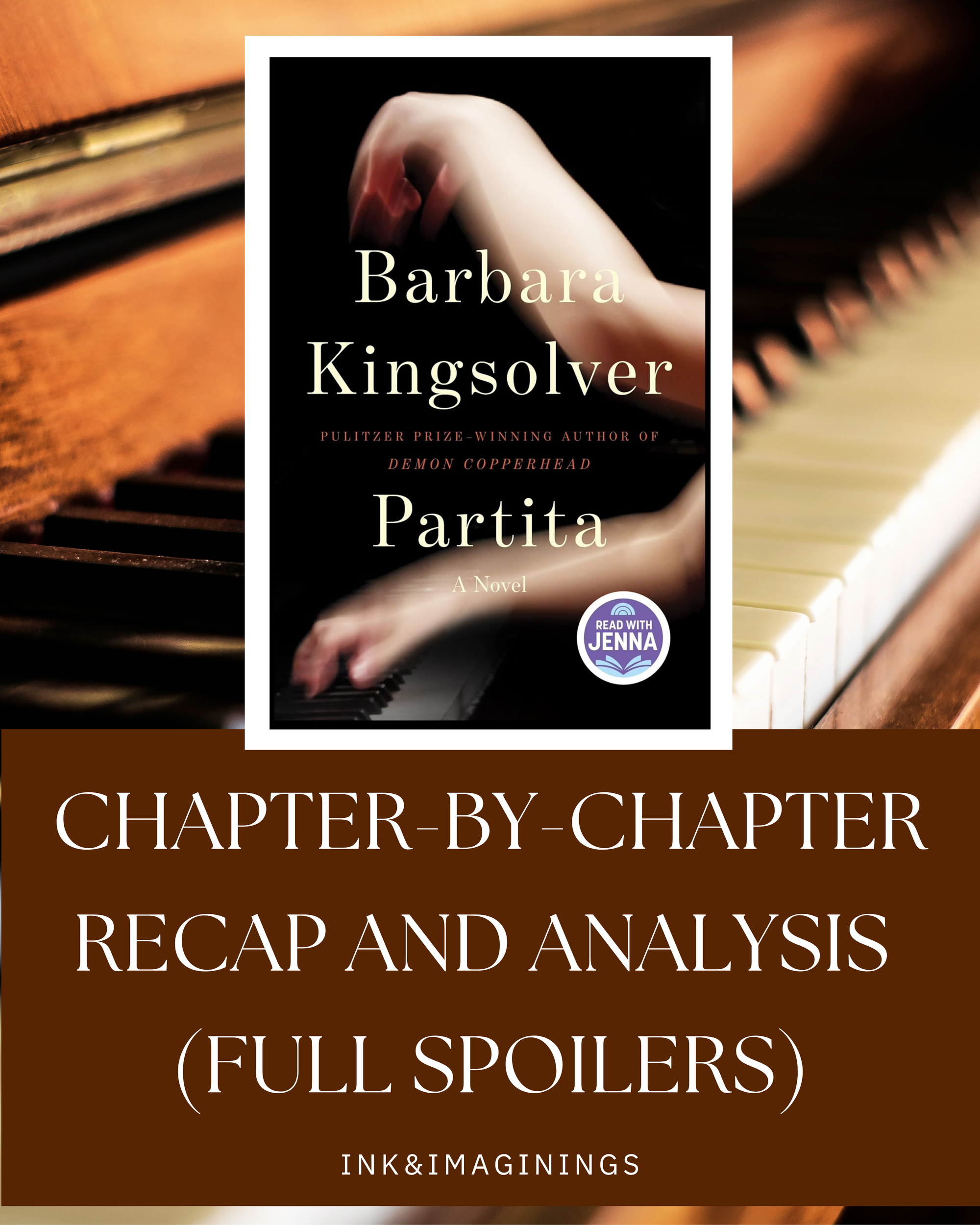
Partita is Barbara Kingsolver's eleventh novel and her first since Demon Copperhead won the Pulitzer. It's the October 2026 Read with Jenna pick, and it came out October 6.
Harper is billing it as a companion to Demon Copperhead, which is a bigger claim than it sounds. Same Appalachian ground, same interest in who gets a shot and who doesn't. But where that book gave us a boy nobody protected, this one gives us a woman with a gift, and asks what happens when the world hands her a future and then takes it back.
Spoilers ahead. This guide walks through the plot and the characters in detail. If you haven't started Partita yet, read the first two sections and then come back.
Partita quick facts
- Author: Barbara Kingsolver
- Released: October 6, 2026
- Publisher: Harper in the US, Faber in the UK
- Pages: 352
- Price: $32.00 hardcover, $15.99 ebook
- Audiobook: narrated by Megan Tusing, with the piano performed by Han Chen, about 14 and a half hours
- Book club: Read with Jenna, October 2026
- Reviews: starred from Kirkus and Library Journal
- Her last novel: Demon Copperhead, 2022, which won the Pulitzer
📖 Buy on Amazon | Buy on Bookshop.org | 🎧 Listen on Audible
A note on content
This is a hard book in places, and it's better to know going in. Livia's brother dies as a child, by his own choice, on a railroad track. Livia loses the use of her right hand in an industrial accident. She seeks an abortion and is obstructed, first by a volunteer who lies to her about the law and then by a bomb threat that closes the clinic. She later survives a placental abruption, an emergency hysterectomy, and several cardiac arrests. Her father dies of cancer on the page.
None of it is gratuitous. All of it is the book's actual subject, which is what bodies do to the lives built on top of them. But if any of that is a hard no for you right now, this isn't the week for it.
What Partita is about
Livia Cable lives quietly in the Tennessee farm country where she grew up. She teaches piano, she's married to Charlie, and she's working through the crowded farmhouse her mother left behind. Then the phone rings, and it's Sigurd, who hasn't spoken to her in decades and who knew her when she was Livia Bohusz, a conservatory pianist with a career ahead of her.
He's been given a medical diagnosis, and it's made him think of her. He wants to visit.
Livia asks for a week to decide. The book spends that week going backward.
Why it's called Partita
A partita is a suite of dance movements, usually written for one instrument, that all stay in the same key. Bach wrote the famous ones, six for keyboard and three for solo violin. The form matters here because the novel is built the same way: Livia's memories arrive as movements rather than chapters, with names borrowed from the dances. A toccata. An allemande. A fugue.
It's not decoration. A partita doesn't travel anywhere. It circles the same home key, finding different things to do inside it. That's the shape of Livia's life as the book tells it.
Partita plot summary
What follows is the story in the order it happens, grouped by the turns that matter. The book's own movements are named for dances, so these headings are mine rather than the author's.
The call
Livia is living quietly with Charlie, teaching piano and clearing her late mother's farmhouse, when Sigurd calls from California. His diagnosis has brought her to mind, and he wants to see her while he's consulting doctors in Tennessee. She asks for a week, though either answer feels dangerous.
The call reopens the question that's followed her since she was eleven: why her brother Cyrus walked to the tracks. She's built a life out of what survived that. Sigurd's voice makes the past present again.
The orange flyer
In 1989, Livia is twenty, studying piano at Indiana University, and sharing an apartment with Jon Link, a fellow musician who assumes they'll marry. She lives on scholarships, work-study, and cheap food, and she's quietly afraid her training is making her useless anywhere but a conservatory.
Outside the music building she meets Sigurd, a typesetter and labor organizer selling a socialist newspaper. He asks about her work. More than that, he treats it as labor with a value, not a private indulgence. Lunch turns into a long conversation about class and ambition and the gap between rural Tennessee and the confident students around her. He gives her a flyer for a meeting. She goes, and leaves when she realizes he isn't there.
A number on a flyer
Days later she hears a South African singing group at a campus divestment rally. The harmonies break every rule she's been taught, and she stays afterward to find Sigurd packing up sound equipment. She gives him her number.
Their next lunch goes somewhere else entirely. Livia tells him about Cyrus: that he'd wanted to learn piano, and that she answered his last invitation with a joke. Sigurd listens without turning her grief into a lesson. Then he takes her to a quiet campus cemetery, and they kiss.
Meanwhile the marriage she's been drifting toward comes apart. Jon wants her to visit her family before he leaves for a summer in Munich, and her resentment at the suggestion exposes how little either of them has examined what they're planning.
Gaspard after midnight
Livia is preparing Ravel's Gaspard de la nuit for a major jury, and Sigurd finds her practicing late. She explains the water spirit in the first movement while he touches her, and the music becomes part of how they are together.
She plays well and gets praised for it. But something has shifted. She's stopped asking how to please her teachers and started asking whether elite musicianship does anything for anyone outside its own circle. She moves into Sigurd's apartment without either of them formally discussing it. Jon leaves for Munich, and that relationship ends at a distance, embarrassed.
Sigurd's politics stay the center of his life. What he gives Livia is tenderness, curiosity, and a real appetite for where she comes from. The love feels enormous. Underneath it, she's starting to doubt the whole career she's built.
The railroad transfer
At the start of summer, Sigurd tells her his party is closing its Bloomington branch and sending him to Arizona to organize railroad workers. He's careful to frame it as a commitment he chose rather than an order he received. The distinction doesn't help her much.
She can't picture leaving music school for an industrial job. She can't follow him without joining the political life she's declined over and over. He doesn't ask her to give up piano outright, but he assumes a shared life would be built around his work. The arguments sharpen while he packs. She promises she could go, then admits that stopping piano would feel like stepping off a cliff.
Sigurd leaves for Phoenix. Livia goes back to Jon's empty apartment with no plan at all.
The dough roller
Broke and behind on rent, Livia takes a kitchen job at Gorgo's, where the manager, Amadeo, puts her on salad prep and keeps telling her to practice.
During a chaotic late shift she's ordered to clean an industrial dough roller. The machine takes her right hand and crushes the bones, the tendons, and the nerves. Surgeons save her thumb and index finger and pin what they can. The hand will never manage concert piano again.
Amadeo comes to the hospital and makes sure the doctors understand what that hand means to a pianist. It's the most anyone does for her. Livia loses her scholarship and leaves school. Then, during a routine X-ray appointment in the middle of a one-handed recovery, she finds out she's pregnant.
The pregnancy clock
Surgery and pain medication had hidden the symptoms, so she's nearly five months along before she knows. She decides she doesn't want a child.
What follows is a sequence of closing doors. A clinic volunteer tells her, falsely, that she needs a parent's permission. A bomb threat shuts the clinic. By the time she reaches Sigurd in Los Angeles, the pregnancy is past the clinic's limit and hospital care costs more than she has. He proposes sending her to his political contacts in Phoenix. She refuses.
Not long after, she suffers a severe placental abruption. She arrives at the hospital bleeding and unconscious. The fetus isn't viable, and surgeons take her uterus to stop the hemorrhage. Her heart stops several times. She survives, and another possible life is gone.
Home between two beds
With no safe way to travel alone after surgery, Livia asks the Cable family for help. Charlie drives her to Tennessee on a bed of clean sheets laid across his car.
On the way she learns that her father, Willard, has had terminal cancer since spring. Her mother never told her, not even when she was demanding Livia come home for Easter.
Charlie and Livia are put in the den beside Willard's hospital bed, and Faye and Mickie help care for all three of them. Willard dies shortly before Christmas, on the same day the family can't find their old dog, Dolly. At his funeral, Livia can't play. Later, alone in the church, she gets through a halting version of a song she once shared with Cyrus.
Partita ending explained
Livia says yes to the visit, but not on his terms. She arranges a student recital, so Sigurd can come without her having to face him alone. That is the whole move, and it tells you who she has become. She puts other people in the room.
He is older now, living with an illness he can manage. What he has carried all this time comes out: he believed she was destined for a concert career, and he stayed away because he was afraid of getting in its way.
She hears two things in that at once. Real remorse, and the limits of what he ever understood about her. He had decided what her life was for, and then absented himself from it on those grounds, without asking. It is the same certainty that took him to Phoenix, pointed the other direction.
At the church, Charlie meets him. The pupils play for the gathered families.
Then two things happen, close together.
A bird gets trapped inside, and finds the open window by following its own reflection in a tray of water. It is the quietest image in the book and it is doing a lot of work. Water is how Livia got out once before, in the one movement she can no longer play.
And Deronne, her most serious student, plays the slow middle movement of Gaspard de la nuit. Worth noticing which movement that is. Livia shared this suite with Sigurd through Ondine, the shimmering water one, the one her right hand can no longer manage. What her student plays is Le Gibet, the slow second movement, a single note tolling through a bleak landscape like a bell. The piece came back to her. Not the part she lost, and not in her own hands.
Livia takes Charlie's hand as the notes end.
That is the ending. The old love stays part of her history. It no longer gets to decide what she owes the present.
Partita characters
Livia Bohusz, later Cable
The pianist who begins again. Raised on a Tennessee farm, where music gave her a private language and a route past what was expected of her. She's observant and disciplined, and she's more comfortable interpreting notes than asking anyone directly for care. Her brother's death taught her to associate love with abandonment, and to make herself useful instead of vulnerable. At college she's drawn to people who see both her talent and where she came from. Her adult life asks her to build meaning out of teaching, marriage, and farm work, after injury changed what her hands can do. Her intelligence isn't only musical. She slowly learns to revise the stories she's told herself about responsibility and survival.
Sigurd
The labor organizer who sees her. A typesetter and union organizer whose attention makes people feel unusually visible. He's curious, physically confident, and sincerely committed to a future where workers share power. That certainty gives his life direction, and it also makes personal compromise hard for him to recognize. With Livia he's tender and attentive, especially about music and her rural childhood. He's drawn to her gifts, and his sense of obligation keeps competing with the intimacy they build. He isn't a rescuer and he isn't a villain. He's what it looks like to live wholly for a cause, including what that costs.
Charlie Cable
The steady farmer beside her. Livia's childhood neighbor, Mickie's brother, a farmer whose prosthetic leg has never stopped him working hard. Quiet, practical, and tuned to what people need before they say it. He doesn't treat care as a declaration. He brings food, teaches Livia the dairy, and stays nearby through the worst of it. The patience can read as self-effacing, but his gentleness isn't passivity. He has a firm sense of what can be done and a talent for doing it now. What he offers Livia is love built on routine, respect, and shared work, which is nothing like the consuming intensity she once took for the only kind.
Cyrus Bohusz
Livia's tender older brother, and her first companion in music and games and the private world they built on the farm. He was sensitive to what boys were supposed to want, especially sports. He'd rather include Livia than beat her, and he recognized how fiercely serious she was about music. She remembers him as the person who understood her without needing it explained. His inner life is one of the silences the family organized itself around, and her memory of him stays loving and unsettled at once.
Livia's mother
The guarded keeper of things. A practical, religious Tennessee farm wife whose reserve shapes the house her children grow up in. She holds tight to objects and routines, and she meets Livia's ambitions with skepticism more often than encouragement. Livia is never sure whether the disapproval is about music, independence, or something else entirely. She isn't easily understood and she isn't reducible to cruelty. Her own history and disappointments stay mostly unspoken. The clutter of her house is a life organized around holding on, and her silences make it hard for her daughter to know what love looked like there.
Mickie Barnes
Livia's plainspoken confidante. Charlie's younger sister, James's wife, and Livia's closest friend. Warm, funny, and direct enough to turn an uncomfortable truth into something Livia can finally look at. Teaching and motherhood have given her a grounded read on how young people test identities. She doesn't treat Livia's childlessness as a reason to keep her out of family life. She's loyal without being indulgent, and she'll push when Livia retreats into silence.
Faye Cable
The neighbor who makes room. Charlie and Mickie's mother, a home-care worker whose instinct is to notice who needs feeding or company or a place to stay. Practical and generous without making kindness feel like a debt. Through Livia's hardest years she offers the kind of maternal attention Livia has rarely had: she listens, she helps, and she lets grief be spoken plainly. Her steadiness is a working example of warmth that's ordinary, repeated, and offered without conditions.
Willard Bohusz
The quiet dairy farmer. Livia and Cyrus's father, a mail carrier and dairyman whose love shows up in gestures rather than conversation. He backs Livia's music when he can, drives her to lessons, and makes room for her enthusiasm even when the household is stretched. He's worn down by the work and cautious about risking the farm, but he thinks hard about its future. Livia understands him only gradually, partly through what he shares with Charlie and the records he leaves behind. The affection is real and often quiet enough that his children have to learn to recognize it.
Jon Link
The musician in her first home. Livia's college boyfriend, kind and orderly, from a family where education and artistic careers are ordinary possibilities. His plans for marriage and student housing offer her stability, but their assumptions about family and class don't quite meet. He respects her playing. Their relationship has settled into habits before either of them asked what the habits meant. He isn't an antagonist. He's a plausible life she once believed she wanted.
Amadeo
The kitchen's protective manager. He runs Gorgo's and loves music like someone who once imagined a different life for himself. He sees Livia's talent and treats her as a person worth protecting rather than an employee. When she's overwhelmed he feeds her, finds her work, and keeps her connected to the piano. The warmth is exuberant and it's matched by action. He becomes her advocate at the exact moment she can't advocate for herself.
The Bloomington circle
Bassoon, also called Greg, is one of Jon's musician friends, nicknamed for his instrument. Shy, funny, and earnest, he turns into a dependable companion through Livia's recovery, offering company without asking her to explain more than she can. His own willingness to claim happiness shows her how unexpectedly a life can widen.
Percussion is the drummer in the same circle and a regular at the apartment, outgoing and irreverent, usually the one defusing awkwardness with a joke. His connection to Bassoon becomes part of how the group changes.
Ladawna is a physician's assistant at the orthopedic clinic who notices when Livia's situation has outgrown the appointment in front of her. She gives clear information, pushes back when Livia hits obstruction, and treats her distress as worth time. Her practical courage is the counterweight to the misinformation Livia runs into elsewhere.
Livia's piano students
Deronne is a gifted Black student who comes to each lesson with unusual focus, seeks out music on his own, and explores past what he's assigned. His seriousness reminds Livia of her own childhood absorption, and his independent choices show that a student can inherit a tradition and still change it.
The Furies are Bella, Cleo, and Rose, three teenagers whose bold clothes and sharp humor cover a serious attachment to each other. Each brings a different temperament, and together they turn lessons into somewhere frustration and grief and invention can all go. They're proof that classical training doesn't have to erase personal taste, and they push Livia to teach more flexibly than she once allowed herself.
The Callisters are a large farming family whose children study with Livia as part of family life rather than a route to prestige. They value music alongside practical skills and carry each other through difficulty, including a serious illness affecting one daughter. They widen Livia's sense of who classical music can belong to.
The rest of the cast
Ethan and Betts Barnes are Mickie and James's teenagers, growing up inside school pressure and family expectation and real uncertainty about what adulthood should look like. Betts experiments with how she names herself and where she belongs. Ethan questions whether college is worth it. They give Mickie and Livia a window onto the next set of choices, and their differences show how one family makes room for separate paths.
Marshall Sterling is a young man from Livia's hometown whose name turns up in old newspaper clippings among her mother's papers. He's a reminder that a public notice preserves only the thinnest outline of a person.
Gaz, whose full name is Gaspard, is Livia and Charlie's border collie. He stays close during her visits to the farmhouse, tracks movement, senses distress, and offers a steady presence that needs no explaining. The name recalls the music that once bound Livia and Sigurd. Day to day he's just her dog.
The music in Partita
The piece at the center is Ravel's Gaspard de la nuit, a three-movement suite for solo piano from 1908, built on prose poems by Aloysius Bertrand. It's one of the hardest things in the repertoire, and Ravel meant it to be.
The first movement is Ondine, and it's the one Livia explains to Sigurd. Ondine is a water spirit singing to lure a listener down to her kingdom at the bottom of a lake. The right hand has to hold a rapid, rippling figure for minutes without a break while the melody is voiced through it. It demands endurance and an almost inaudible evenness at the same time. Knowing what happens to Livia's right hand later, the choice of piece is not an accident.
The other two movements are Le Gibet and Scarbo. Ravel wrote Scarbo specifically to be harder than Balakirev's Islamey, which was then the benchmark for unplayable.
The audiobook is worth knowing about here: the piano is performed by Han Chen rather than described, so you actually hear what Livia is working on.
Is Partita worth reading?
Honestly, I've got mixed feelings about this one. I had trouble getting into it, and compared to the rest of Kingsolver's work, Partita felt kind of forgettable to me.
But I didn't DNF it. And I'm in the minority here: the critics loved it. Book Marks counts it as a rave across 18 reviews, with starred reviews from Kirkus and Library Journal. So if you're a Kingsolver fan, don't let my lukewarm take stop you from picking it up.
Frequently asked questions
Is Partita a sequel to Demon Copperhead?
No. Harper calls it a companion, which means shared Appalachian ground and shared concerns about class and opportunity rather than shared characters or plot. You can read Partita without having read Demon Copperhead.
What does the title Partita mean?
A partita is a suite of dance movements for a single instrument, all of them staying in the same key. Bach wrote the best-known ones. The novel borrows the form: Livia's memories are organized as movements named after dances rather than numbered chapters.
Is Partita based on a true story?
Not as a whole, but Kingsolver has said the hands are personal. She told NPR she has an inherited condition that contracts the fascia in her hands and requires surgery every few years, and that she studied piano for a year in college before concluding she'd never play professionally.
How long is Partita?
352 pages in hardcover. The audiobook runs about fourteen and a half hours.
Who narrates the Partita audiobook?
Megan Tusing narrates, and the classical piano is performed by Han Chen, so the music in the book is played rather than only described.
Is Partita a book club pick?
Yes. It's the October 2026 Read with Jenna pick.
What happens to Livia's hand?
She takes a kitchen job after leaving school and is ordered to clean an industrial dough roller. The machine crushes her right hand. Surgeons save her thumb and index finger, but the hand can no longer manage concert piano.
How does Partita end?
Livia agrees to see Sigurd, but arranges a student recital so she does not have to face him alone. He admits he stayed away because he believed she was bound for a concert career and feared obstructing it. Her student Deronne plays the slow middle movement of Gaspard de la nuit, and Livia takes her husband Charlie's hand as it ends.
Does Livia end up with Sigurd or Charlie?
Charlie. She stays with her husband. The final gesture of the novel is Livia reaching for Charlie's hand while the music Sigurd once shared with her is being played by someone else.
Which movement does Deronne play at the end of Partita?
The slow middle movement of Ravel's Gaspard de la nuit, which is Le Gibet. That matters, because the movement Livia shared with Sigurd was Ondine, the first one, and Ondine is the one her injured right hand can no longer play.
What piano piece does Livia play in Partita?
Ravel's Gaspard de la nuit, and specifically its first movement, Ondine, which depicts a water spirit and is notoriously punishing for the right hand.
What to read next
Partita came out in October, so you'll find it alongside everything else from that month in my October 2026 new releases. And if you want another big literary novel for your book club, my Whistler ending explained walks through how Ann Patchett's latest ends.
If you want the rest of this year's club picks in one place, our running list of every Reese, Oprah, and Read with Jenna pick of 2026 is updated monthly.