Mercy is illegal. Love is a death sentence. And survival demands complicity.
In Daggermouth, H. M. Wolfe constructs a dystopian city that does not merely punish rebellion, it criminalizes empathy itself. Set in the city of New Found Haven, the novel interrogates power through ritualized violence, enforced anonymity, and the normalization of cruelty.
What makes Daggermouth so devastating is not just what happens, but how the city trains its people to accept it.
This is a story about power who wields it, who survives it, and who finally breaks it. If you like your dystopia sharp, political, and emotionally brutal this book is for you.

A dark dystopian romance where mercy is outlawed and love is a political crime. True enemies-to-lovers, morally grey characters, and brutal power dynamics.
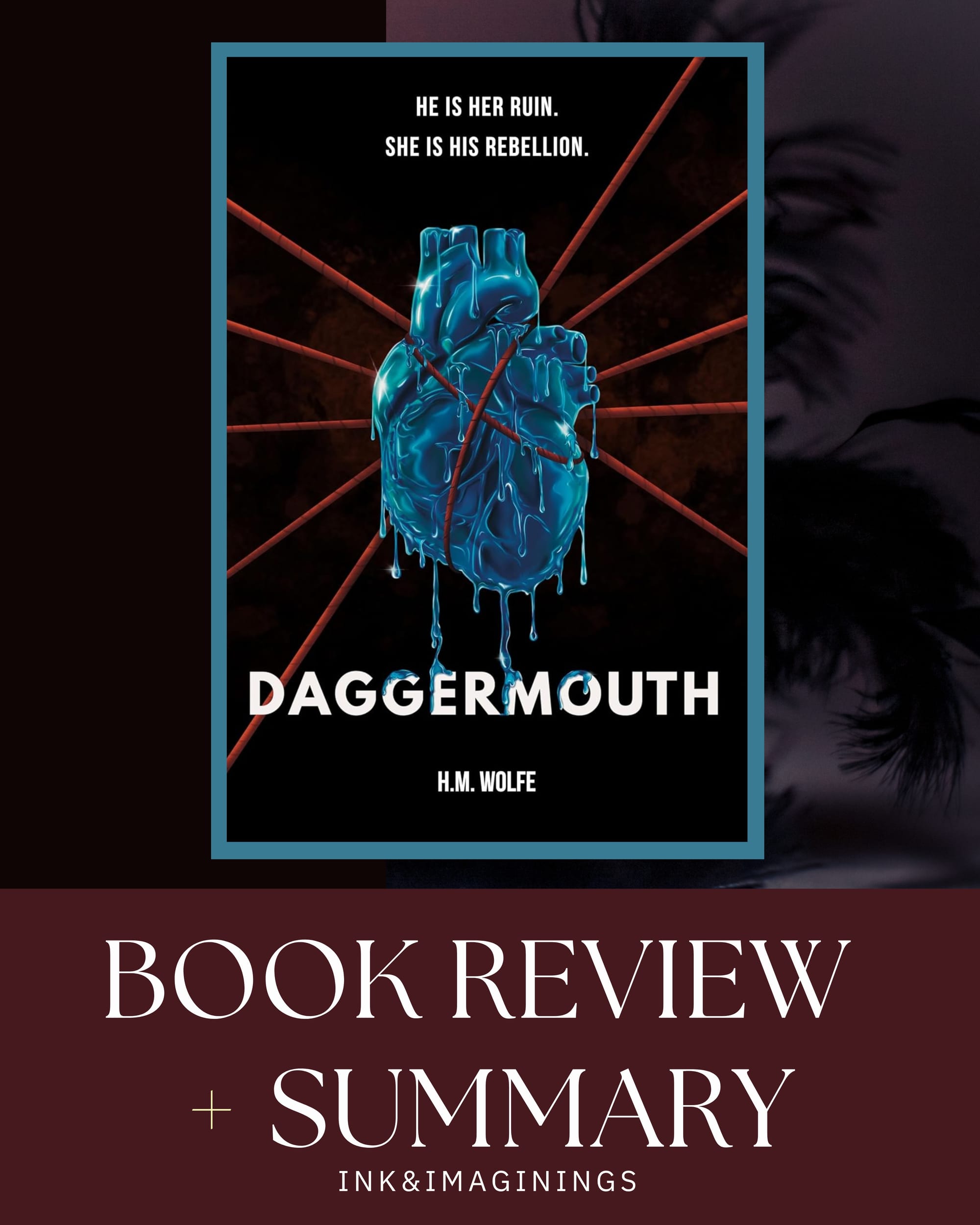
The cover of Daggermouth by H.M. Wolfe
Daggermouth Summary
Daggermouth by H. M. Wolfe is a dark dystopian romance set in the brutal city of New Found Haven, where mercy is illegal and love across class lines is punishable by death. Power is enforced through ritualized violence, surveillance, and anonymity, with a masked elite ruling from the city’s core known as the Heart.
The story opens with a public execution broadcast across every ring of the city. Greyson Serel, son of the President and the city’s Executioner, is tasked with killing two rebels. His brief hesitation before carrying out the sentence becomes a dangerous crack in the system. Because in New Found Haven, empathy is not aloud.
Unknown to his father, Greyson is already living a double life, secretly smuggling medicine and supplies to the oppressed rings. When his loyalty is questioned, he is ordered into a political marriage meant to bind him permanently to the regime.
Meanwhile, in the Boundary, Shadera Kael, a feared Daggermouth assassin, accepts a contract on Greyson’s life. The job is personal. Her parents were executed by the Heart, and violence has been survival ever since.
When Shadera’s assassination attempt fails and both she and Greyson are publicly unmasked, the punishment is swift and symbolic: forced marriage under the city’s brutal Vow laws. Their union is not meant to save them, it is meant to control them.
As rebellion brews, secrets unravel. Torture, betrayal, and long-buried truths expose the full extent of the regime’s cruelty, including a genocidal plan known as the Culling. The city’s rigid power structure begins to collapse not through force alone, but through visibility when women across the Heart remove their masks and refuse silence.
New Found Haven: A City Built to Enforce Obedience
New Found Haven is divided into rings of privilege and poverty, culminating in the Heart, where masked elites rule through spectacle, surveillance, and ritual.
The Three Rings of New Found Haven:
The Heart: The innermost ring, which serves as the seat of power. It is inhabited by the ruling class and the "masked elite," representing the highest level of luxury and control.
The Cardinal: An intermediate ring representing a middle tier of society, situated between the luxury of the Heart and the poverty of the outer ring.
The Boundary: The outermost ring, which consists of the slums. Residents here live in extreme poverty and are often targeted by the regime resulting in the area serving as a source of rebellion.
Violence here is not hidden. Executions are broadcast, weddings are punishments, and tradition is weaponized.
Masks as Instruments of Control
In Daggermouth, masks are not merely aesthetic flourishes. They are structural tools of governance.
They grant anonymity as a privilege to the elite.
They enforce dehumanization on those beneath them.
They demand ritualized silence, particularly from women.
The masks are not just concealment. They are hierarchy made visible
Greyson Serel The Executioner as a Prisoner
Greyson Serel is the President’s son and the city’s Executioner, both symbol and weapon of the regime.
Publicly: He is flawless, obedient, and lethal
Privately: He smuggles medicine to the oppressed rings, and questions the violence he is required to perform
His hesitation during the opening execution is the first crack in the Heart’s armor. In a city where violence must be clean and unquestioned, doubt is dangerous.
Greyson’s arc isn’t about heroism. It’s about complicity.
How long can you benefit from a system you despise before you become it?
Shadera Kael and Survival as a Weapon
Shadera Kael is a Daggermouth assassin. Feared, efficient, and forged by loss. Her parents were executed by the Heart. Violence was not a choice, it was her only inheritance.
She is not morally grey because she enjoys killing.
She is morally grey because violence was the only language the city ever taught her.
When her contract to kill Greyson fails, she is forced into a political marriage with him. A union designed to humiliate, control, and erase her.
Shadera’s journey is about reclamation. Reclamation of agency, of identity, and of rage.
Love does not soften her.
It sharpens her.
Masks, Marriage, and the Politics of the Body
Daggermouth is deeply concerned with how systems control bodies. Especially women’s bodies.
- Masks erase identity
- Marriage becomes punishment
- Sex becomes spectacle
The Consummation Chamber exposes the Heart’s true intent: loyalty enforced through ritualized violation. It is one of the most disturbing and important revelations in the novel.
When women unmask themselves publicly, they transform the regime’s greatest tool of control into its undoing.
Violence as Language
The violence in Daggermouth isn’t gratuitous. It’s how the story communicates stakes, power, and consequence.
- Execution is warning
- Torture is interrogation
- Ritual is indoctrination
Nothing happens without structural purpose.
This is true enemies-to-lovers. Greyson stabs Shadera. Shadera shoots Greyson. Their relationship is forged in ideology, trauma, and bloodshed. The hostility isn’t performative, it’s foundational.
The romance is volatile because the system they inhabit is volatile. It isn’t built on banter or proximity tropes. It’s built on survival, suspicion, and shifting power.
This is not soft romance but that’s the point.

Why Daggermouth Works
What sets Daggermouth apart is that it refuses to let romance soften its politics. The love stories do not distract from the critique. They intensify it.
This is dystopia that wants you angry.
That wants you questioning power.
That understands revolution is both personal and collective.
And I enjoy that the characters are in their 30s. The trauma has history and their choices have real weight.
If this analysis hit for you:
1. Operation Bounce House for another dystopian novels obsessed with power
2. Alchemised for more true enemies-to-lovers done right
3. Deirdra Duncan on Writing Until I Die for a behind the scenes on writing romance inside systems of oppression.
Daggermouth Character Guide
Greyson Serel
Role: Executioner, President’s son
Greyson is both symbol and weapon of the regime. Raised to embody obedience and violence, he benefits from the system even as it destroys him. His secret acts of rebellion place him in constant danger. Greyson’s journey is not about becoming a hero, but about confronting his own complicity and deciding whether survival without resistance is a form of evil.
Shadera Kael
Role: Daggermouth assassin
Shadera is feared, efficient, and shaped by loss. Her parents were executed by the Heart, and violence became her inheritance. She is not morally grey by choice but by necessity. Forced into marriage with the man she was hired to kill, Shadera’s arc centers on reclaiming agency, identity, and voice in a world that only values her usefulness.
Maximus Serel
Role: President of New Found Haven
Maximus rules through fear, psychological manipulation, and ritualized brutality. His love is conditional, his punishments intimate. He treats his children as extensions of the state and views mercy as weakness. Maximus represents institutional power at its most personal and most dangerous.
Lira Serel
Role: Strategist, silent revolutionary
Greyson’s sister and the city’s media architect, Lira understands that control of narrative is control of power. Long silenced by abuse, she becomes the catalyst for rebellion by exposing the regime’s rituals and orchestrating a mass unmasking of women across the Heart.
Elara Serel
Role: First Lady, quiet survivor
Elara survives by becoming invisible. For decades, she endures violence in silence, watching and waiting. When she finally acts, her vengeance is precise and devastating. Elara’s arc is a reminder that patience, when paired with resolve, can be more powerful than brute force.
Callum Thane
Role: Information broker, club owner
Greyson’s closest confidant and the owner of the Heart’s most exclusive club, Callum moves easily between worlds. Beneath his charm is a rebel using his access to smuggle information and aid. His loyalty and intelligence make him invaluable and vulnerable.
Jaeger Nolin
Role: Leader of the Daggermouths
Jaeger rules the Boundary through ruthless pragmatism. He is both mentor and threat to Shadera, shaping her into a weapon while using her for survival. His leadership reflects the harsh reality of rebellion without safety or moral clarity.
Jameson “Ghost” Vine
Role: Rebel leader, Shadera’s lover
Jameson leads the Boundary rebels with desperation and ferocious loyalty. His relationship with Shadera is built on shared trauma and fleeting tenderness. He believes in the cause—but understands the cost of hope better than most.
Brooker Serel
Role: The betrayer
Greyson’s older brother, believed dead, is revealed to be alive and complicit in the regime’s worst crimes. His betrayal exposes the truth that rebellion alone does not guarantee righteousness and that power reproduces itself through fear and ambition.
Trad Rerelease Information
Daggermouth has been picked up for traditional publishing. These are the details we have so far.
- Trad rerelease: First half of 2026
- Current indie cover available until: January 31, 2026
- Audiobook: Not currently available
- Sequel (Python): Trad-only release planned for late 2026
More details about the rerelease and audiobook are expected in the coming months.
Ending Explained (Spoilers Ahead)
⚠️ This section contains major spoilers.
Stop here if you haven’t finished the book.
Daggermouth Ending: What Really Happens
By the final act of Daggermouth, the illusion holding New Found Haven together finally collapses violently, publicly, and irreversibly.
The Truth About Brooker Serel
One of the novel’s most devastating twists is the revelation that Brooker Serel, Greyson’s long-presumed-dead older brother, is alive and complicit.
Rather than leading a rebellion as believed, Brooker has been working with President Maximus Serel, acting as a controlled opposition figure designed to expose and dismantle real resistance movements from within. His “death” was strategic theater, another ritualized lie engineered by the Heart.
This betrayal shatters Greyson’s last remaining faith in family and resistance alike. It also reinforces one of the novel’s core arguments: systems of power reproduce themselves by weaponizing hope.
The Culling Revealed
President Maximus’s ultimate plan the Culling is exposed in full.
The Heart intends to exterminate the Boundary and Cardinal rings entirely, clearing space for elites fleeing failing city-states. This isn’t population control. It’s genocide framed as progress.
The bombs are armed. The targets are chosen. And the regime believes the city will accept it because obedience has been ritualized for generations.
This revelation reframes everything that came before it. The executions, the masks, the forced marriages all of it was preparation.
Elara Serel’s Reckoning
The most quietly radical moment in the novel belongs to Elara Serel.
After decades of silence and survival, Elara kills Maximus publicly on the execution platform the same stage he used to terrorize the city. Her act is not impulsive. It is precise, patient, and symbolic.
Elara’s rebellion proves that compliance can be camouflage, and that endurance itself can be a form of resistance.
The Women Unmask
As chaos erupts, Lira Serel’s long-game comes to fruition.
Women across the Heart remove their masks in a coordinated, public act of defiance. What was once a tool of anonymity and control becomes a weapon of exposure. The city watches as the silence breaks not privately, but collectively.
This moment marks the true turning point of the story.
The regime doesn’t fall because of brute force alone.
It falls because the narrative collapses.
Greyson and Shadera’s Final Choice
Greyson and Shadera do not “win” cleanly.
They survive scarred, complicit, and changed, but they refuse to continue playing their assigned roles. Their bond is forged not through forgiveness, but through shared accountability.
They choose resistance knowing it will cost them safety, comfort, and illusion.
This is not a happily-ever-after. It is a refusal to remain silent.
What the Ending of Daggermouth Means
The ending of Daggermouth deliberately rejects the idea of a perfect ending.
- Justice is incomplete
- Liberation is violent
- Survival comes with moral cost
But the novel insists on one final truth:
Silence is the regime’s greatest weapon and solidarity is its undoing.
The revolution doesn’t erase trauma.
It simply makes a future possible
Revolution is messy. Justice is incomplete. Survival is not the same as healing.
Where to Buy Daggermouth
Daggermouth is currently available in its indie edition for a limited time and as an e-book. Perfect for readers who want their romance sharp, political, and emotionally devastating.
Support local bookstores when you purchase from our bookshop.org storefront.
Final Take
Daggermouth is dark, political, and deliberately uncomfortable and it earns every one of those choices. This is dystopia that understands its job. It doesn’t soften its critique to make it more palatable, and it refuses to treat violence as spectacle without consequence.
Wolfe delivers a pointed examination of patriarchy, fascism, capitalism, and state violence, not through monologues or moralizing, but through structure, character, and ritual. The world building is intentional. The brutality has narrative purpose. The emotional devastation feels constructed, not gratuitous.
What elevates the novel is that its romance does not dilute its politics. It intensifies them. The love story is angsty, cinematic, and volatile, but never detached from the systems that shape it. Every moment of intimacy exists in tension with power.
This is a book that understands survival is not enough. To truly live, these characters must risk everything status, safety, identity, and yes, love.
He is her ruin.
She is his rebellion.
And the novel is stronger because it refuses to let either of them escape unchanged.
Frequently Asked Questions About Daggermouth
Is Daggermouth a romance or dystopian novel?
Both, but dystopia comes first. The romance sharpens the political critique rather than softening it.
Is it enemies to lovers?
Yes. True enemies to lovers, rooted in ideology and violence.
How spicy is it?
Moderate (3/5). Explicit but in a purposeful way.
Is it very dark?
Yes. Includes state violence, forced marriage, torture, and sexual violence themes.
Does it have a happy ending?
Not traditionally. It’s hopeful, but unresolved.
Is there an audiobook?
Not yet.