Last updated: February 20, 2026
⚠️ MAJOR SPOILER WARNING: This post explains the ending of Alchemised by SenLinYu in full detail. If you haven't finished the book, stop here and come back after you've turned that final page. You'll thank me later.
If you just finished Alchemised's 1,024 pages and feel like you need someone to walk you through what just happened, you're not alone!
The final act of this book moves fast, and there are revelations, reversals, and emotional gut-punches stacked on top of each other in ways that can be hard to process in the moment.
This post breaks down exactly what happens at the end of Alchemised: the final battle, what happened to Helena and Kaine, the soul fragment, the island, the epilogue, and that devastating final line that has the internet in pieces.
Let's unpack all of it.
A Quick Refresher: Where Things Stand Before the Ending
If you need a full chapter-by-chapter breakdown, check out our Alchemised Chapter-by-Chapter Recap and Analysis. For the magic system, characters, and world-building, see our Complete Guide to Alchemised.
Here's where things stand heading into Part 3:
The book's structure is crucial to understanding the ending.
Part 1 shows us Helena as a prisoner with no memories, held captive by the terrifying High Reeve, Kaine Ferron.
Part 2 rewinds to show us the war and the devastating truth: Helena and Kaine were secret lovers. She was a spy for the Resistance; he was a double agent working to destroy Morrough from the inside. Their entire relationship was forged in secrecy, danger, and impossible choices.
At the end of the war, Helena was captured. To protect Kaine's identity as a spy, she transmuted her own memories, erasing him from her mind so that when she was interrogated, no one could discover he was the last surviving member of the Order of the Eternal Flame. She sacrificed her own identity to save the man she loved.
Kaine then spent fourteen months tearing the world apart looking for her. When he finally finds her in a warehouse full of captured women being held for Morrough's breeding program, he positions himself to be assigned as her handler knowing she won't remember him, knowing he'll have to play the role of her captor while Morrough watches.
That's the nightmare of Part 1 reframed. Everything cruel Kaine did, the transference sessions, the coldness, the control, was a performance under Morrough's surveillance to keep Helena alive until he could get her out.
Part 3 picks up the moment Helena's memories finally break through.
What Happens When Helena Gets Her Memories Back?
Helena's pregnancy is the catalyst. Morrough forced Helena and Kaine to produce a child (he wants to harness the baby's potential alchemical power), but the pregnancy itself triggers the return of Helena's transmuted memories. The very thing Morrough engineered to control her becomes the thing that frees her.
When Helena wakes up screaming and remembering, Kaine is right there. He tells her the war is over. He tells her Lila Bayard is alive. Her baby, Apollo (Pol), Luc's son, is safe. But Helena is overwhelmed. Flooded with memories she erased, struggling to reconcile the Kaine she hated in Part 1 with the Kaine she loved in Part 2.
Over the following days, Helena pieces reality back together. She remembers their promise: that when the war ended, they would escape together.
But there's a problem. A massive one.
The Soul Fragment: Why Kaine Is Dying
Here is the key to understanding the ending.
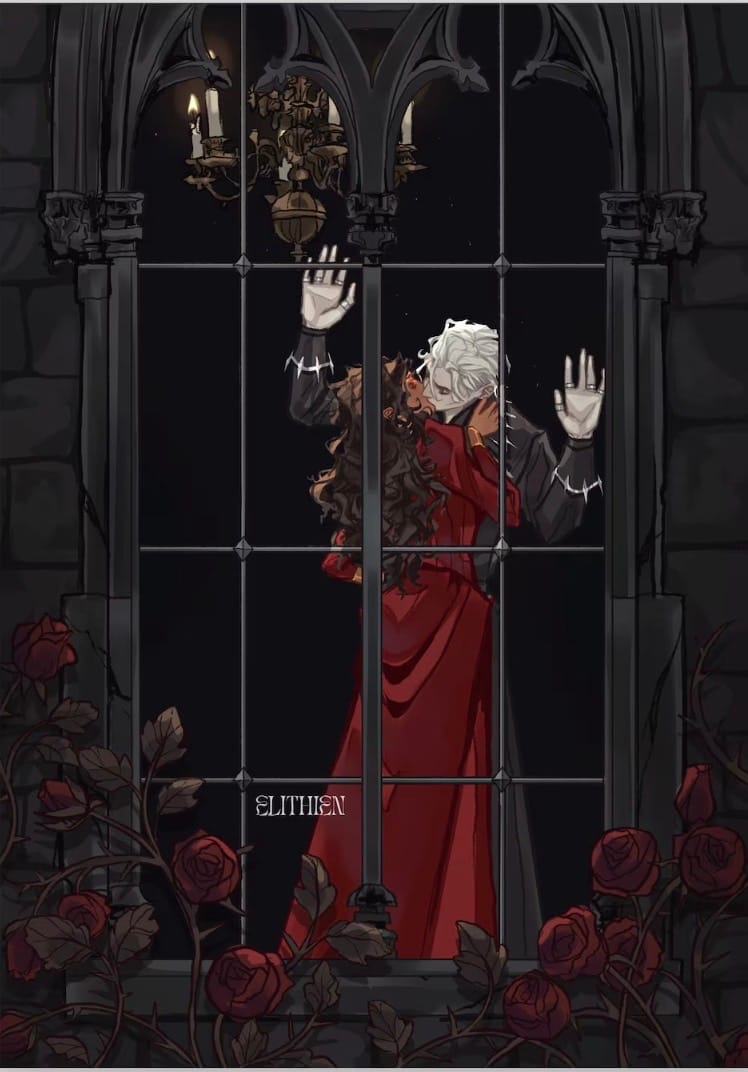
Morrough's power works through bone fragments. He places pieces of his own bones inside his followers through a corrupt alchemical procedure, turning them into the Undying. These bone connections let Morrough siphon power from them, making himself nearly unkillable. Kaine has one of these fragments embedded in his body, a piece of Morrough's bone in his arm.
This means two things: Morrough can track and control Kaine, and Morrough is literally draining Kaine's life force. Kaine is weakening. He's dying, slowly, from the inside.
Helena realizes the horrifying truth: the only way to weaken Morrough is to destroy the Undying he's drawing power from, but Kaine is one of them. Killing Morrough's power source means potentially killing Kaine.
Helena, being Helena, refuses to accept this. She's a vivimancer (healer of life) and an animancer (manipulator of minds and souls) abilities so rare they terrified both sides of the war. She decides to do what should be impossible: retrieve and replace Kaine's stolen soul fragment.
And she succeeds.
The procedure works. Helena manages to extract Morrough's bone fragment and restore Kaine's soul. Kaine lives. Morrough's power dims significantly. This is the moment that breaks the necromancer's hold not through a grand battle, but through Helena's healing, the very skill the Order once condemned as impure.
How Does Morrough Actually Die?
This is a detail that some readers miss in the rush of the final chapters.
Helena and Kaine don't kill Morrough directly. After Helena restores Kaine's soul and they escape, it's Lila Bayard Luc Holdfast's lover and the mother of his son Pol, who ultimately kills Morrough. Lila returns to Paladia and assassinates the High Necromancer, becoming a hero in the process.
Morrough's identity itself is one of the book's biggest reveals: he's actually Cetus, an ancient alchemist and the sibling of Orion Holdfast, the founder of Paladia. His entire necromantic movement, the Undying, the war, the destruction was ultimately revenge against his own brother's legacy. Centuries of suffering, caused by a family grudge.
With Morrough dead and the Undying's power dismantled, the necromantic regime collapses. Paladia begins to rebuild.
The Island: Helena, Kaine, and Enid's Life After the War
Helena and Kaine don't stay for the rebuilding. They can't.
Kaine is still the High Reeve in the eyes of the world, the most feared general of the Undying, a mass murderer responsible for countless deaths. The fact that he was secretly a Resistance spy the entire time doesn't matter to the public. Helena is a war criminal in official records. If they stayed in Paladia, they would be hunted and killed.
So they flee to a remote southern island, where they meet back up with Lila before her final mission. And there, in isolation, they build a life.
Helena and Kaine raise their daughter, Enid Rose Ferron, named after Kaine's mother, whose death at Morrough's hands was what originally drove Kaine to become a spy for the Resistance.
The island chapters are quiet. Deliberately so. After 900+ pages of war, torture, espionage, and survival, SenLinYu gives Helena and Kaine something startlingly ordinary: a home. A child. Peace. But the trauma doesn't disappear. Their relationship still requires careful management. The damage is permanent even if the love is real.
Kaine secretly kills Dr. Stroud (the regime doctor who oversaw Helena's experiments) to erase evidence of their past. He's still protecting her. Still making morally devastating choices in her name. It's a reminder that even in peace, the war lives inside them.
The Epilogue: Enid Goes to Paladia
This is where the ending shifts from bittersweet to devastating and where readers either break down or start arguing.
Years later, Enid Rose Ferron grows up and leaves the island to study vivimancy at the rebuilt Alchemy Institute in Paladia. She's accepted as a student alongside Pol Holdfast Luc and Lila's son. The next generation, side by side, exactly as their parents once were.
But when Enid arrives in the rebuilt city, she encounters the official history of the war. And it's wrong.
She finds a book about the conflict. Inside is a photograph of her mother, Helena, alongside Luc Holdfast and Soren Bayard. The caption beneath the photograph describes Helena Marino as:
"A non-active member of the Order of the Eternal Flame and did not fight."
That's it. That's how history remembers Helena Marino. The woman who healed hundreds of soldiers, who served as a covert spy, who transmuted her own memories to protect the Resistance's last secret, who restored a stolen soul fragment and broke the necromancer's power, who sacrificed everything and was the single most important reason the war was eventually won.
She "did not fight."
Why the Final Line Hits So Hard
This is the line that has the internet in pieces, and I think it works on multiple levels.
On the surface, it's an act of historical erasure. Helena's contributions are deliberately written out of the record. The victors who rebuilt Paladia either didn't know what she did (because it was covert) or chose to erase her (because acknowledging a vivimancer's role would undermine the Order's ideology). The system that oppressed her during the war continues to erase her after it.
On a thematic level, it's the book's final statement about how power controls narrative. Alchemised is fundamentally about memory. Who controls it, who erases it, who gets to decide what's real. Helena spent the entire novel fighting to recover her own memories. And in the end, the world takes them from her again. Not from her mind this time, but from history itself.
On a character level, it's both devastating and oddly fitting. Helena never fought for recognition. She fought for survival, for Kaine, for the people she loved. She didn't want to be a hero in anyone's story. But Enid does. The novel ends with the implicit promise that Enid, armed with the truth, will fight to restore her mother's legacy.
Does Alchemised Have a Happy Ending?
This is the most-asked question about the book, and the honest answer is: it depends on how you define "happy."
What Helena and Kaine got: They survived. They're together. They have a daughter. They have a home. They escaped Morrough, the war, and the regime. Even their unusual pet survived. By any realistic measure, they got the best possible outcome for two people who went through what they went through.
What they lost: Everything else. Their names, their reputations, their community, their friends. Helena's life's work as a healer is uncredited. Kaine will be remembered as a monster. They live in exile, unable to return to the world they saved.
What remains unresolved: The moral weight of Kaine's actions. He is, objectively, a mass murderer. Even if he was coerced, even if he was a spy, even if he acted to protect Helena. The book doesn't fully resolve this, and I think that's intentional. SenLinYu doesn't give you a clean answer because there isn't one.
So: the ending is hopeful but not happy, triumphant but not clean, earned but not painless. It's a bittersweet conclusion to a story that was never going to end any other way.
Unanswered Questions Readers Are Still Debating
Even at 1,024 pages, Alchemised leaves some threads open. Here are the ones I see discussed most:
Does Enid succeed in restoring Helena's legacy? The book ends before we find out. Enid's determination and her alliance with Pol suggests she will, but it's left to the reader's imagination.
Was Kaine justified? This is the book's central moral question and it's deliberately unresolved. He committed atrocities to maintain his cover as a spy. He killed to protect Helena. He tortured people under Morrough's orders. The book asks you to hold all of this simultaneously.
Why didn't Kaine just tell Helena the truth in Part 1? This is the question that frustrates some readers most. When Helena was his prisoner with no memories, why didn't he simply explain who he was? The answer the book provides: Morrough was monitoring them. Kaine couldn't break character because any sign that Helena was more than a prisoner would have gotten them both killed. But some readers find this explanation insufficient given the specific dynamics shown.
Will there be a sequel? As of February 2026, Alchemised is a standalone. The Legendary Entertainment movie deal (a reported seven-figure rights acquisition) suggests the story will be adapted for screen, but no sequel has been announced. SenLinYu has not publicly discussed plans for a follow-up, though the Enid epilogue certainly leaves room for one.
How does this ending differ from Manacled? Alchemised is a reimagining of SenLinYu's Harry Potter fan fiction Manacled (which had over 10 million views on Archive of Our Own before removal). The core emotional arc is similar, but the world, characters, and specific plot mechanics are entirely original. Readers who know both report that the endings share emotional DNA but diverge in meaningful ways.
Frequently Asked Questions About the Alchemised Ending
Do Helena and Kaine end up together?
Yes. Helena and Kaine survive the war and escape to a remote island together. They raise their daughter, Enid Rose Ferron, in isolation. They remain together for the rest of the story.
Does Helena die in Alchemised?
No. Helena survives. Despite multiple near-death experiences throughout the novel including suicide attempts during her captivity Helena lives through the ending and the epilogue.
Does Kaine die in Alchemised?
No. Kaine nearly dies because Morrough's bone fragment is draining his soul, but Helena uses her vivimancy and animancy abilities to retrieve and restore his stolen soul fragment. Kaine survives.
Who kills Morrough?
Lila Bayard kills Morrough. She returns to Paladia specifically to assassinate him.
Who is Enid in Alchemised?
Enid Rose Ferron is Helena and Kaine's daughter. She's named after Kaine's mother. In the epilogue, she grows up and travels to Paladia to study at the Alchemy Institute, where she discovers that her mother's role in the war has been erased from official history.
What does the last line of Alchemised mean?
The official history describes Helena as "a non-active member of the Order of the Eternal Flame and did not fight." This is factually wrong, Helena was arguably the most important figure in the Resistance's eventual victory. The line represents the erasure of women's contributions, the control of historical narrative by those in power, and the book's central theme that memory is always contested.
Is Alchemised a standalone or part of a series?
Alchemised is a standalone novel. No sequel has been announced. However, the Legendary Entertainment film rights deal and the open-ended epilogue leave room for future stories in this world.
What is the Legendary Entertainment movie deal?
In September 2025, Legendary Entertainment acquired the film rights to Alchemised in a reported seven-figure deal. No casting, director, or release timeline has been announced as of February 2026.
Final Thoughts: Why This Ending Works
Alchemised could have ended with a battle. It could have ended with a grand victory parade, with Helena recognized as the hero she was, with Kaine redeemed in the public eye. A lesser book might have given us that.
Instead, SenLinYu gave us something harder and more honest: survival. Not vindication. Not justice. Just two broken people on an island, raising a daughter who will one day go back into the world and fight for the truth they couldn't claim for themselves.
The genius of the ending is that it mirrors the book's structure. Just as Helena's memories were erased and had to be recovered, her legacy is erased and will have to be recovered this time by Enid. The cycle of memory, erasure, and reclamation continues. The fight never really ends. It just passes to the next generation.
That's not a happy ending. But it might be a hopeful one.
More Alchemised Content on Ink & Imaginings:
- Alchemised Chapter-by-Chapter Recap and Analysis
- Complete Guide to Alchemised: Summary, Characters, and Magic System
- Books Like Alchemised: True Enemies to Lovers
Looking for more deep-dive book analysis? Subscribe to Ink & Imaginings for weekly reviews, reading guides, and spoiler breakdowns.
In the end, Alchemised isn’t just about transformation in the literal sense it’s about what we’re willing to break, rebuild, and believe in order to survive. The final chapters leave us with some answers, but also with quiet, lingering questions about identity, sacrifice, and whether true change is ever as clean as we hope it will be.
Some threads resolve beautifully. Others feel intentionally unsettled, almost daring the reader to sit with the discomfort. And maybe that’s the point. Not every ending is meant to tie itself into a neat bow. Some are meant to leave lingering questions.
Whether you saw that final twist coming or it completely caught you off guard, it’s the kind of ending that sticks.
I’d love to know did the ending work for you? Did you interpret it the same way, or did you see something different in those final scenes? Let’s talk in the comments.