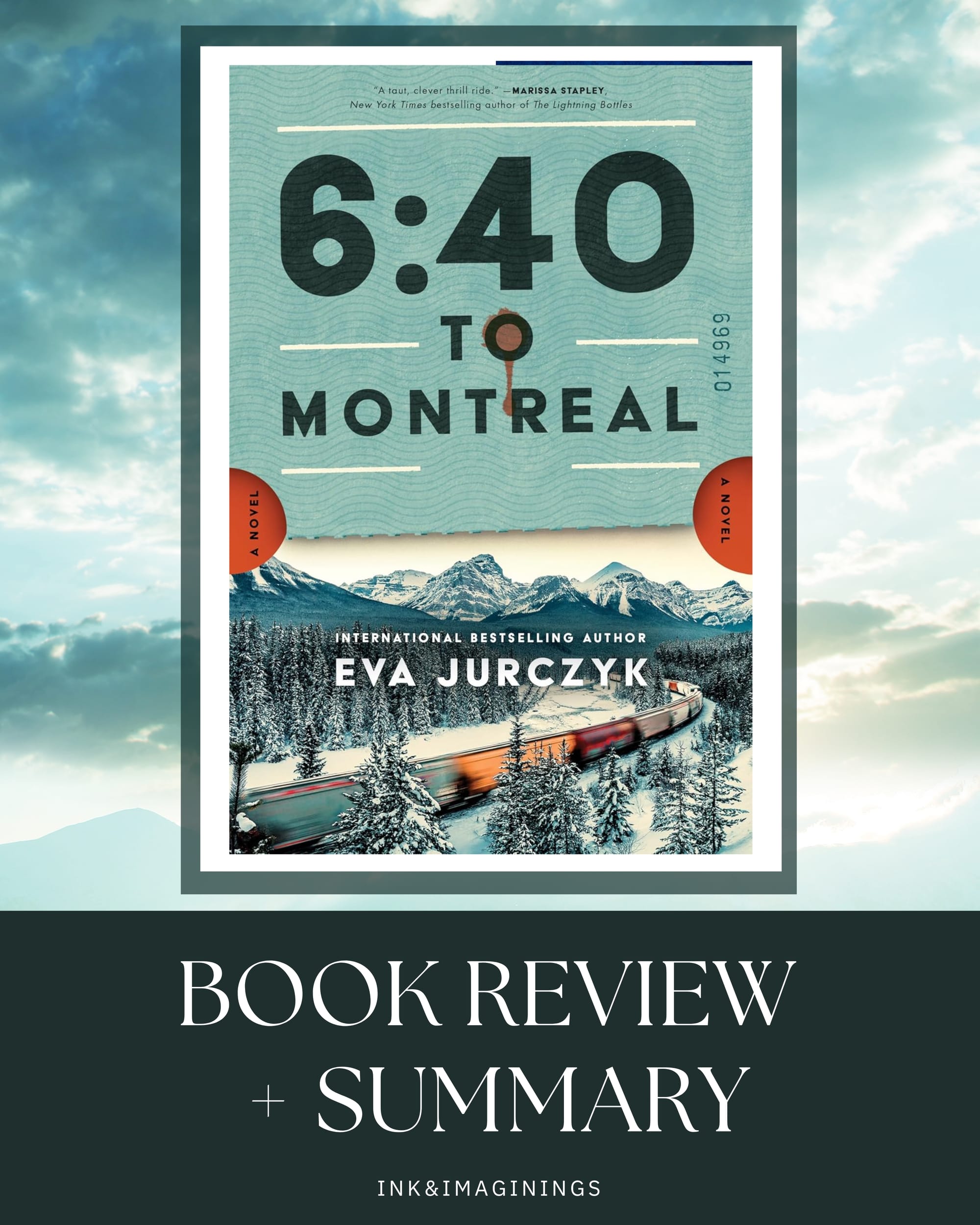
6:40 to Montreal taps into a classic suspense structure. A confined space, a limited cast, no easy exits and uses it to explore how quickly trust can fracture under pressure. If you love mysteries where the setting itself becomes part of the tension, this one understands exactly how to use atmosphere to keep you unsettled.
No WiFi. No distractions. No way out.
Agatha thought she was in for the perfect writing retreat: six hours of peace aboard a train from Toronto to Montreal, surrounded by beautiful winter scenery and a handful of quiet passengers. But when the train breaks down in the middle of the frozen Canadian wilderness, her day takes a chilling turn.
One passenger dies quietly in his seat. Another vanishes. And suddenly, Agatha and her fellow travelers realize they are trapped in a fight for survival against an unknown, unseen enemy lurking in the aisles.

Closed-setting mysteries have long relied on psychological tension over spectacle, and 6:40 to Montreal fits comfortably within that lineage. Rather than rushing toward twists, it lets unease build slowly. Through glances, conversations, and the awareness that no one can leave until the journey ends.
The Setup
There’s something inherently thrilling about train-set mysteries: the movement, the isolation, the strangers with secrets. But 6:40 to Montreal is far more than a locked-room mystery. Eva Jurczyk's latest novel takes a simple premise of a woman escaping on an early train and turns it into a spiraling journey of betrayal, reckoning, and reinvention.
Prefer to support local bookstores?
You can find 6:40 to Montreal and other atmospheric mysteries in my Bookshop.org storefront, where every purchase supports independent bookshops.
6:40 to Montreal Characters
Agatha St. John: Disillusioned writer, haunted survivor
Once a celebrated novelist, Agatha is now paralyzed by self-doubt, past betrayal, and the physical and emotional fallout of cancer. Her arc is about reclaiming her voice, even as she participates in morally dubious decisions. She is both deeply flawed and achingly human.
Teddy: Supportive husband, secretive manipulator
Teddy is Agatha’s husband and a restaurateur. His role shifts from concerned partner to possible villain as evidence surfaces he may have plotted against her. He embodies both loyalty and betrayal, leaving his motivations ambiguous.
Cyanne Candel: Aggrieved muse, vengeful antagonist
Once Agatha’s friend, Cyanne believes her life was stolen and turned into fiction. She is vindictive, theatrical, and unpredictable, but her pain is real. She eventually becomes an unlikely co-conspirator.
Finch Weatherby: Entitled businessman, unintended victim
Finch is rude and dismissive, particularly toward Agatha. His early demand for her seat places him in everyone’s crosshairs. When he dies via a spider bite, he becomes the symbol of arbitrary justice and unchecked privilege.
Dorcas: Competent attendant, tragic scapegoat
Dorcas is the poised and efficient business-class attendant. Her attempts to maintain order ultimately lead to her death at the hands of a panicked passenger. Her demise marks the point of no return.
Vivien: Desperate mother, accidental killer
A tightly wound mother trying to keep her diabetic son alive in a crisis, Vivien’s unraveling culminates in a violent act that haunts the survivors. Her love is genuine, her actions morally grey.
Rupinder: Sick young man, catalyst for crisis
Vivien’s teenage son suffers a diabetic emergency that pushes the car into chaos. He represents both innocence and the high cost of inaction.
Jeff (Jeffrey Valentine): Gentle giant, secret writer, sacrificial hero
Kind, observant, and strong, Jeff becomes the moral heart of the group. His quiet bravery and presumed death in the storm give the story its most selfless moment.
The Trainee:Missing employee, possible killer, cipher
An enigmatic figure whose disappearance and discarded uniform raise questions. His true identity remains unresolved, adding to the novel’s layered mystery.
Malee: Distant friend, symbol of normalcy
Agatha’s friend in Montreal, present mostly through text messages. She offers a glimpse of life beyond the chaos a what-could-have-been.
If You Love Mysteries Like This
Stories that trap characters together tend to thrive on tension, observation, and small moments that feel loaded with meaning. If that’s your sweet spot, you might also enjoy:
- Murder on the Orient Express — the classic locked-room train mystery
- The Hunting Party — isolated setting, layered secrets
- One by One — a modern take on suspicion in a snowbound retreat
Summary (Spoilers Ahead)
Agatha is not just catching a train; she's trying to escape a life that no longer fits. Once a bestselling author, now creatively stalled, emotionally depleted, and recovering from cancer, she wakes before dawn to quietly flee her Toronto home.
The destination? Montreal. The occasion? A supposed writer’s retreat booked by her husband, Teddy. Meant to be a restorative trip but for Agatha, it’s more like an escape hatch.
The tone is set from the very first page. Agatha's mind is racing as she tiptoes past the sleeping bodies of her husband and son. Her reflections, tinged with resentment, guilt, and grief, reveal a woman who’s both fleeing and seeking. The tension is palpable. So are the cracks in her resolve.
Mud, Matrimony, and Microaggressions
Teddy’s surprise appearance before she leaves adds a layer of discomfort. Their parting exchange, laced with habitual affection and buried disappointment, perfectly depicts a marriage in slow decay.
The mud he tracks in becomes an accidental metaphor. He brings mess, remains unaware, and expects Agatha to adapt. Every gesture, from the goodbye hug to the overly supportive train ticket, is filled with so much meaning.
These tiny moments help us to peel back the layers of Agatha’s life, exposing both external constraints and internal doubt.
On the Train
The train to Montreal becomes its own little ecosystem. The business-class car is filled with sharply drawn passengers; Dorcas, the calm attendant; Vivien and her diabetic son Rupinder; the curt and pompous Finch; and, later, the disruptive return of Cyanne, a woman from Agatha’s past.
Agatha instinctively views them through the lens of a writer. But even as she crafts stories about them, she’s unable to craft her own. Her writer’s block hangs heavy, Showing us how she is trapped in a creative and emotional paralysis.
Power Plays and Window Seats
Finch, the arrogant businessman, demands Agatha give up her window seat. She refuses. In that moment, Agatha reclaims something small but significant. She refuses to yield. In this contained space, every gesture carries symbolic weight, and Duncan masterfully builds interpersonal tension without veering into melodrama.
A Specter of the Past
When Cyanne, Agatha’s former friend and now online tormentor, shows up on the train, the tension cracks wide open. Her presence isn’t coincidence. Cyanne believes Agatha stole her life story and turned it into a bestselling novel. Their argument forces Agatha to reckon with the blurred line between inspiration and exploitation.
Murder, Mayhem, and a Spider’s Bite
What begins as a psychological drama suddenly tilts into a murder mystery. Finch is found dead in his seat, killed by an Australian funnel-web spider hidden in a mesh pouch. Clearly an intentional act. Panic ripples through the car. Was Agatha the intended target? Is the killer still among them?
As chaos builds, Rupinder’s medical emergency escalates the stakes. When Dorcas, the attendant, is wrongly accused of withholding help, Vivien lashes out in fear and grief, killing Dorcas with a broken bottle. Now, the survivors aren’t just passengers they're accomplices in a desperate cover-up!
Desperation, Deception, and Survival
With the blizzard still raging and the train trapped, Agatha and Cyanne, once enemies, become reluctant allies. They move Dorcas’s body, spin a plausible story, and try to keep everyone together. But the balance is fragile. The narrative fractures again when Vivien tries to escape into the snow to save her son. The passengers finally break a window and send Jeff, the most physically capable among them, into the storm for help.
A Return to Order
Eventually, the train powers back up. Help is coming. But the emotional wreckage is vast. The survivors share more than trauma. They share guilt, and a need to bury the truth. When police arrive, Agatha and Cyanne tell a carefully constructed version of events. The detective, distracted and weary, accepts it.
The truth about Finch, Dorcas, Cyanne’s accusations, and who was truly behind the spider’s appearance remains uncertain. But Agatha suspects the worst: that Teddy, the husband she tried to leave behind, may have been on the train in disguise and orchestrated the murder. The clues a familiar matchbook and a worn boot heel point toward a betrayal so intimate it shakes her to her core.
The Final Pages
Agatha returns home. Her relationship with Teddy is fragile, full of subtext and silence. Freddie, her son, is safe. But she is not the same woman who boarded that train. She begins writing again. Not because she’s healed, but because the only way forward is through the story.
What she writes will likely never tell the whole truth. But it will be hers. And that is enough.
Review
⭐ Rating: 3.5/5 stars
I love a good locked-room mystery, and 6:40 to Montreal delivered exactly that atmosphere. The setup was clever a train car becomes both sanctuary and trap, with every stop of the journey ratcheting up tension. The first half was fast-paced, filled with quirky side characters, tense exchanges between passengers and crew, and small details that made you question who could be trusted!
The Canadian winter setting was vivid, you could practically feel the chill coming through the pages. The mix of suspense and atmosphere kept me hooked! Trying to pick up on clues about who (or what) was behind the unfolding danger.
That said, while the beginning had me absolutely hooked, the pacing faltered toward the 80% mark. The ending came a little abruptly, and felt slightly rushed compared to the careful buildup earlier on. I wanted more payoff from the tension that had been building throughout.
Still, the concept of a “closed train car” mystery is one I adore, and this book delivered that. If you love mysteries set in confined, isolated spaces where the atmosphere is as much a character as the people then you’ll probably enjoy 6:40 to Montreal!
Thinking of picking this one up?
You can find 6:40 to Montreal and similar atmospheric thrillers in my Bookshop.org storefront. An easy way to support local bookstores while discovering your next read.
Final Thoughts
6:40 to Montreal is a quick, engaging thriller with an excellent setup and an atmospheric winter setting that mystery fans will appreciate. While the ending may feel a bit abrupt, the journey itself is suspenseful and entertaining enough to make this worth the read.
This is a novel for readers who like their thrillers laced with existential dread, their characters deeply flawed but compelling, and their endings messy, raw, and haunting.
Read-Alikes
If you enjoyed 6:40 to Montreal, you might also like:
- Murder on the Orient Express by Agatha Christie (the classic locked-train mystery)
- The Hunting Party by Lucy Foley (isolated, snowed-in suspense)
- One by One by Ruth Ware (a ski chalet mystery with a similar claustrophobic vibe)
- Death on Board by Anita Davison (another travel-based whodunit)
- I Am Behind You by John Ajvide Lindqvist (for an eerie, supernatural spin on being trapped)
If you enjoy thoughtful reviews of mysteries and stories that linger long after the last page, you might like The Weekly Bookmark my newsletter for books and literary news worth your time.